
An AI governance operating model sets out who decides what about AI use, and how each decision is recorded and enforced. In software delivery, it turns a written policy into roles, approvals and automated checks in the delivery pipeline. For a CTO at a large SaaS company, it is the difference between agent output that can be defended and agent output that cannot be traced.
The sections below describe the parts of such a model, the UK guidance that informs it, and the way each part applies to AI coding agents.
What an AI governance operating model covers
An operating model is the working arrangement behind a governance programme. It names the people who receive an AI request, classify it, review it and approve it. It also names the evidence each step produces and the route a disagreement follows.
In an engineering organisation, the scope is narrower and more concrete than in a company-wide programme. The subject is applied AI in software delivery: agents that plan, write, test and prepare application changes. Building or training AI models sits outside that scope.
The NIST AI Risk Management Framework provides guidance aligned with GOVERN 2.1 and 2.3. It recommends a multi-disciplinary risk management team with clear roles, including a designated AI governance officer who oversees AI use policies and processes. This framework fits the needs of engineering teams managing AI in software delivery more closely than UK-specific guidance.
A working model usually contains four parts:
-
named roles with clear decision rights
-
a register of AI uses and agent-enabled workflows
-
controls that run automatically inside the delivery pipeline
-
monitoring, escalation and review routes
Each part is useful alone. Together they let a team show, change by change, who decided and on what evidence.
How an operating model differs from a framework or policy
A framework states what governance should achieve. It holds principles, standards and regulatory expectations. A policy states what is permitted, prohibited and required in a given organisation.
Neither describes how a decision actually moves through the company. That is the work of the operating model. It specifies who approves, who monitors, what happens on an exception and how often the arrangement is reviewed.
The distinction matters in engineering because a policy that nobody enforces gets read once and then ignored. A rule such as “agent-written code needs review” has little effect until the pipeline refuses to merge a change without a recorded approval.
The UK Government’s guidance on implementing the AI regulatory principles lists five voluntary principles. They cover safety and security, transparency, fairness, accountability and governance, and contestability and redress. Those principles are the framework layer. The operating model is where each one acquires an owner and a check.
Our article on CI controls for an AI governance framework shows how that translation looks inside a pipeline.
Roles and decision rights
Decision rights are the core of the model. When they are vague, delivery teams end up setting their own acceptable level of risk, and governance then arrives late as a review queue.
A common model assigns accountability at the project level to a responsible owner, typically the product or service manager. A technical lead with appropriate AI training oversees development and tooling, while a risk and compliance officer conducts risk and impact assessments and determines the necessary level of human oversight. New AI-enabled systems and tooling are reviewed and signed off by a design authority before launch, which in large SaaS companies may be an architecture board or technical design authority.
The engineer who initiates an agent is considered the author of the resulting change, maintaining a named authorship to ensure the audit trail does not end with “the agent did it.” A separate person or automated check reviews the change.
The GOV.UK AI Risk Management Toolkit identifies roles involved in risk management, including senior leaders, data teams, AI practitioners, security, legal and compliance professionals, business domain experts, and end users. In engineering settings, security and legal functions engage early in the process rather than only at release.
Forums and escalation routes
The AI Knowledge Hub advises that governance runs through an AI governance board, or through AI expertise on an existing board. That body provides oversight and strategic guidance on risk, compliance, assurance and alignment with business objectives.
For a company that already has an architecture review board and a security council, adding AI expertise to them is often the lighter option. A new board is warranted when AI use is spread across many product lines.
A useful forum has a short list of powers. It approves policy, sets risk appetite and can stop a significant initiative. Its decisions are written down and visible to the teams affected.
Escalation needs equal attention. Risk owners, business owners and delivery teams will sometimes disagree. The model states which forum resolves the dispute and how quickly, so that a release is never decided by whoever is under the most schedule pressure.
Named people decide releases and rollbacks. Agents advise on them, and automated checks block what fails the rules.
Registering and approving AI use cases
A register is the simplest evidence that an organisation knows what AI it runs. Without one, agents appear in individual repositories and nobody can say how many are active or who owns them.
The post by Entrust on techUK’s site about agentic AI governance treats an agent as a living system. It calls for named ownership of every agent in production, with a defined review and escalation path. It also asks for change management that considers identity and access whenever an agent’s capabilities grow.
A register entry for an engineering agent typically records:
-
the agent’s name and its accountable owner
-
the workflow it supports, such as test generation or pull request drafting
-
the repositories and systems it can reach
-
the actions it is permitted to take
-
the date of approval and the date of the next review
The GOV.UK Code of Practice for the Cyber Security of AI asks for a documented assessment of the business problem, the security risks and the mitigations before an AI system is created. It also asks for an audit trail of how the system operates.
In practice, a person approves the plan before any code is written. That approval is stored with the work item, so the reviewer of the final change can see what was agreed at the start.
Controls for coding agents inside the delivery pipeline
Controls that depend on memory fail under deadline pressure. Controls that sit in the pipeline apply to every change, whoever or whatever produced it.
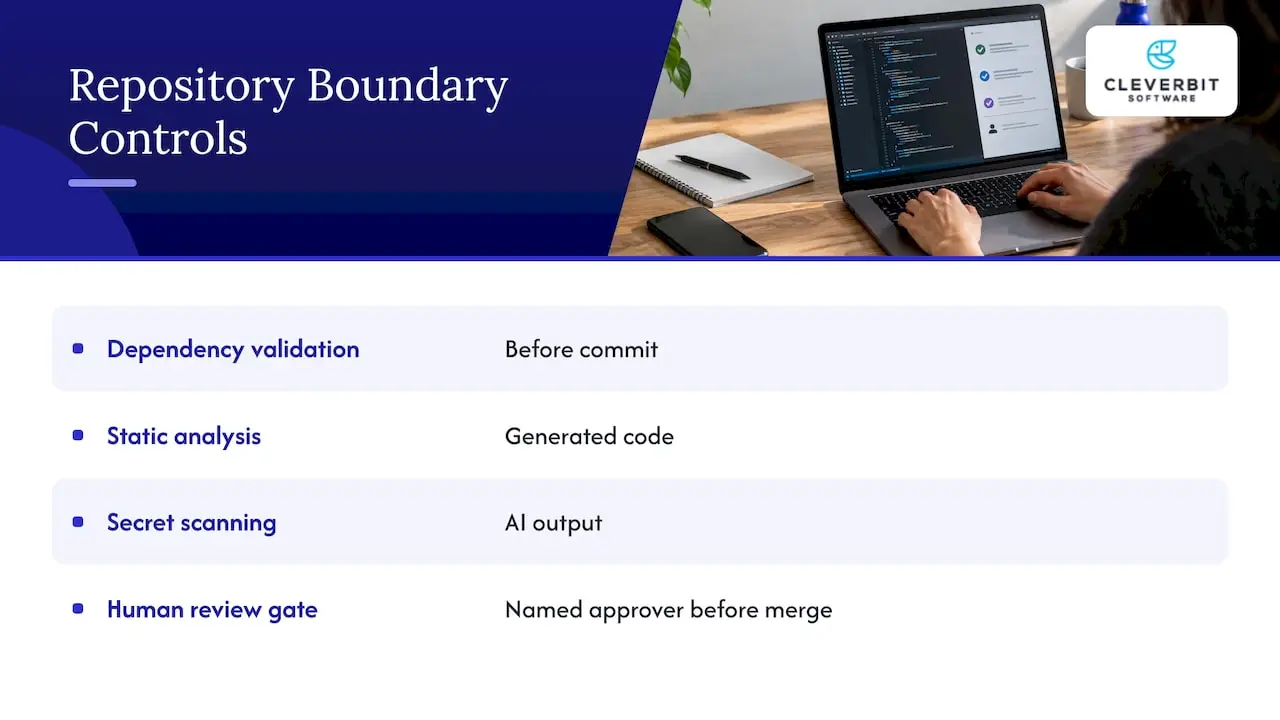
The OWASP agentic trust-boundary model is a community contribution to the OWASP Agentic Skills project. It describes controls where code crosses into the repository, including dependency validation before commit, static analysis of generated code, secret scanning of AI output, and a human review gate at the crossing.
The techUK guidance adds identity controls for agents. Each agent has a distinct identity with permissions tied to its purpose. Credentials are time-limited and rotated, and every action is logged against an identity that can be traced.
The Code of Practice also expects human oversight to be built in as a technical measure where it serves as a risk control. In pipeline terms, that means a merge gate that waits for a named approver.
Further detail appears in our pieces on AI code guardrails and AI change management controls.
Preventing drift in agent-written code
Drift appears when agent output gradually departs from the architecture and conventions a team agreed. Each change looks reasonable alone. Over a quarter, the codebase no longer matches its design.
An operating model counters drift with architectural rules that the pipeline checks, and with review that looks at consistency as well as correctness. The architecture work behind this is covered in our governance-first architecture blueprint.
Monitoring, review and incident handling
Governance continues after release. Monitoring deployed AI systems in health care separates two activities. Real-time support remediates acute failures, while periodic governance review examines longitudinal trends. Pre-agreed alert thresholds route notifications to the accountable technical team.
The same split suits software delivery. On-call engineers handle a failing agent workflow as they would any production fault. A governance forum looks at patterns across weeks, such as repeated policy exceptions or a rising rate of rejected agent changes.
Incident response needs agent-specific records. Responders ask which agent and configuration acted, what credentials it used, what it changed and whether a person approved it. Logs tied to agent identity make those answers quick to find.
Our guide to AI incident response covers the response side in more detail.
After an incident, the findings feed back into the model. Permissions, checks and approval rules are adjusted, and the change is recorded. The model then improves with each event rather than staying fixed at launch.
Regulatory context
A SaaS company selling into the EU may need to comply with EU AI regulations, depending on where its systems operate and where their output is used. Legal counsel typically confirms which regime applies to a given product.
The UK has not passed a single AI statute. The five principles above are voluntary, and regulators apply them within their existing remits. Where AI touches personal data, UK GDPR and the Data Protection Act 2018 apply as usual.
For engineering leaders, the practical effect is that auditors and enterprise customers ask for evidence of accountability. A register, approval records and pipeline logs give a direct answer.
A starting point for enterprise SaaS teams
Cleverbit designs and implements agentic AI development practices with the controls built in from the start. The Agentic SDLC Workshop is the entry point for engineering leaders who want a governance arrangement fitted to their own repositories and pipelines.
Frequently asked questions
Operating model versus framework
A framework defines what governance should achieve through principles, standards and regulatory expectations. An operating model defines who does what, who decides and how policy becomes enforced practice. Most organisations need both, written separately so that the standard and the mechanism can be challenged independently.
Who owns AI governance in an engineering organisation
Accountability usually sits with a named lead, such as an AI governance officer, supported by a cross-functional team. Project-level ownership stays with a product owner, a technical lead and a risk or compliance officer. Named people approve releases and rollbacks.
Where the controls for coding agents run
They run in the delivery pipeline, at the point where code reaches the repository and again before merge. Secret scanning, static analysis and dependency validation apply to agent output, and a named approver signs off. Applying the same checks to every change keeps one standard for hand-written and agent-written code.
How an existing governance board fits
The AI Knowledge Hub advises that AI expertise can join an existing governance board rather than requiring a new one. This suits organisations whose architecture and security boards already hold decision rights. A dedicated board becomes useful when AI use spreads across many teams.