
An AI branch strategy is a set of rules for where agents may write code, how that code travels towards production, and who must approve it before it does. The branching model matters less than the gate. Give agents short-lived, single-task branches, deny them any route to main, run every agent change through a supervised integration step, and require human approval that the agent can never bypass.
That is the short answer. The longer one is about why most teams get it wrong, and what a controlled version looks like in practice.
Why agents break the branching habits you already have
Most branching conventions were designed around a human constraint: people write code slowly, so changes stay small and reviewers can keep up. Agents remove that constraint. A task that took a developer two days now produces a large diff in minutes, and the review burden lands on the same people as before.
The evidence points the same way. The 2024 DORA State of DevOps report found that rising AI adoption correlated with weaker delivery performance: an estimated 7.2% drop in delivery stability and a 1.5% drop in throughput for every 25% increase in AI usage, even while individual developers reported productivity gains. DORA’s own explanation is that agents encourage teams to drift from the small-batch principle. Fast generation produces bigger, harder-to-verify changes.
This is the hidden cost leaders rarely see on a velocity chart. Output rises, review quality falls, and the difference is deferred as technical debt. A branch strategy is one of the few controls that sits exactly where that cost is created.
Agentic software development changes who the author is
In agentic software development, an agent plans a task, edits files, runs tests and opens a pull request with little prompting. The agent is an author. It is not a reviewer, an approver or an administrator, and your repository settings should say so.
Two consequences follow:
- Accountability stays human. The agent cannot own a decision about a payment flow or an authentication path. A named person must.
- Rules must apply to code, not to its origin. A review gate that exists only for “AI code” is easily bypassed by a developer pasting agent output. The gate should apply to every change, whoever or whatever wrote it.
That second point is central to how we approach governance at Cleverbit, and we return to it in our perspective below.
The five elements of a workable AI branch strategy
Whatever model you run, five elements carry the weight.
1. Isolated, short-lived, issue-scoped branches
Every agent task gets its own branch, named by convention and tied to one issue, for example ai/task-123. Guidance on AI-assisted Git workflows recommends exactly this: agents work in isolated branches with no ability to commit directly to main or an integration branch.
Branch lifetime matters as much as naming. The same source advises implementing each agent task in a dedicated Git worktree branched from a base such as develop, and never reusing a branch for a second task. The reasoning is practical. A fresh branch forces a clean, reviewable diff and stops the agent leaning on undocumented local state or leftovers from earlier work.
2. A reserved namespace and least privilege
Give agents a branch prefix and nothing else. One agent governance guide proposes using branch-name targeting in rulesets so that agents can push only to ai/** or a similar pattern, granting the smallest permission set the task needs.
In GitHub, rulesets can restrict who creates, updates or deletes branches matching a pattern, with only bypass-permitted actors exempt. That last clause is where many programmes fail.
3. Agents are never on the bypass list
A ruleset with an agent identity in its bypass list is a ruleset with a hole in it. GitHub’s guidance on maintaining codebase standards in a Copilot rollout frames the underlying worry plainly: developers accepting AI suggestions without review. The practical rule we draw from it is simple: agent identities are authors with restricted permissions, never bypassers. Their pull requests trigger mandatory approvals from a human who did not prompt them.
A Codeowners file is a sensible backstop. Even if an agent finds a plausible implementation path, a subject-matter owner still signs off on sensitive directories such as payments, identity, data access and infrastructure.
4. Required status checks before anything merges
Branch protection should block merges until CI passes: unit and integration tests, static analysis, dependency and secret scanning, and whatever your compliance regime demands. If you cannot state which checks are mandatory for an agent’s pull request, you do not yet have a strategy, only a hope.
5. A supervised integration gate
This is the element that separates a mature approach from a cosmetic one. The Integration-Gate Flow is a trunk-based variant for teams where agents and humans both open pull requests. It keeps short-lived branches and adds one thing standard trunk-based development lacks: a supervised integration branch where automated testing, covering performance, security and chaos scenarios, gates all agent changes before they become release-eligible.
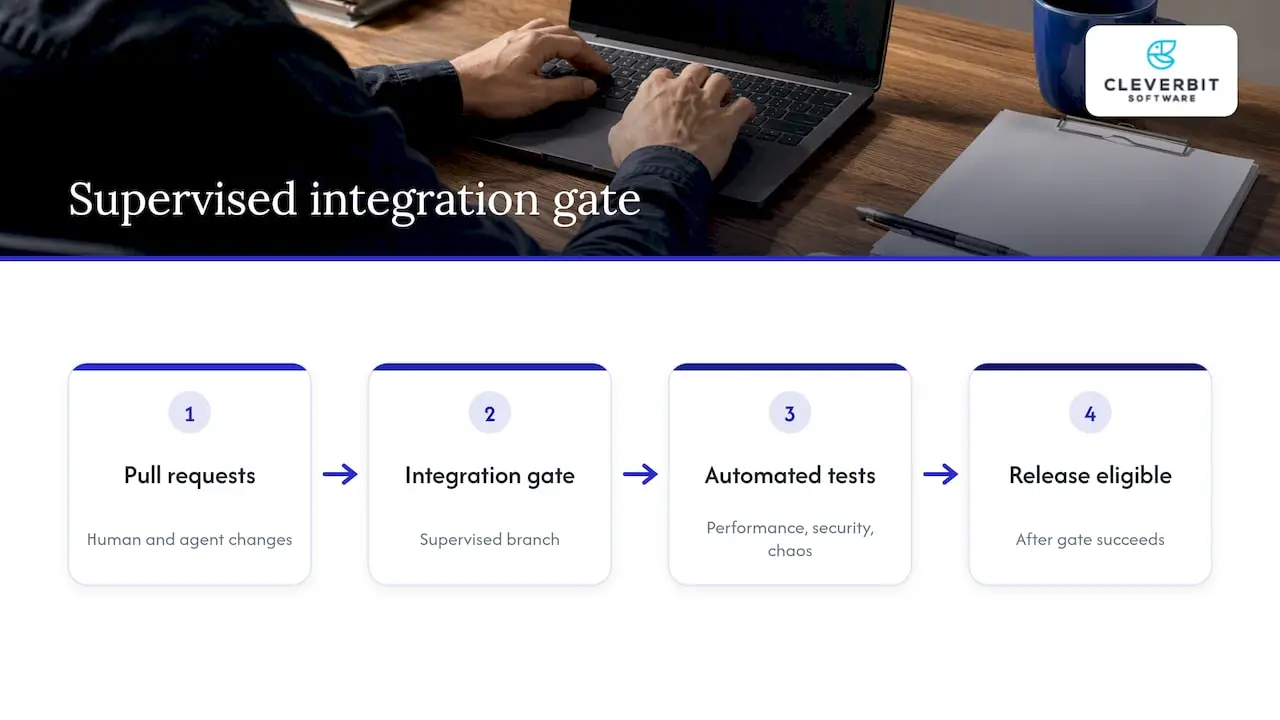
Why does this matter? Speed-optimised agents can present functional regressions as optimisations. Without a gate that exercises the system under load and attack, throughput rises while stability quietly erodes. One open-source agent orchestrator takes a comparable line, planning, validating and implementing each task in an isolated worktree and submitting changes only through pull requests.
Trunk-based or Gitflow? The wrong first question
Search results for this topic are dominated by one debate: is Gitflow still relevant in the AI era? It is a fair question, but it comes second.
| Model | Fit with agents | Where it strains |
|---|---|---|
| Trunk-based, short-lived branches | Strong. Enforces small batches and fast feedback | Needs excellent automated testing and feature flags |
| Trunk-based with integration gate | Strongest for mixed human and agent teams | Needs a maintained integration environment |
| Gitflow | Workable where release cycles are formal or regulated | Long-lived branches let agent drift accumulate and merges grow large |
Trunk-based development is commonly the default in agent-oriented guidance. AWS’s AI-DLC workflows, for instance, show trunk-based development as the default, with feature branches living one to two days at most and squash-merging to main.
But the model is not the control. A Gitflow shop with a rigorous gate and human-only approvals is safer than a trunk-based shop where agents can merge their own work. Choose the model your release process and regulators already accept, then bolt the five elements onto it.
Preventing vibe code drift
Vibe code drift is what happens when an agent optimises for the appearance of a finished task rather than for the integrity of the system. The symptoms are familiar to anyone who has reviewed an agent-generated pull request: bloated diffs, duplicated logic, new patterns that ignore existing architecture, and tests that pass because they assert very little.
Drift is cumulative. Each change looks acceptable alone, and the architecture decays in aggregate. Analysis of AI-assisted development from TTC Global argues that sustainable teams must prioritise refactoring and reuse to counter AI’s tendency to produce redundant code.
Branch strategy gives you four practical defences:
- Atomic work units. One task, one branch, one worktree, one reviewable diff. If a pull request cannot be understood in a single sitting, send it back and split it.
- A size ceiling. Agree a maximum diff size and have CI flag anything above it. This protects the small-batch principle DORA identifies as the casualty of fast generation.
- Architecture as a check, not a document. Encode your conventions as linters, dependency rules and architectural tests, so that drift fails the build instead of waiting for a reviewer to notice.
- Mutation and regression testing at the gate. Mutation testing exposes tests that pass without proving anything, which is precisely how agents can mask weak coverage.
Treat agent output as advisory input, not a finished artefact. That is the stance DORA’s analysts recommend, with independent verification for every agentic pull request.
Guardrails when developing with AI: a leader’s checklist
Branching rules are one layer. Before you let agents near a production repository, you should be able to answer yes to each of these.
- Can an agent push to
main, a release branch or the integration branch? (It should not.) - Is any agent identity on a bypass list? (It should not be.)
- Does every pull request, human or agent, face the same required checks?
- Does a human who did not direct the agent approve each agent pull request?
- Does Codeowners route sensitive paths to named experts?
- Can you see, per repository and per sprint, how much merged code was agent-authored and what the defect and rollback rates were?
- Are credentials for deployment and runtime access kept out of the agent’s reach?
That last point is easy to miss. A protected pull request path does not protect every route to production; direct pushes, administrative overrides and deployment credentials need governing too.
If you are mapping these controls to a broader framework, the NIST AI Risk Management Framework offers a recognised structure built around mapping, measuring and managing risk. Its useful lesson for engineering leaders is that governance is a set of controls that runs through the lifecycle, not a review bolted on at the end. We cover the control side in more depth in our piece on five enforceable controls for AI change management.
AI governance is a people problem first
Tools enforce rules; people decide which rules exist. BCG’s 10/20/70 principle, reported by Forbes in January 2026, suggests putting 10% of effort into algorithms, 20% into technology and data, and 70% into people and processes. Applied to engineering, that means the ruleset is the easy part. The hard part is agreeing ownership, review standards and escalation paths, and then holding to them under delivery pressure.
The DORA report points to the same conclusion. It recommends that organisations define a clear AI mission and usage policies, communicate them openly, and say where AI-written code is permitted and which tools are approved. A branch strategy turns that policy into something a repository can enforce.
Our perspective: fast is easy, controlled is hard
We see the same pattern repeatedly. A team adopts agentic tools, velocity jumps, and for a quarter everything looks like success. Then reviews slow, incidents rise, and nobody can say which parts of the codebase were written by whom, or under which rules.
Our view is that this is predictable, and avoidable, because it is an engineering discipline problem rather than a tooling problem. Three convictions shape how we work:
- Governance is designed in on day one. Retrofitting policy onto a pipeline that agents already dominate is far harder than starting with review gates that apply to all code regardless of author.
- Agents perform best inside coherent systems. Fragmented teams with no shared standards are where AI-assisted development creates the most risk. Clear ownership, shared conventions and a dedicated team that carries your engineering culture are what make a branch strategy stick.
- Evidence beats enthusiasm. We start with consultancy on your stack and compliance needs, design the team structure and guardrails, run a pilot to demonstrate performance, and scale from that evidence.
You should be suspicious of any approach that promises speed without showing you what the controls are and who owns them.
— Cleverbit
Putting a branch strategy into practice
A sensible rollout looks like this:
- Baseline. Record current pull request size, review time, change failure rate and rollback rate before agents scale up. You cannot show improvement, or damage, without it.
- Define the namespace. Reserve
ai/**for agent branches and write the naming convention, including the issue reference. - Lock the trunk. Use rulesets to block direct pushes, require pull requests, require status checks and require approvals. Check the bypass list line by line.
- Add the integration gate. Stand up the supervised branch with performance, security and mutation testing. Make passing it a condition of release eligibility.
- Assign owners. Maintain Codeowners for sensitive paths and name accountable reviewers.
- Pilot on one team. Run it for a few sprints, compare against the baseline, then widen.
- Review quarterly. Agents and tools change quickly, and your rules should be revisited with them.
For how this connects to the wider pipeline, our articles on AI in DevOps and where it breaks and governance-first agentic architecture cover the deployment and design stages either side of the branch.
Where Cleverbit can help
If you want these controls in place without pausing delivery, our Agentic SDLC engagements cover the Foundation Engagement, Execution and Maintain stages: defining policies aligned to your engineering standards, embedding review gates, and keeping visibility into what AI is doing in your pipeline. Where you also need people, our AI-integrated engineering teams work inside your processes with governance built into how they operate. Prices are not published; the starting point is a conversation with your technical leadership.
FAQ
What is the best branching strategy for AI-assisted development?
For most teams, trunk-based development with short-lived, single-task branches and a supervised integration gate suits mixed human and agent contributors. Gitflow can work where releases are formal or regulated, but long-lived branches let drift accumulate. The gate and the approval rules matter more than the model name.
Should AI agents be allowed to merge their own pull requests?
No. Agents should act as authors with restricted permissions and never appear on a ruleset bypass list. Every agent pull request should need approval from a human who did not direct the work, with Codeowners covering sensitive paths.
How do you stop vibe code drift?
Keep work atomic: one task, one fresh branch, one small diff. Add size limits, architecture rules enforced in CI, and mutation or regression testing at the integration gate. Drift is cumulative, so measure it over time rather than only per pull request.
Does an AI branch strategy replace an AI governance framework?
No. It is the enforcement layer inside one. A framework such as the NIST AI RMF sets how you map, measure and manage risk, while branch rules, required checks and approvals make those decisions real in the repository.
Sources
- 2024 DORA State of DevOps report
- Git Branching Strategy for AI-Assisted Development
- AI agent governance guide
- Available rules for rulesets, GitHub Docs
- Maintaining codebase standards in a GitHub Copilot rollout
- nokto-agent-orchestrator
- AWS AI-DLC branching strategies
- AI in Software Development: Productivity Gains, But at What Cost?
- NIST AI Risk Management Framework
- Why AI’s 10/20/70 principle matters, Forbes