
AI architecture planning means using agents to draft options, record decisions and test designs against standards, while named people approve the plan before any code is written. For a CTO at a large SaaS company, the value lies in earlier, better-documented decisions, not in handing design to a model. Agents shorten the route to a reviewable proposal. Accountability for the architecture stays with the engineers and architects who sign it off.
This article covers what the practice involves, which decisions agents support well, how context is prepared, how reviews speed up and which controls keep the result durable.
What AI architecture planning involves in a software team
Architecture planning is the stage where a team turns requirements into a structure: services, data flows, interfaces, constraints and the trade-offs between them. In an agentic setup, AI agents take part in that stage. They read requirements, propose designs, draft decision records and flag risks before implementation begins.
The scope here is applied AI in software delivery. It concerns agents that help plan and check application software. It does not concern building or training models.
Academic work gives a useful map of the field. A 2025 literature review on AI for software architecture reports that AI can derive partial design solutions from requirements. It also describes quantitative trade-off analysis and the summarising and prioritising of quality requirements.
The same review notes a limit. Architectural design involves high-level planning and reasoning about how a system evolves over years, and current AI capability can struggle there.
That limit shapes the practice. Agents contribute well to bounded, checkable work. Long-horizon judgement about a living system remains with senior engineers.
The search term also attracts readers looking for building design and rendering tools. Those tools belong to a different field. This article addresses software architecture only.
Architecture decisions where agents add value
Not every architecture decision benefits equally from agent support. The useful ones share a trait: the output can be inspected against explicit criteria by a person who understands the system.
Drafting options from requirements
Given a clear brief, an agent can produce several candidate designs with the trade-offs stated side by side. A team that once weighed two options because of time pressure can weigh several options. The architect still chooses, and the reasoning is written down.
Writing architecture decision records
An architecture decision record (ADR) is a short document that states a decision, its context and its consequences. Agents draft these quickly from a discussion or a proposal. Teams often skip ADRs because writing them is tedious, so drafting support raises the share of decisions that leave a trace.
Public sector examples show the pattern. The UK Department for Environment, Food and Rural Affairs (Defra) publishes configuration examples for coding assistants that include prompts to write ADRs and run security reviews against its standards. The standards travel with the tool rather than living in a wiki.
Surfacing risks and missing requirements
Agents read documents without fatigue. They can compare a proposed design against a list of non-functional requirements and mark where the design is silent. A gap found at the planning stage is usually cheaper to close than one found in production.
Checking designs against enterprise standards
Approved stacks, data handling rules and platform constraints are all written down in most large organisations. An agent can compare a proposal with those documents and report deviations. The report advises. A named reviewer decides whether a deviation is acceptable.
Context that agents need before proposing options
An agent produces plausible designs whether or not it understands the system. The quality of the plan therefore depends on the context supplied. Generic prompts yield generic architecture.
Practitioners describe a context pack assembled before options are requested. One 2026 practitioner write-up lists its parts: domain goals with explicit non-goals, regulatory and performance constraints, enterprise decision constraints, the current state with diagrams and known pain points, and decision criteria with a way to measure them.
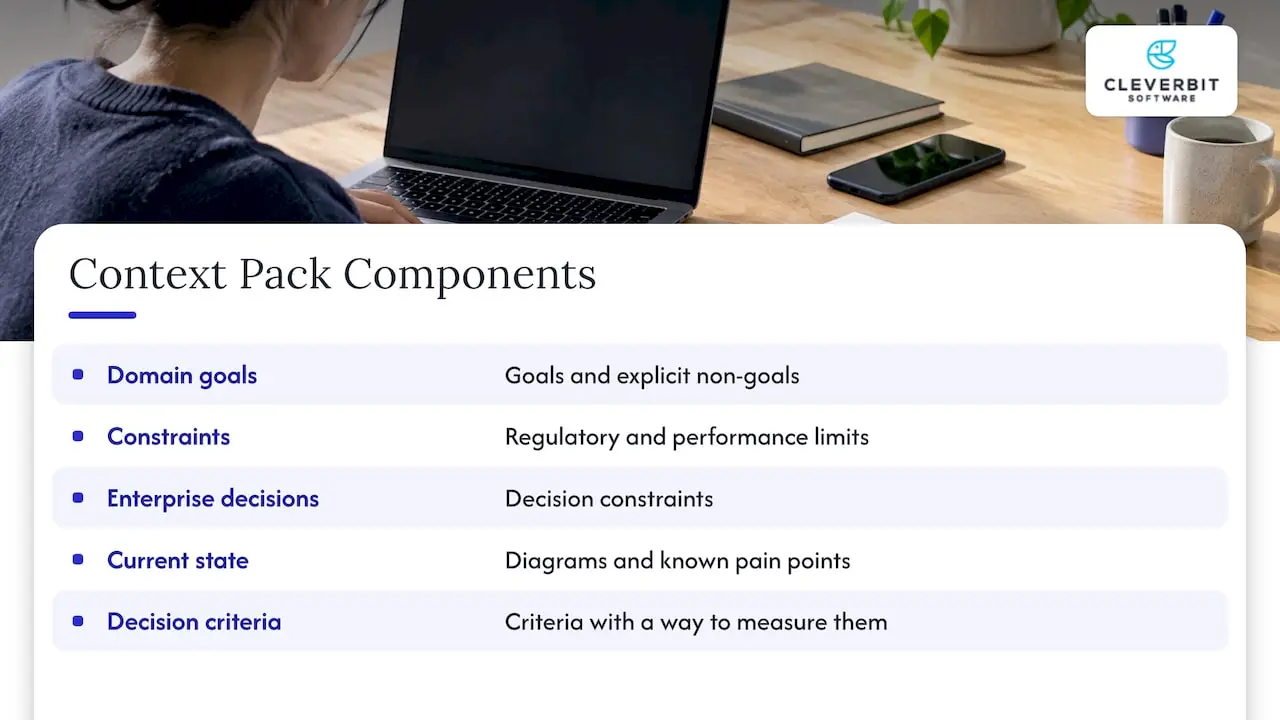
Each part answers a question the agent cannot guess. Non-goals prevent over-engineering. Constraints rule out options that would fail a compliance review. Current-state diagrams anchor proposals in the system as it exists.
UK government teams have reached a similar view. The Government Digital Service’s AI engineering lab repository points technical leads to context engineering for repository setup, baseline metrics and a phase-by-phase playbook for AI-assisted delivery.
Two habits make context more reliable. The first is to mark unknowns openly, so the agent reports a gap rather than inventing a value. The second is to record which decisions are already accepted, so the agent does not reopen them.
For finance SaaS teams the context also carries regulatory obligations. Data residency, audit requirements and segregation of duties belong in the brief from the start, since they limit which designs are viable.
Keeping a named person accountable for the plan
The central principle of governed architecture planning is that a person approves the plan before code begins. The engineer who starts an agent is the author of the resulting change, and the agent is never the approver of its own work.
UK public bodies state this plainly. The Home Office engineering standards require AI-assisted code and outputs to be reviewed and approved by suitably qualified people before production. Teams keep full accountability and work within approved guardrails against data leakage, insecure code and erosion of engineering standards.
Defra’s blog on generative AI in software development takes the same position. AI-generated work is reviewed rigorously for security, efficiency and readability, and final decisions remain with human developers.
For architecture, this has concrete consequences. A design proposal carries the name of the architect who accepted it. The ADR records who decided and on what basis. A later incident review can then trace a structural choice to a person and a date.
Defra’s published triage automation service shows the same shape in a different domain. An agent proposes scores with written rationale, but a person reviews and approves at every stage, and the agent runs under cost and time limits.
Tiering by risk keeps this workable at scale. Low-risk modules need a light review. Authentication, payments and data migration warrant sign-off at the design stage, before generated code exists. A 2026 design review guide describes this split and argues for writing decisions down before generation.
Faster architecture reviews without weaker review
Architecture review boards often become a queue. Documents wait for a slot, reviewers read long proposals cold and feedback arrives after the team has moved on. Agents can shorten the queue by preparing the ground.
Three parts of the process suit assistance:
-
Pre-review checks that compare a proposal with standards and flag missing sections.
-
Summaries that give reviewers the decisions, trade-offs and open risks on one page.
-
Draft risk registers that the human reviewers then correct and extend.
Human time moves from finding gaps to judging them. Reviewers spend the meeting on the contested decisions rather than on formatting and completeness.
Separating generation from criticism improves the output. A proposing agent and a reviewing agent, each with its own instructions, produce more useful challenge than one agent asked to mark its own work. The principle that whatever writes a change never checks it applies to designs as much as to code.
A second model review is still fallible. Agreement between two agents is not proof of correctness. Deterministic checks, such as dependency rules and schema validation, stay outside the model and run in the delivery pipeline.
Speed claims in vendor material deserve care. Figures for review times vary with scope, baseline and how the review was defined. A team gains more from measuring its own queue before and after than from adopting a published number.
Our guide on agentic AI architecture design sets out a governance-first approach to the same questions for teams that want more detail.
Preventing vibe code drift
Vibe coding describes prompting an agent until the output looks right, without a stated design. In a single prototype this is tolerable. Across an enterprise codebase it produces drift: structures that no one planned and no one can explain.
Drift enters when agents generate code without a fixed architectural reference. Each prompt yields a locally reasonable answer. Over months the answers diverge in naming, layering and error handling, and the system loses coherence.
The corrective is to move control upstream. When an approved plan and its ADRs exist before generation, the agent works inside a defined frame.
Branching discipline supports this. Each change is checked before merge and ships on its own, so that a drifting change stays small and reversible. Our note on branch strategy for agent-written code covers how teams keep that separation in practice.
Size limits help too. Very large pull requests defeat reviewers, and agents produce large diffs easily. A warning threshold on changed lines pushes work into reviewable units.
Attribution also matters. Marking AI authorship in commit history lets a later reader see which changes an agent drafted and which engineer owned them. Drift becomes visible when it can be traced.
Guardrails that sit in the delivery pipeline
Policy documents alone do not hold under delivery pressure. Controls that run automatically in the pipeline apply the same standard to every change, whether a person or an agent wrote it. Agents advise, automated checks enforce and named people decide.
The pipeline here is the delivery pipeline that ships application code. For architecture, it can enforce what the plan established:
-
Dependency and layering rules that fail the build when a service crosses a boundary.
-
Linting, type checking and secret scanning on every change.
-
Required approvals scaled to the blast radius of the change.
-
Links from each change back to the approved plan or ADR.
Defra’s examples show standards encoded into assistant configuration, including a code reviewer agent and accessibility checks. The approach keeps guidance consistent across teams instead of depending on each engineer’s memory of the rules.
Our article on CI controls for an AI governance framework describes how such checks are wired in. A wider view of AI code guardrails in secure delivery covers the controls around code itself.
Deployment and rollback remain human decisions. An agent can report that a release looks healthy. A named person releases it and a named person rolls it back. Where the plan touches operations, AI in DevOps looks at what agents deliver and where they break.
Measuring whether planning improves outcomes
A team adopting agentic planning needs evidence that it works. Without measures, the change rests on impressions, and impressions favour whoever speaks loudest.
Defra’s AI SDLC maturity assessment for system design lists sensible indicators. They include design alternatives explored, issues detected before implementation, documentation completeness and the time taken by design refinement cycles.
Two further measures suit enterprise SaaS. Rework after merge shows whether planning caught problems early. Review queue time shows whether agents are easing the board’s workload or only adding more documents.
A baseline matters more than any single figure. Recording review times and defect origins before agents are introduced gives each later number something to be compared with. Teams that skip this step struggle to show gains to their own risk and compliance functions.
Because starting points differ, no single target shape fits every team. A team with a fragile monolith and one with a mature platform will set different goals, different approval tiers and different measures.
Where the Blueprint fits
Teams that want a starting point for governed planning can begin with the Agentic SDLC Blueprint. It is a fixed-price workshop that produces a blueprint and a baseline.
Frequently asked questions
Can AI agents decide an architecture on their own?
Agents can draft options, record decisions and flag risks. They do not decide. In well-governed teams a named architect approves the plan before code begins, and the decision record carries that name.
Which architecture decisions suit AI support best?
Bounded, checkable work suits agents best: comparing options against stated criteria, drafting ADRs and checking designs against enterprise standards. Long-term judgement about how a system evolves stays with senior engineers, as academic reviews of the field note.
How does AI speed up architecture reviews?
Agents run pre-review checks, summarise proposals and draft risk registers. Reviewers then spend their time on contested decisions instead of completeness checks. The review still ends in human approval.
What stops AI-assisted planning from creating drift?
Approved plans and ADRs exist before generation, and pipeline checks enforce the boundaries they set. Small, separately shipped changes keep any deviation visible and easy to reverse.
Sources
-
Artificial Intelligence for Software Architecture: literature review (arXiv, 2025)
-
GenAI and software development: a new paradigm (Defra Digital)
-
Design reviews for vibe-coded features: ADRs and architecture boards