Most engineering leaders assume their AI coding tools are generating reasonably safe output. The reality is considerably more alarming.
40% of GitHub Copilot suggestions are vulnerable, 62% contain design flaws or security issues, and 21% of agent trajectories include insecure steps. AI code guardrails are the structured controls that sit between your developers and these risks, filtering, validating, and monitoring AI-generated code before it reaches production. This article covers layered defence strategies, practical framework choices, and the honest trade-offs between security robustness and development velocity that every technology executive needs to understand before scaling AI-assisted development.
Key Takeaways
| Point |
Details |
| Guardrails address hidden risks |
Automated and layered code guardrails are essential to block many vulnerabilities missed by traditional QA. |
| No single tool suffices |
Effective AI code safety requires combining input, semantic, output, and behaviour checks from multiple frameworks. |
| Continuous oversight is vital |
Advanced attacks can bypass guardrails so regular red-teaming and human review are always required. |
| Security impacts performance |
Stronger enforcement adds latency, making it crucial to balance guardrail rigour with development speed. |
| Expert integration drives success |
The right partner and mature processes ensure robust, scalable AI software delivery aligned with business goals. |
Why AI code guardrails matter: The scale of the risk
The conversation about AI-assisted development is often dominated by productivity gains. What receives far less attention is the security liability that scales alongside that productivity. When AI code generation is adopted at speed, without corresponding governance, the exposure grows faster than most teams realise.
Empirically, the numbers are striking. Research consistently shows that
82.8% of functionally correct AI-generated code remains insecure. That means code that passes unit tests, satisfies functional requirements, and clears manual review can still carry serious vulnerabilities into production. The problem is not that AI tools are poorly designed. It is that they are optimised for functional output, not security-first output.
| Vulnerability indicator |
Rate reported |
| GitHub Copilot suggestions with flaws |
40% |
| AI code with design or security issues |
62% |
| Functionally correct code that is insecure |
82.8% |
| Agentic trajectories with insecure steps |
21% |
“The assumption that functional correctness implies security is one of the most dangerous misconceptions in modern AI-assisted development.”
Traditional QA processes were built around human-written code, where a skilled reviewer could reason about intent, context, and known patterns. AI-generated code changes this dynamic significantly. It can be syntactically clean, logically coherent, and still embed subtle vulnerabilities such as insecure deserialization, hardcoded credentials, or improperly scoped permissions. Human reviewers, under velocity pressure, often miss these.
The gaps that guardrails address in
AI software delivery are structural, not incidental:
- Volume: AI tools generate code far faster than human review can process it at the same scrutiny level.
- Context blindness: AI models do not understand your specific threat model, data classification requirements, or regulatory constraints.
- Compounding risk: Each insecure suggestion builds on the last, creating layered technical debt with a security dimension.
- Agentic autonomy: As AI agents take on more autonomous tasks, the attack surface expands dramatically.
You can review
AI code audit data to understand your current exposure. But the broader point is this: relying solely on human code review and legacy QA when AI is generating a significant portion of your codebase is a governance failure waiting to happen. Additional automated guardrails are not optional. They are a structural requirement of responsible AI-assisted development. Now that the risk is clear, it is crucial to understand what modern guardrails look like and how they work.
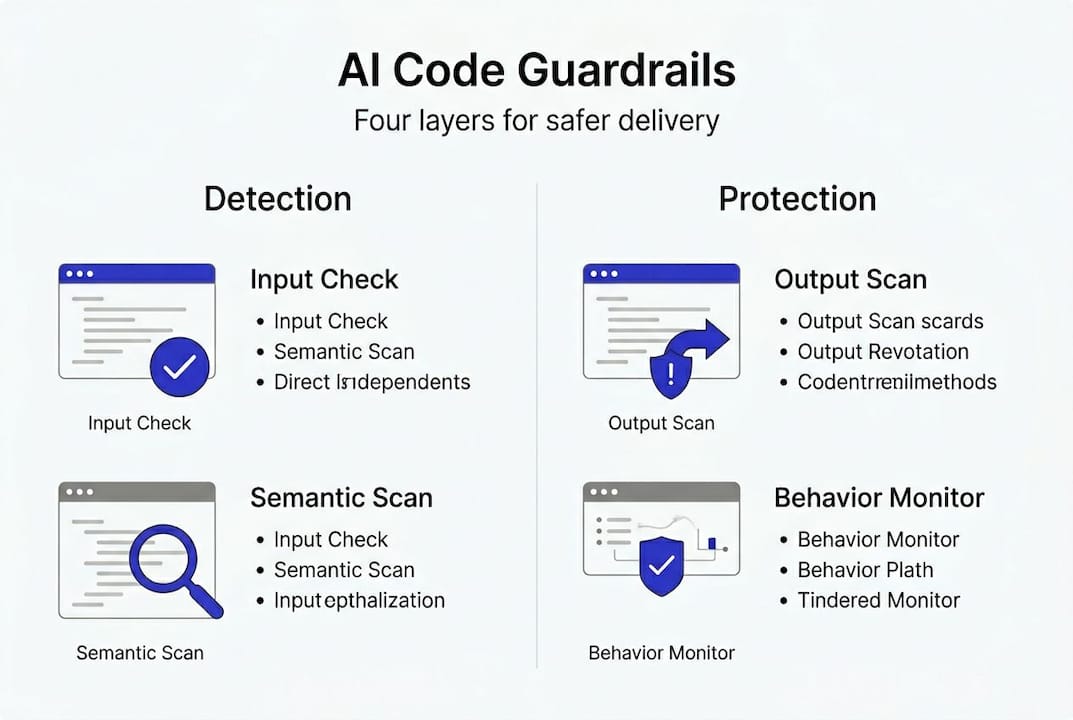
AI code guardrails are not a single tool or a single check. They are best understood as a
multi-layered defence strategy, with each layer targeting a different class of risk. Understanding what each layer does, and where it sits in your pipeline, is essential before selecting any specific framework.
The four core layers are:
- Input validation: Screens prompts and retrieved context before they reach the AI model. Blocks prompt injection attempts, sensitive data inclusion, and off-policy instructions.
- Semantic analysis: Evaluates the meaning and intent of generated code, not just its syntax. Flags logic that violates security policies, even when it appears structurally sound.
- Output scanning: Analyses AI-generated code for known vulnerability patterns, secret leakage, insecure dependencies, and policy violations before it enters the codebase.
- Behavioural monitoring: Tracks patterns across sessions and agentic tasks to detect adversarial drift, unusual access patterns, or policy erosion over time.
| Framework |
Key strength |
Best suited for |
| NeMo Guardrails |
Dialogue flow and policy enforcement |
LLM-integrated workflows |
| Guardrails AI |
Custom validators and schema control |
Output quality and structure |
| Amazon Bedrock Guardrails |
Managed, scalable cloud deployment |
AWS-native enterprise stacks |
| GitHub Copilot agentic principles |
Developer workflow integration |
IDE-level code review |
Each tool has genuine strengths and real trade-offs.
GitHub Copilot’s agentic security principles make it well-suited for teams already embedded in the GitHub ecosystem, but it offers limited customisation for bespoke threat models. NeMo Guardrails provides deep policy configuration but requires meaningful engineering investment to operationalise. Bedrock suits teams running AWS-native infrastructure but introduces cloud dependency.
For teams investing in
securing AI coding workflows, the most resilient approach combines at least two layers: output scanning as a baseline, plus behavioural monitoring for agentic deployments. Refer to the
in-depth guardrails guide for detailed configuration patterns.
Pro Tip: Do not choose your guardrail framework based on marketing claims. Run a structured pilot against your actual threat scenarios, including adversarial prompts specific to your domain, before committing to any tooling at scale.
Understanding the specific layers and available frameworks sets the stage for tackling implementation barriers and edge cases.
Real-world implementation: Overcoming barriers and blind spots
Deploying guardrails in a controlled demo environment is straightforward. Deploying them in production, against real workloads, agentic systems, and adversarial users, is where most teams discover the blind spots.
Even advanced guardrails fail in predictable ways. Understanding these failure modes before you encounter them is what separates mature implementations from reactive ones.
Common failure scenarios include:
- Prompt injection via RAG pipelines: When AI systems retrieve external documents or data to inform responses, that retrieved content can carry embedded instructions that bypass input filters. Traditional guardrails do not inspect retrieved context with the same rigour as direct user input.
- Tool misuse in agentic systems: 32% of deployable attacks against agentic systems succeed through tool misuse, where the AI is manipulated into using legitimate tools for illegitimate purposes.
- Multi-turn adversarial drift: Over extended conversations or sessions, attackers can gradually shift the AI’s behaviour through incremental prompts, eroding the self-checks that guardrails rely on.
These are not theoretical risks. Known
NeMo injection vulnerabilities have demonstrated how even well-regarded frameworks carry exploitable weaknesses in specific deployment contexts.
Closing these gaps requires a different mindset. It is not enough to configure guardrails and consider the problem solved. Mature teams treat guardrail robustness as an ongoing practice, not a one-time deployment decision. Review
AI guardrail implementation patterns and ensure your
policy enforcement guidelines are aligned with production realities.
Actionable best practices for production environments:
- Red-team your guardrails quarterly. Assign a dedicated team to stress-test configurations against novel attack patterns, including domain-specific adversarial prompts.
- Inspect RAG-retrieved context. Apply the same validation logic to retrieved data as you apply to direct inputs. Do not treat retrieval as a trusted channel.
- Scope agentic permissions tightly. Enforce least-privilege access at the tool and API level, reducing the blast radius of any successful manipulation.
- Log and audit behavioural patterns. Guardrails generate signal. That signal is only valuable if someone is reviewing it and acting on anomalies.
Pro Tip: Treat your guardrail configuration as living policy, not static configuration. Version-control it, review it on the same cadence as your security policies, and update it as your AI tooling evolves.
Filling these gaps means navigating often tricky trade-offs, especially between robust security and developer velocity.
Every guardrail check adds latency. That is not a flaw in the design. It is the cost of validation. The question is not whether to accept that cost, but how to manage it intelligently so that security does not become a bottleneck that developers route around.
Each validator check adds 50 to 100ms of latency, and layering multiple validators compounds that effect. For interactive developer workflows, where real-time code suggestions are the expectation, this overhead can materially degrade the experience. For batch processing or CI pipeline integration, the same latency is largely invisible.
| Guardrail layer |
Typical latency impact |
Recommended deployment context |
| Input validation |
10 to 30ms |
All contexts |
| Semantic analysis |
40 to 80ms |
CI pipeline, not IDE real-time |
| Output scanning |
30 to 60ms |
Pre-commit and CI gate |
| Behavioural monitoring |
Async, minimal |
Always-on in production |
“Security controls that developers actively avoid create more risk than they prevent. Usability is a security property.”
Strategies for maintaining both rigour and velocity:
- Run semantic and output checks asynchronously where possible, surfacing results in the CI pipeline rather than blocking the IDE suggestion loop.
- Deploy custom validators tuned to your specific codebase and threat model. Generic validators generate false positives that erode trust and lead to suppression behaviours.
- Enforce IAM policies at the infrastructure level, not just within the guardrail framework. Defence-in-depth means controls exist at multiple layers, not just the AI layer.
- Tier your validation intensity based on code sensitivity. Code touching authentication, payment processing, or PII handling warrants heavier scrutiny than internal tooling.
For teams investing in robust AI delivery strategies, the goal is a guardrail architecture that feels proportionate. Developers should experience it as a quality signal, not an obstacle. When guardrails are well-tuned, they surface real issues and stay quiet on clean code. That is the calibration target. Explore low-latency guardrail insights for configuration guidance specific to high-throughput environments. By mastering these trade-offs, leaders can ensure AI guardrails drive both innovation and safety.
The uncomfortable truth about AI guardrails: Why ‘silver bullet’ thinking puts teams at risk
Here is what many guardrail vendors will not tell you: no framework eliminates vulnerability risk on its own. The technology is genuinely useful. It is not a substitute for disciplined human oversight and adaptive governance.
We see this pattern repeatedly. A team deploys a reputable guardrail framework, ticks the compliance box, and then treats the problem as solved. Six months later, an adversarial edge case exposes a gap that the framework was never designed to catch. The failure was not in the tool. It was in the thinking that the tool was sufficient.
Effective guardrail strategy demands continuous red-teaming, staged rollout, and honest alignment between security requirements and delivery realities. It requires engineers who understand both the threat model and the tooling constraints. It requires leadership that treats best-practice AI delivery as an ongoing organisational commitment, not a procurement decision. Guardrails compound positively when they are part of a living security culture. They fail silently when they are treated as a checkbox.
Build secure, scalable AI delivery with expert partner support
Implementing robust AI code guardrails at scale is not a configuration task. It is an engineering discipline that requires the right team, the right frameworks, and the governance maturity to sustain them. Cleverbit Software works with scaling tech companies to design, implement, and operationalise guardrail strategies that hold up in production. Our AI software delivery service integrates security controls into your development pipeline without sacrificing velocity. Whether you need
scalable software solutions or access to
high-performance development teams with proven experience in AI governance, we can help you build the capability that your AI-assisted development strategy demands.
Frequently asked questions
What are the essential layers of AI code guardrails?
The four core layers are input validation, semantic analysis, output scanning, and behavioural monitoring, used together to block insecure code, PII leakage, and policy breaches across AI-assisted development pipelines.
How effective are AI code guardrails against complex attacks?
Guardrails block most common errors, but advanced threats such as prompt injection and adversarial drift can bypass them, making continuous red-teaming and multi-layer deployment essential rather than optional.
Do layered guardrails slow down software delivery?
Yes, each validator adds 50 to 100ms of latency, so the most effective implementations deploy heavier checks asynchronously in CI pipelines rather than blocking real-time developer workflows.
Are human code reviews still necessary with strong AI guardrails?
Absolutely. Given that 82.8% of functionally correct AI-generated code can still contain security flaws, human review and static analysis remain non-negotiable components of a responsible delivery pipeline.
Recommended
