
Treat agentic AI as a bounded, auditable actor in your system: define an autonomy envelope, version every agent-facing artefact as code, and bind runtime permissioning to pipeline gates. That is the whole discipline of AI architecture design once you strip away the vendor noise. Get this wrong and agents drift from what you built toward whatever the model decided was plausible that week, a failure mode we’ve come to call vibe code drift. Get it right and you have something closer to a colleague with a clear job description than a black box you’re hoping behaves.
Four pillars hold this up:
- An autonomy envelope with explicit task-level permissioning, separating agentic decisions from human-owned ones
- Version control for prompts, tool manifests, policies and memory schemas, with approvals and rollback like any other production artefact
- Pipeline-level enforcement: composite identity, tool-approval gates and audit trails baked into CI/CD, not layered on after
- A pilot-first rollout, tracking behavioural metrics before scaling the operating model
NIST’s AI Risk Management Framework treats governance as a cross-cutting function running through mapping, measurement and management, not a checkbox at the end. That framing matters more than any individual control you choose.
What is AI architecture design for agentic systems?
AI architecture design, in the agentic sense, is the discipline of deciding what an AI agent is structurally permitted to do, how that permission is enforced at runtime, and how every decision it makes stays traceable back to a human-owned intent. It borrows heavily from distributed systems thinking: bounded contexts, least privilege, immutable audit logs. What’s new is the unpredictability of the actor sitting inside those boundaries.
Most engineering teams still architect for agentic AI the way they’d architect a feature flag: bolt it onto existing services and hope the blast radius stays small. That approach works right up until an agent with write access to a deployment pipeline decides, correctly by its own logic, that skipping a review step is the fastest path to the goal it was given. Sound architecture for agentic systems assumes the agent will eventually attempt something you didn’t anticipate, and asks: what stops it, and who finds out?
This is also where machine learning in architecture and generative design in architecture terminology gets confused with software architecture for AI agents. This article is about the latter: how you structure the pipelines, permissions and governance around autonomous software agents operating inside your SDLC, not about AI tools for building design or physical construction. The vocabulary overlaps; the engineering problem does not.
Architecture principles: envelopes, orchestrators and personas
Every agentic system needs a defined autonomy envelope: an explicit statement of which decisions the agent can make unsupervised and which remain deterministic, human-gated code paths. Without this boundary, agentic scope creeps outward one convenient exception at a time until nobody can say with confidence what the system is allowed to do.
The Code proposes framing this as an autonomy continuum rather than a binary switch: agents earn broader latitude as they demonstrate reliability against measurable criteria, not by default. Pair that with an orchestrator, a component whose sole job is decomposing a task, assigning it to the right agent, and constraining that agent’s scope to exactly what the task requires. The orchestrator is not optional infrastructure. It’s the difference between a system of narrow, auditable agents and one sprawling agent that quietly accumulates capabilities nobody signed off on.
Agent personas deserve the same rigour you’d apply to an API contract. A persona defines what an agent must and must not do, its escalation triggers, and its data-handling constraints, and it belongs in Git, not in someone’s prompt-engineering notebook. Treating personas as versioned behavioural contracts rather than ad-hoc prompts is one of the clearest signals of a mature agentic architecture.
- Autonomy envelope: explicit boundary between agentic and deterministic decision paths
- Orchestrator: decomposes tasks and limits per-agent scope
- Persona: versioned contract, not an informal prompt
- Escalation triggers: defined conditions that hand control back to a human
Pro Tip: Resist the urge to make everything agentic just because the model can technically handle it. The “everything agentic” anti-pattern is the fastest route to architectural drift: every agent you add without a clear boundary is a new source of unpredictable coupling between systems that used to be independent.
How do you enforce safe agent behaviour at runtime?
Principles only matter if they survive contact with a live pipeline, which is where most agentic AI architecture actually fails. GitLab’s guidance on governing agentic AI frames this around a deceptively simple pair of questions: what can this agent do, and what needs a human to say yes first? Four controls answer those questions in practice.
- Tool-approval guardrails per flow. Classify every tool call as always-allow, ask, or deny, and apply that classification per agent and per flow, not globally. A code-formatting tool might sit in always-allow; a production deployment tool sits firmly in ask.
- Composite identity for every action. Bind agent actions to both the agent and the human or system that requested them. This is the only way to answer “who did this” when an agent, not a developer, pushed the change.
- Pipeline-level enforcement. Scanner policies, merge-request rules and admission gates should apply identically whether a human or an agent generated the change. GitLab’s model of pipeline checks keeps headless CI actions reviewable and auditable rather than trusted by default.
- Independent verification against injection. Prompt-injection detection and input sanitisation matter more once an agent can act on content it retrieves, not just content a human typed.
The OWASP Top 10 for LLM Applications lists excessive agency, excessive permissions and excessive functionality among the most common failure classes in production LLM systems, and its prevention advice tracks the same logic: minimise what an agent can reach, run it in the requesting user’s context, and require explicit approval for anything with real-world consequence. None of this is exotic. It’s the same least-privilege discipline you already apply to service accounts, extended to an actor that writes its own next move.
Versioning and behavioural testing: treat agent artefacts as code
Prompts, tool manifests, policy configurations and memory schemas are production artefacts, and they should live in Git with the same rigour as application code. The InfoQ playbook on agentic development argues for treating these as Infrastructure-as-Code: semantic diffs on prompt changes, formal approval before merge, and rollback paths when a change degrades behaviour in production.
This matters because bisecting a behavioural incident without versioned artefacts is close to impossible. If an agent starts approving pull requests it shouldn’t, you need to know whether the model changed, the policy changed, or the memory schema changed, and you can only answer that if all three were tracked as separate, diffable commits.
Progressive delivery techniques translate directly: canary a new prompt version to a small percentage of traffic, run it against A/B behavioural checks, and set automatic rollback triggers when error or escalation rates spike. Golden trajectories, recorded sequences of reasoning steps and tool calls for known-good scenarios, give you a regression suite for agent behaviour the same way unit tests give you one for functions.
| Artefact | Storage | Change control | Test method |
|---|---|---|---|
| Prompts | Git, semantic diff | Approval + rollback | Golden trajectory replay |
| Tool manifests | Git, versioned schema | Merge request review | Permission scope test |
| Policy configs | Git, IaC pipeline | Admission gate | Policy simulation |
| Memory schemas | Git, migration scripts | Approval + rollback | Regression on recall accuracy |
Hash-chained audit logs tie all of this together, giving you provenance you can actually defend in an audit rather than a log file someone hopes wasn’t tampered with.
What operating model and roles govern agentic delivery?
Architecture and controls only work if someone owns the decisions behind them. Deloitte’s analysis of agentic engineering models makes the point plainly: without a defined operating model, adoption becomes fragmented and ungovernable, because nobody can say who’s accountable when an agent’s output turns out wrong.
Start with a decision authority matrix that separates who performs work from who decides it should happen. An agent might execute a database migration; a named engineer decides whether that migration runs against production. Two investment gates keep this honest in practice: one at initiation, confirming the pilot’s scope and risk profile before any code is written, and one post-design, confirming the architecture actually matches what was approved before it scales.
Four roles tend to recur across mature agentic teams:
- Operator/orchestrator: owns task decomposition and agent assignment, accountable for the overall workflow
- Context engineer: maintains personas, memory schemas and prompt versions as living artefacts
- Validator/reviewer: signs off on agent-generated changes at the same gates human-written changes pass through
- Security lead: owns the tool-approval matrix and incident response for agent-caused failures
Pro Tip: Don’t hire a “prompt engineer” and call the operating model solved. The scarce skill is context engineering, maintaining the personas, guardrails and memory schemas that keep an agent’s behaviour predictable over months, not the one-off skill of writing a clever instruction. Our team structure guidance sets out how these roles map onto a delivery team without duplicating existing engineering functions.
The path from pilot to scale should run on evidence, not enthusiasm: define success metrics before you start, measure against them honestly, and only widen an agent’s autonomy envelope once the data supports it.
A pilot-to-production checklist for agentic AI architecture
Running an agentic pilot without a checklist is how “just testing it out” becomes an unreviewed production dependency six months later. Work through this sequence before you scale anything.
- Scope a low-risk pilot with clearly bounded tasks, defined success metrics, and a handful of golden trajectories representing expected behaviour.
- Publish an agent catalogue listing every agent, its persona, its tool access, and its current autonomy level.
- Set tool-approval guardrails for every flow the pilot touches, always-allow, ask, or deny, before the agent runs against real data.
- Version every artefact, prompts, manifests, policies, memory schemas, with rollback triggers defined in advance, not improvised during an incident.
- Add admission gates and automated scanners to the pipeline so agent-generated changes face the same checks as human-generated ones.
- Monitor incident signals continuously: escalation frequency, rollback rate, and drift between golden trajectories and live behaviour.
Only once these six steps produce clean metrics for a defined period does it make sense to widen scope or add agents.
Security and privacy considerations specific to agentic AI components
Agentic components introduce new security challenges that traditional application security tools may not detect, such as data exfiltration triggered by manipulated inputs acting through authorised tools.
Prompt injection is the headline risk, but the more persistent problem is scope creep through tool composition: an agent with access to a file reader and a messaging tool can be induced to combine them into a capability nobody explicitly granted. This is why the OWASP guidance on minimising extension functionality matters as much for privacy as for security: every tool an agent can reach is a potential exfiltration path for whatever data that tool touches.
Memory schemas need their own privacy review. An agent that retains conversation history or retrieved documents across sessions can leak one customer’s data into another’s context if the memory boundary isn’t enforced as strictly as a database row-level security policy. Treat agent memory as a data store subject to the same retention, access and deletion rules as any other system holding personal data, not as an implementation detail of the model.
Independent verification, a second agent or a deterministic check confirming a high-impact action before it executes, is worth the latency cost anywhere the failure mode touches customer data or financial transactions.
Integration patterns for legacy and enterprise systems
Most agentic pilots fail not because the agent is unreliable but because it was pointed directly at a legacy system never designed to be called by anything other than a human through a UI. The pattern that works is an abstraction layer: a well-defined API or tool manifest that mediates between the agent and the legacy system, translating agent intent into the same calls a human operator would make through existing interfaces.
This mediation layer does double duty. It enforces the tool-approval guardrails discussed earlier at the point of contact with legacy infrastructure, and it gives you a single place to add logging and rate limiting without touching systems that may not have been meaningfully modified in a decade. Enterprise service buses and API gateways that already sit between modern and legacy systems are a natural home for this layer rather than a new component to build from scratch.
Where legacy systems expose no API at all, resist the temptation to let an agent drive a UI directly through browser automation as a permanent pattern. It’s fragile, hard to audit, and nearly impossible to apply consistent permissioning to. Treat UI automation as a bridge during migration, not an architecture, and prioritise building a proper interface behind it.
Composite identity, binding every action to both the agent and its human or system requester, becomes especially important at integration points with systems that predate any concept of AI actors. Legacy audit tooling was built assuming a human made the call; your integration layer needs to supply that context explicitly, because the legacy system won’t infer it.
How should AI agent architectures handle failure and faults?
Agents fail differently to conventional software, and fault tolerance strategies built for deterministic systems don’t map cleanly. A traditional service either returns the expected response or throws an exception you can catch. An agent can return a confident, well-formatted, entirely wrong answer, and nothing in the response signals failure.
Design for graceful degradation rather than binary success or failure. Set confidence thresholds below which an agent action requires human confirmation rather than proceeding, and build circuit breakers that pause an agent’s autonomy when its escalation or error rate crosses a defined threshold, the same pattern you’d apply to a misbehaving microservice.
Timeouts need rethinking too. An agent stuck in a reasoning loop doesn’t fail loudly; it just keeps consuming tokens and time until something external stops it. Hard limits on reasoning steps, tool calls per task, and wall-clock time all belong in the architecture from day one, not added after the first runaway execution generates an unexpected bill.
Retry logic also needs agent-specific handling. Blindly retrying a failed agent task can compound errors if the failure was caused by the agent’s own reasoning rather than a transient system issue. Distinguish between infrastructure failures, worth retrying, and reasoning failures, worth escalating to a human rather than repeating.
Fallback paths matter most here: every agentic workflow needs a deterministic, non-agentic path that activates when the agent’s confidence, latency or error signals cross a defined threshold, so a single component’s unreliability never becomes a full outage.
What ethical frameworks and standards apply here?
Two standards now anchor most serious agentic AI governance programmes, and CTOs building an architecture from scratch should map their controls to both rather than inventing a bespoke framework. NIST’s AI RMF structures governance around four functions, GOVERN, MAP, MEASURE and MANAGE, with GOVERN explicitly cross-cutting rather than a phase that finishes before the others start. That framing alone should change how you sequence a governance rollout: documentation and accountability need to exist from the pilot’s first day, not get retrofitted once the system reaches production.
ISO/IEC 42001 takes a management-system approach, the same Plan-Do-Check-Act cycle familiar from ISO 9001 or ISO 27001, applied to an AI Management System (AIMS). For engineering leaders already running an ISO 27001 information security programme, this is the more natural fit: it slots agentic AI governance into an audit structure your compliance team already understands, rather than asking them to learn an entirely new framework.
Neither standard tells you exactly which tool-approval guardrail to set on a given agent flow. That decision stays yours, informed by risk tolerance and regulatory context. What both standards insist on is that the decision gets documented, reviewed periodically, and tied to a named accountable owner, which is precisely the discipline that separates a governed agentic architecture from one that merely looks governed in a slide deck.
Data lineage and governance for AI agents
An agent that retrieves data, transforms it, and acts on the result creates a lineage problem conventional data governance tools weren’t built to track: which data influenced which decision, and where did that data ultimately come from. Without this trace, you can’t answer a regulator’s question about why an agent made a specific call, and you can’t debug why it made a wrong one.
Data lineage for agentic systems needs to capture three things: the source of every input the agent consumed, the tool calls it made using that input, and the final action it took as a result. This is more granular than typical data lineage tooling, which usually tracks table-to-table transformations rather than model-to-action chains.
Usage governance matters as much as lineage. Define explicit rules for which data classes an agent may access for which task types, and enforce those rules at the tool layer rather than trusting the agent’s own judgement about what’s appropriate to retrieve. A customer-support agent that can technically query a finance database because both systems share an API gateway is a governance failure waiting to surface, regardless of how well-behaved the agent has been so far.
Retention policy needs equal attention. Memory schemas that persist context across sessions are, in effect, a new data store, and it needs a defined retention and deletion policy tied to the same regulatory obligations, GDPR right-to-erasure requests included, that govern every other system holding personal data. Treating agent memory as exempt from these obligations because it’s “just context” is a mistake regulators are increasingly unlikely to accept.
Explainability in agent decision-making
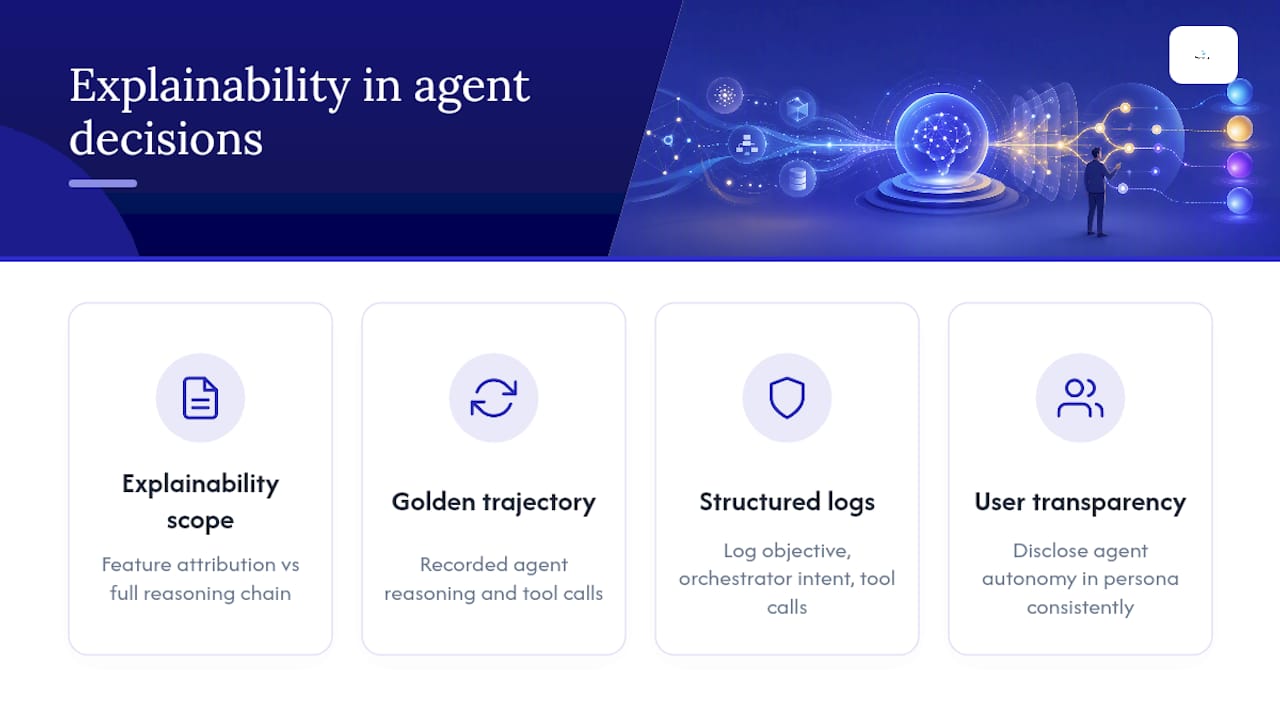
Explainability for agentic systems is a different problem to explainability for a single model’s prediction. A classifier’s explainability challenge is showing which features drove a score. An agent’s explainability challenge is reconstructing an entire chain: which sub-goal it pursued, which tools it called in what order, and why it judged the outcome sufficient to stop.
Golden trajectories, discussed earlier for regression testing, double as explainability infrastructure. A recorded trajectory showing an agent’s full reasoning chain and tool invocations is the closest thing to an audit trail a black-box model can produce, and it’s far more useful to a reviewer than a post-hoc summary the agent generates about its own reasoning, which can be confidently wrong in the same way its final answers can be.
Structured logging matters more than any explainability model bolted on afterwards. Every agent action should log the objective it was pursuing, the orchestrator intent that triggered it, and the specific tool calls made, tied together as described earlier through composite identity. That log, not a natural-language justification generated after the fact, is what should satisfy an auditor or an incident reviewer asking why an agent did what it did.
Transparency to end users is a separate obligation from transparency to engineers. A customer interacting with an agentic support system deserves to know they’re dealing with an autonomous agent and understand roughly what it’s authorised to decide unassisted. Baking that disclosure into the persona itself, rather than leaving it to a support team’s discretion, keeps the answer consistent and auditable across every conversation the agent handles.
Cleverbit’s perspective: governance as an engineering discipline
We don’t treat governance as paperwork attached to an engineering project. It’s engineering: artefacts versioned in Git, approval semantics enforced in the pipeline, and audit trails that exist because the architecture produces them, not because someone remembered to write a report. That distinction shows up clearly in our SDLC case study, where a pilot’s metrics, not enthusiasm, decided how far agentic scope expanded.
Every embedded team we place keeps decision ownership with the client, operating to their standards rather than importing ours by default. The teams that get the most out of agentic AI are the ones that scaled deliberately from evidence, and that’s the operating model we build toward from day one, not the one we retrofit after something goes wrong.
How Cleverbit helps you build this safely
Cleverbit is the practical alternative to guessing your way through agentic adoption: we design the autonomy envelope, tool-approval guardrails and versioning workflow for your specific pipeline, then prove it with a measurable pilot before anyone talks about scale. That means governance architecture built alongside your engineering standards from the outset, not a compliance layer added after an incident forces the question. We embed teams that carry your existing review culture, whether an agent or a developer generated the change, and hand over the structure cleanly if you decide to take direct ownership later. If you want to see where agentic AI creates the most value in your own pipeline without inheriting the risk that comes with rushing it, start with our AI software delivery service page and talk to us about scoping a pilot.
Sources
- How to govern agentic AI, MCPs, and AI code assistants (GitLab blog)
- AI & Agentic Workflow Design and Governance (AI4SDLC play)
- Prompts to production: playbook for agentic development (InfoQ)
- Artificial Intelligence Risk Management Framework (NIST AI RMF 1.0)
Recommended
- AI Integration Articles – Cleverbit Software
- The AI Organisational Chart That Will Define 2027 – Cleverbit Software
- Types of team structures for agentic AI delivery
- AI Development Tools – Cleverbit Software