
Integrate AI-specific playbooks and telemetry into your existing incident response programme now, and make certain at least one containment action is executable within 60 minutes of detection. That single discipline separates teams that manage AI incidents from those that discover them retrospectively, in a post-mortem, after the damage is done.
Immediate actions to execute today:
- Declare the incident using your existing IR process; do not wait for AI-specific confirmation.
- Execute fast containment: revoke agent permissions, disable the affected model endpoint, or route traffic to a fallback.
- Preserve evidence immediately: freeze prompt logs, model input/output pairs, inference traces and memory state snapshots before rotation policies delete them.
- Notify the AI system owner, MLOps lead and legal/compliance within the first 15 minutes.
- Trigger AI-specific telemetry retention: extend log retention windows beyond default settings for all affected pipelines.
- Open a formal incident ticket and assign an AI incident coordinator as the single accountable owner.
Two authoritative frameworks underpin this approach. CoSAI recommends embedding AI incident procedures directly into existing IR frameworks and capturing AI-specific telemetry such as prompt logs, inference activity and memory state changes. NIST SP 800-61r2 provides the canonical lifecycle (prepare, detect, analyse, contain, eradicate, recover, lessons learned) that every AI-adapted playbook should map back to. Your SLA targets: acknowledge promptly; execute a containment action within an hour of detection.
Why conventional incident response models fail for AI systems
Traditional IR was built for deterministic systems. A firewall rule either blocks traffic or it does not. A server either responds or it crashes. AI systems behave differently, and that difference breaks almost every assumption your existing playbooks are built on.
The core technical failures:
- Non-deterministic outputs. The same prompt, submitted twice, can produce materially different responses. This makes reproduction of an incident unreliable and root-cause analysis genuinely difficult.
- Silent degradation. A model can drift from its intended behaviour over weeks without triggering any alert. There is no equivalent of a 500 error; the system keeps responding, just incorrectly.
- Ambiguous root cause. A harmful output might originate from poisoned training data, a corrupted retrieval index, a manipulated prompt, or an emergent interaction between model layers. These are not mutually exclusive, and they require different remediation paths.
Telemetry and taxonomy gaps compound the problem. Most SOC tooling was not built to capture prompt logs, confidence scores, retrieval provenance from RAG pipelines, or embedding drift. Without those signals, investigators are working blind. Existing incident taxonomies also lack categories for novel AI harm types: hallucination-driven misinformation, agent runaway, memory poisoning. Responders reach for the nearest familiar category and apply the wrong playbook.
Human factors are equally serious. Responders investigating a hallucination incident may be exposed to harmful, disturbing or legally sensitive outputs during evidence review. That requires welfare protocols most IR teams have never considered. Cross-team coordination is also harder: an AI incident may simultaneously involve the SOC, the MLOps team, the product owner and legal, none of whom share a common vocabulary or escalation path.
Pro Tip: Invest in AI-specific observability before your first incident, not after. Teams that instrument confidence metrics, drift signals and prompt logs in advance reduce mean investigation time substantially compared to those reconstructing evidence post-hoc.
What does a defensible AI incident response framework look like?
A defensible framework does not replace your existing IR programme. It extends it. CoSAI’s guidance is explicit on this point: siloed AI-only plans create coordination failures during cross-functional incidents. The goal is augmentation, not duplication.
Eight core principles:
- Preserve fundamentals. Map every AI procedure to the NIST SP 800-61r2 lifecycle. Do not invent parallel structures.
- Telemetry-aware governance. Define what you log, how long you retain it, and who can access it before an incident occurs.
- Staged remediation. Prefer reversible containment actions (disable endpoint, revert model version) over irreversible ones (delete training data) until root cause is confirmed.
- Response-centric taxonomy. Group incident types by containment workflow, not by technical mechanism. This reduces cognitive load under pressure and produces shorter, more actionable runbooks, as the GenAI-IRF study demonstrates.
- Cross-functional RACI. Every AI incident type must have a named owner from engineering, a named owner from security, and a named escalation path to legal/compliance.
- Auditable evidence chain. Treat AI artefacts (model weights, prompt logs, retrieval indices) with the same chain-of-custody discipline as forensic disk images.
- Embedded AI procedures. AI runbooks live inside your existing IR platform (SOAR, wiki, ticketing system), not in a separate document that responders cannot find under pressure.
- Continuous improvement loop. Every AI incident feeds a lessons-learned process that updates detection rules, playbooks and training scenarios.
Mapping to authoritative standards:
| Principle | Standard / Framework |
|---|---|
| Lifecycle alignment | NIST SP 800-61r2 |
| Telemetry and embedding | CoSAI AI Incident Response Framework |
| Structured incident records | ETSI AICIE TS 104158-01 |
| Threat technique mapping | MITRE ATLAS |
| Application-level risk taxonomy | OWASP LLM Top-10 |
| Playbook validation | GenAI-IRF peer-reviewed study |
Minimum artefacts every team needs:
- Runbook templates for each incident archetype (see Section 6).
- A RACI matrix covering SOC, MLOps, SRE, product and legal.
- SLA windows: acknowledge 15 minutes, initial triage 2 hours, containment action 60 minutes from detection.
- Evidence retention policy: keep AI-specific telemetry for a period adequate to support investigations and compliance, with longer retention for incidents under regulatory scrutiny.
Pro Tip: When embedding AI procedures into your SOAR platform, tag AI-specific runbooks with a dedicated incident category so they surface automatically during triage, rather than requiring responders to search for them under pressure.
The AI incident response lifecycle: from detection to lessons learned
The five-phase lifecycle below maps directly onto NIST SP 800-61r2 and extends each phase with AI-specific entry criteria, evidence requirements and decision gates.
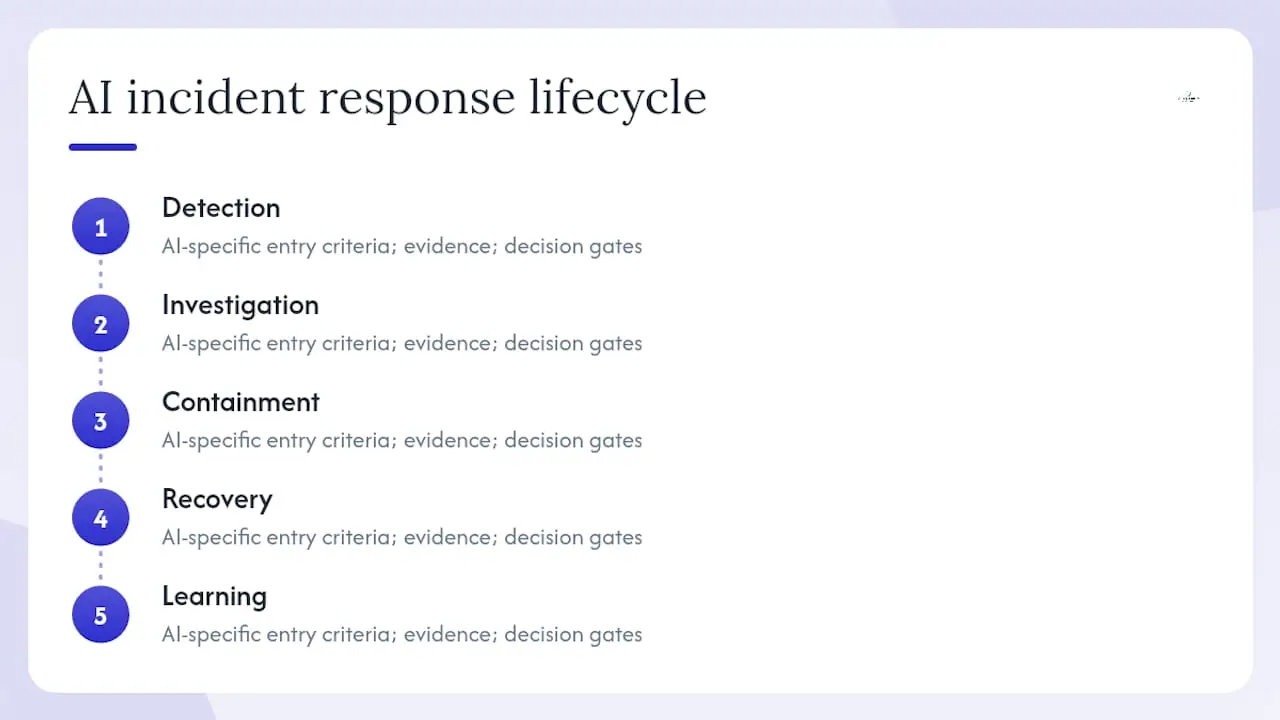
Phase 1: Detect
Objective: Surface anomalous AI behaviour before it causes downstream harm.
Triggers: Spike in user-reported incorrect outputs; classifier confidence drop below threshold; embedding drift alert; unusual prompt volume pattern; agent executing actions outside defined scope.
First actions:
- Validate the signal against baseline metrics (is this drift or noise?).
- Correlate with recent model updates, retrieval index changes or prompt template modifications.
- Assign an initial severity rating using your AI severity matrix (see Section 5).
- Open a tracking ticket and notify the AI incident coordinator.
Evidence to collect: Confidence score time series, prompt volume logs, model version at time of alert, retrieval provenance records.
Decision gate: If confidence drop exceeds threshold or user reports exceed baseline by a defined multiplier, escalate to Phase 2 immediately.
Phase 2: Investigate
Objective: Identify contributing factors across training data, retrieval inputs, model updates and operator actions.
AI investigations rarely yield a single root cause. Treat the investigation as a hypothesis-driven analysis: form a ranked list of contributing factors, collect evidence for each, and update the ranking as evidence accumulates. Microsoft’s guidance frames this explicitly: investigators should expect multiple concurrent contributing factors, not a clean causal chain.
Evidence to collect: Full prompt/response pairs for the affected period, retrieval provenance (which documents were retrieved and from which index version), model weight checksums, operator action logs, any recent fine-tuning or RLHF updates.
Decision gate: Sufficient evidence to support at least one containment hypothesis. Do not wait for definitive root cause before moving to Phase 3.
Phase 3: Contain
Objective: Stop the harm from spreading while preserving evidence.
Prefer reversible actions. Disable the model endpoint rather than deleting weights. Revert to a previous model version rather than retraining. Restrict agent permissions rather than terminating the agent entirely. Each action must be logged with a timestamp and the name of the responder who executed it.

SLA: Containment action within 60 minutes of detection for high-severity incidents.
Phase 4: Recover
Objective: Restore safe, verified operation.
Verify the fix before re-enabling the system. Run a controlled set of adversarial prompts against the restored model to confirm the issue is resolved. Define a watch period (minimum 24 hours for high-severity incidents) during which telemetry is monitored at elevated frequency.
Phase 5: Learn and report
Objective: Update playbooks, detection rules and training scenarios; fulfil reporting obligations.
Every incident produces at minimum: an updated runbook, a new or revised detection rule, and a post-incident review document shared with all stakeholders. For incidents meeting regulatory thresholds, initiate the reporting workflow described in Section 8.
Pro Tip: Run a 30-minute post-incident review within 48 hours while evidence is fresh. A longer formal review can follow, but the immediate debrief captures the operational detail that written logs miss.
What telemetry should you collect from AI systems?
Detection depends entirely on what you instrument. Most organisations discover they have significant gaps only when an incident is already under investigation.
Key metric definitions and suggested thresholds:
- Confidence shift: Alert when mean confidence score drops more than 15% from the 7-day rolling baseline across a 1-hour window.
- Prompt volume spike: Alert when similar prompt patterns (cosine similarity above 0.9) increase by more than 3x the hourly baseline, which may indicate coordinated injection attempts.
- User-report spike: Alert when user-flagged outputs exceed 2x the daily baseline for a given model or feature.
Practitioners should monitor classifier confidence shifts and embedding drift as leading indicators, since these signals often surface before downstream failures become visible in user reports.
Privacy and evidence trade-offs require deliberate policy decisions. Prompt logs may contain personal data under UK GDPR. Your retention policy must balance forensic readiness against data minimisation obligations. A practical approach: log prompt hashes and metadata by default; retain full prompt/response pairs only when an alert is triggered, with access restricted to named investigators and a documented legal basis for retention.
Pro Tip: Use the AWS Well-Architected generative AI lens as a reference architecture for layering telemetry storage: hot storage for recent signals, warm for 30-day retention, cold for long-term forensic preservation. This keeps costs manageable without sacrificing evidence.
Runbooks for the most common AI incident archetypes
The GenAI-IRF study identifies six recurrent incident archetypes and validates role-based playbooks that improved simulated response metrics (high inter-rater reliability and strong usability scores reported in simulated scenarios.) in controlled evaluations. Note that these evaluations were simulated; real-world performance will vary. The archetypes below map to OWASP’s LLM Top-10 and MITRE ATLAS threat techniques.
Prompt injection / jailbreak
Trigger: User-reported policy bypass; confidence spike on restricted output categories; SIEM alert on known injection pattern.
Containment actions (in order):
- Enable content safety filtering at the API gateway layer (e.g. Azure AI Content Safety).
- Block the source IP or user account if the attack is targeted.
- Preserve the full prompt/response pair with timestamp and session ID.
- Notify the product owner and legal team.
- Review prompt template and system prompt for exploitable instructions.
- Deploy a patched system prompt or updated guardrail; validate with adversarial test set before re-enabling.
Evidence: Prompt logs, session metadata, content safety filter logs, model version.
Decision gate: Confirm the patched system prompt passes adversarial verification before restoring full access.
Owner: SOC analyst (initial), AI engineer (remediation).
RAG data leakage
Trigger: User reports receiving content from documents they should not access; retrieval provenance log shows cross-tenant document retrieval.
Containment actions (in order):
- Disable the affected retrieval pipeline immediately.
- Preserve retrieval provenance logs and vector DB state.
- Identify the scope of leaked documents and affected users.
- Notify legal and data protection officer within 1 hour.
- Audit access control configuration on the vector DB and document store.
- Restore retrieval with corrected access controls; validate with a controlled test before re-enabling.
Evidence: Retrieval provenance records, vector DB access logs, document metadata, user session logs.
Decision gate: Legal sign-off on notification obligations before re-enabling the pipeline.
Owner: MLOps lead (technical), DPO (regulatory).
Model / memory poisoning
Trigger: Systematic output bias detected; model behaviour diverges from baseline after a training or fine-tuning update; anomalous patterns in RLHF feedback data.
Containment actions (in order):
- Roll back to the last known-good model version immediately.
- Freeze the training pipeline and preserve all recent training data and feedback logs.
- Verify model weight checksums against the pre-update baseline.
- Isolate the poisoned dataset or feedback batch.
- Notify the AI system owner and security team.
- Conduct a full audit of the training pipeline before resuming any updates.
Evidence: Model weight checksums, training data snapshots, RLHF feedback logs, pipeline access logs.
Decision gate: Independent verification that the rolled-back model passes a full adversarial test suite.
Owner: MLOps lead, AI engineer.
Hallucination / misinformation
Trigger: User reports factually incorrect or fabricated outputs; downstream system acts on incorrect AI-generated data.
Containment actions (in order):
- Add a content disclaimer to affected outputs or disable the feature.
- Preserve the specific prompt/response pairs that triggered the report.
- Identify whether the hallucination is systematic (model-level) or isolated (prompt-level).
- If systematic, escalate to model rollback or retrieval augmentation review.
- Notify affected users or downstream systems if the incorrect output has already been acted upon.
- Update the system prompt or retrieval context to reduce the failure mode.
Evidence: Prompt/response pairs, retrieval provenance, model version, user-report logs.
Decision gate: Confirm the fix reduces hallucination rate on the affected prompt class before re-enabling.
Owner: Product owner (user notification), AI engineer (technical fix).
Agent runaway
Trigger: Agent executes actions outside its defined scope; unexpected API calls, file writes or external communications detected; resource consumption spike.
Containment actions (in order):
- Revoke agent API keys and permissions immediately.
- Terminate the agent process or sandbox it from external systems.
- Preserve all tool execution logs and agent action traces.
- Identify the trigger that caused the out-of-scope behaviour.
- Review agent goal specification, tool permissions and kill-switch configuration.
- Restore agent with restricted permissions and a validated goal specification; monitor at elevated frequency for 24 hours.
Evidence: Tool execution logs, API call logs, agent action traces, goal specification version.
Decision gate: Confirm the restored agent operates within defined scope across a controlled test scenario before returning to production.
Owner: SRE (containment), AI engineer (root cause), product owner (scope validation).
Pro Tip: Before escalating a hypothesis to human responders, use an adversarial verification step: re-run the suspected prompt with controlled variations or against an alternative model. This filters hallucinated root causes and prevents responders from chasing false leads during high-pressure triage.
How do you embed AI incident response into existing teams?
The answer is not a new team. It is new responsibilities distributed across existing roles, with clear ownership and a shared escalation path.
| Role | Detect | Investigate | Contain | Recover | Learn/Report |
|---|---|---|---|---|---|
| SOC analyst | Primary | Support | Execute | Monitor | Contribute |
| AI / ML engineer | Support | Primary | Support | Primary | Primary |
| MLOps engineer | Support | Primary | Execute | Primary | Contribute |
| SRE | Support | Support | Execute | Primary | Contribute |
| Product owner | Inform | Inform | Approve (user comms) | Approve | Approve |
| Legal / DPO | Inform | Inform | Approve (data) | Approve | Primary (regulatory) |
| Comms | Inform | Inform | Approve (external) | Approve | Support |
Escalation checklist:
- Severity 1 (active harm, data breach, agent runaway): notify AI incident coordinator, SOC lead, legal and product owner within 15 minutes.
- Severity 2 (systematic degradation, policy bypass): notify AI incident coordinator and MLOps lead within 30 minutes.
- Severity 3 (isolated anomaly, low user impact): assign to AI engineer for investigation within 2 hours.
Embedding AI governance into team charters is where most organisations fall short. Agentic software development introduces a specific risk that Cleverbit describes as vibe code drift: the gradual erosion of engineering standards when AI-generated code is accepted without the same review rigour applied to human-written code. The same principle applies to AI incident response governance. Without explicit charter language, the MLOps team assumes the SOC owns AI incidents; the SOC assumes MLOps owns them. Neither acts fast enough.
Practical steps to prevent this:
- Add AI incident responsibilities to existing role descriptions for SOC analysts, MLOps engineers and SREs.
- Define AI-specific on-call rotations and escalation paths in your incident management platform.
- Run a tabletop exercise covering at least two AI incident archetypes every six months. Include legal and comms in at least one exercise per year.
- Review team structures for agentic AI delivery to understand how ownership models shift as AI moves deeper into the SDLC.
Pro Tip: Tabletop exercises for AI incidents should include a “no telemetry available” scenario, forcing responders to practise decision-making under evidence scarcity. This is the most common real-world condition, and the one teams are least prepared for.
Standards, reporting and UK regulatory considerations
Relevant frameworks at a glance:
- CoSAI: Practical recommendations for embedding AI IR into existing frameworks and capturing AI-specific telemetry. Start here for operational guidance.
- NIST SP 800-61r2: The canonical IR lifecycle. Every AI playbook should map back to its phases and artefact requirements.
- NIST AI Risk Management Framework (AI RMF): Governance and risk management for AI systems across their lifecycle; complements SP 800-61r2 for AI-specific risk categorisation.
- ETSI AICIE (TS 104158-01): Defines a structured, interoperable record format for AI incident information, enabling sharing across reporting communities and regulators. Adopt this format for any incident you share externally.
- MITRE ATLAS: Threat-centric taxonomy of adversary techniques against AI systems. Use it to classify incident indicators and populate detection rules.
- OWASP LLM Top-10: Application-level risk taxonomy covering prompt injection, data leakage and related threats that map directly to the archetypes in Section 6.
UK-specific reporting considerations:
The UK NCSC (National Cyber Security Centre) is the primary point of contact for significant cyber incidents affecting UK organisations, including those involving AI systems. For incidents that constitute a personal data breach, notify the ICO within 72 hours under UK GDPR. Where an AI incident involves a critical national infrastructure operator or a regulated financial services firm, sector-specific reporting obligations (FCA, PRA) apply in parallel.
The EU AI Act’s serious incident reporting provisions (immediate notification followed by a detailed report within 15 days for high-risk AI systems) do not directly apply to UK-domiciled organisations post-Brexit, but UK organisations deploying AI systems into EU markets remain subject to those obligations for those deployments. Legal advice is required to determine the precise scope; this is general information, not legal guidance.
Notification checklist (serious AI incident):
- Immediate: notify AI incident coordinator, legal/DPO, and executive sponsor.
- Within 15 minutes: open formal incident record using ETSI AICIE format fields.
- Within 72 hours: assess ICO notification obligation (personal data breach threshold).
- Within 72 hours: consider voluntary NCSC notification for significant incidents.
- Within 5 business days: notify affected customers or downstream system operators as required by contract.
- Ongoing: preserve all evidence and communications for potential regulatory review.
Which tools support AI incident detection and investigation?
No single tool covers the full AI incident response workflow. The practical approach is to extend your existing SIEM/SOAR stack with AI-specific telemetry sources and observability tooling.
Tool categories and their roles:
- SIEM/SOAR platforms (Splunk, Microsoft Sentinel, IBM QRadar): ingest AI telemetry alongside traditional security events; automate initial triage and ticket creation; trigger AI-specific runbooks. The key integration task is defining custom data sources for prompt logs and confidence metrics.
- MLOps observability platforms (MLflow, Weights & Biases, Evidently AI): monitor model performance metrics, confidence distributions and data drift in production. These are your primary early-warning systems for silent degradation.
- Model provenance and integrity tools: track model version lineage, weight checksums and training pipeline changes. Essential for investigating model poisoning incidents.
- Vector DB monitoring: log retrieval queries, document access patterns and index changes for RAG pipelines. Without this, RAG data leakage incidents are nearly impossible to investigate.
- Content safety services: Azure AI Content Safety provides real-time content filtering and classification that can serve as both a detection signal and a containment control during prompt injection incidents.
- Forensic network capture: tools like Corelight provide network-level telemetry that captures AI API traffic, enabling investigators to reconstruct the sequence of events even when application-layer logs are incomplete.
Instrumenting agentic systems safely requires specific controls that most observability platforms do not provide out of the box. Every agentic system should have: a defined permission boundary (least-privilege API keys), a kill switch that can be triggered remotely within seconds, a sandbox environment for post-incident forensic replay, and an action log that records every tool call with its inputs, outputs and timestamp. Guidance on implementing these AI code guardrails during development prevents the need to retrofit them after an incident.
Pro Tip: When capturing AI evidence into an existing incident ticket, attach the prompt log, confidence score time series and retrieval provenance as separate artefacts with cryptographic hashes. This preserves chain of custody and makes the evidence admissible if regulatory review follows.
The Cleverbit perspective on AI-aware incident response
The teams we work with consistently underestimate one thing: how much of their AI incident risk is created during development, not during operation. By the time a model is in production, the decisions that determine how detectable, containable and recoverable an incident will be have already been made. Or not made.
Cleverbit’s approach starts with discovery: mapping every AI component in the delivery pipeline, identifying what telemetry exists, what does not, and where agentic systems have permissions that exceed their actual requirements. From that inventory, we build a pilot playbook covering the two or three archetypes most relevant to the client’s specific stack, instrument the telemetry gaps, and embed the RACI into the existing delivery team’s working practices before the first production deployment.
The vibe code drift problem is real and underappreciated. When agentic tools generate code that is accepted without the same review gates applied to human-written code, engineering standards erode gradually and invisibly. The same drift happens in AI incident response when AI-generated hypotheses are accepted without adversarial verification. Cleverbit’s AI-integrated delivery model builds review gates into the workflow regardless of whether the output came from a developer or an agent, and the same discipline applies to incident investigation.
Our teams operate as extensions of client SRE and engineering functions. That means tabletop exercises run on the client’s actual stack, runbooks that live in the client’s existing IR platform, and detection rules tuned to the client’s specific model behaviour rather than generic thresholds. The AI across the engineering SDLC case study illustrates how this integration works in practice across the full delivery lifecycle.
The organisations that handle AI incidents well are not the ones with the most sophisticated tooling. They are the ones that made deliberate decisions about governance, telemetry and ownership before the incident happened. That preparation is an engineering discipline, and it is one most teams defer until after their first serious incident.
If you want to assess where your team stands before that moment arrives, the AI engineering maturity scorecard is a practical starting point.
Sources
The sources below are the primary references for implementing the guidance in this article. Each is directly relevant to UK security and engineering teams building or improving AI incident response capability.
- Defending AI Systems: A New Framework for Incident Response in the Age of Intelligent Technology
- Incident response for AI systems