
AGENTIC SDLC
THE CLEVERBIT WAY
THE CLEVERBIT WAY
Governed from requirement to release
Our method has two parts. Neither one works without the other
The path
Where work moves
The flows and order work moves in, based on risk, impact and controls, with checks to make sure that items are in the right path.
The checking
What stops bad output
Everything that stands between an agent's output and your customers.
Two ways agentic development fails without a system
1. Ungoverned speed.
Code ships fast, but nobody can explain why it exists or trace it to a decision. Security finds out after it’s live.
2. Governance bolted on afterward.
More manual reviews layered on AI output. They get skipped under pressure, or slow you back to pre-AI speed.
Four convictions behind the system
A review after the fact is already too late. The system should catch the mistake before a person ever looks.
You should never end up stuck with us. If you can understand, challenge and run the system yourself, it's doing its job.
Speed you can't explain isn't speed. If it can't be audited or traced to a decision, it's risk with a head start.
AI is probabilistic, so we treat it that way. It's fast, capable and sometimes wrong, which is why the system around it matters.
THE PATH
Structure before code
1. Requirement
→
2. Specification
HUMAN SIGN-OFF
→
HUMAN SIGN-OFF ↓
3. Generation
→
THE CHECKING
Enforcement while it happens, not after
Every AI change is scanned, validated and tied to a decision as it’s produced. Reviewers get a digest of what happened and why, not raw output to reverse-engineer.
A human owns the call
AI can generate, but only a named person can decide something ships. No autonomous shipping path.


Risk-based control
Not every change carries the same risk. Each piece of work gets a risk level before it starts. The level decides how deep the checking goes.
- Throwaway. Experiments that never reach customers. Light checks only.
- Low risk. Small, easily reversible changes. Plan sign-off and one review
- Standard. Everyday feature work. Full plan sign-off and a dedicated code review
- High risk. Anything touching money, access or regulated data. Most reviewers, most testing, closest watch after release
Not locked to one model
How engagement works
STEP 1
Workshop
Three sessions with our engineering leadership. You leave with:
- A clear view of what your delivery performance could be
- The cost of standing still
- A plan, with budgets, that covers risks and mitigations
- A board-ready presentation, delivered with you
→
STEP 2
Pilot
We deliver the slice of the plan that moves your metric fastest. You leave with:
- A working agentic setup running in your environment
- At least one feature delivered through it
- Before-and-after numbers against your baseline
- A team of your engineers who’ve seen it work first-hand
→
STEP 3
Scale
Once the pilot proves the gain, We embed with your teams, one at a time. You leave with:
- Agentic delivery rolled out one team at a time
- Enforcement and sign-off points in every pipeline
- Shared metrics across teams
- Engineers coached to run it themselves
Six things we setup for your team
1. Stories
Who writes them, how much lives in people’s heads and what a wrong requirement costs
2. Agents
Which are approved, what they can reach and what evidence a run leaves behind
3. Pipeline
What runs on every merge and what it actually catches
4. Codebase
Whether an agent can build, test and find its way around it safely
5. People.
Who holds each role, and whether the busiest people have the time
6. Risk
The worst case, how fast you’d know and where our responsibility stops
More from the team that built this method
FREE DOWNLOAD
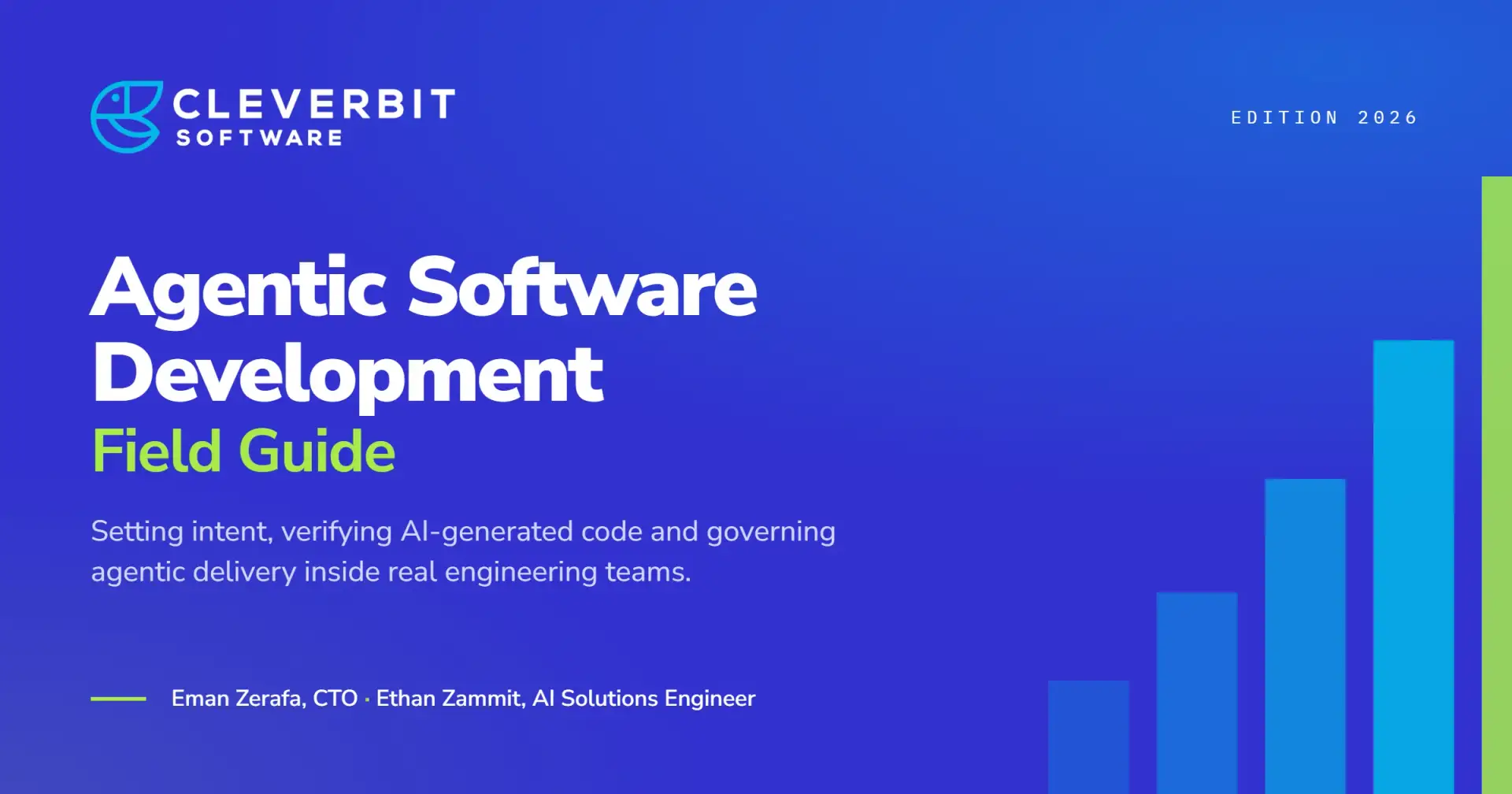
The Agentic Software Development Guide
WEBINAR