
AI in DevOps now reliably speeds incident triage, summarises logs, cuts alert noise, and accelerates infrastructure-as-code and pipeline authoring. It is a force multiplier, not a replacement, and it only pays off when paired with verification and governance. What follows covers the concrete use cases, the implementation patterns, the guardrails, and the practical next steps.
Where AI actually reduces engineering toil today
Most of the value from AI in DevOps shows up in the unglamorous middle of the incident lifecycle, not in headline-grabbing automation. Engineers spend disproportionate time correlating noise, not writing code, and that is precisely where large language models earn their keep.
Incident triage and alert correlation benefit most obviously. Instead of an on-call engineer scanning twenty disconnected alerts at 3am, an AI layer groups correlated signals, ranks them by likely business impact, and suggests a starting remediation path based on similar past incidents. This does not replace judgement. It replaces the first twenty minutes of manual pattern matching.
Log summarisation works similarly. Feeding raw log streams into a model that surfaces likely root-cause candidates cuts mean time to resolution because engineers start their investigation with a hypothesis rather than a blank terminal.
Runbook and playbook generation is where things get genuinely interesting. Rather than static wiki pages that rot within a quarter, AI-generated runbooks live in the repository alongside the code they describe, get reviewed in pull requests like any other change, and can become executable rather than purely instructional.
Infrastructure-as-code and pipeline assistance rounds out the practical toolkit. Generating Terraform modules, Kubernetes manifests, or CI/CD pipeline YAML from a plain-language description saves real time. The catch, and it is not a small one, is that generated infrastructure code must pass through the same validation pipeline as anything a human writes.
The common thread across these use cases:
- AI drafts, humans and automated checks decide
- Outputs land in version control, not in a chat window that nobody can audit later
- Every generated artefact, from a Terraform snippet to a remediation suggestion, gets treated as a proposal rather than a fact
- Speed gains compound only when the validation step is fast enough not to become the new bottleneck
Get that last point wrong and you have simply moved the toil from writing code to reviewing AI output, which is not the win it looks like on a slide.
How do agentic workflows differ from copilots?
A copilot suggests. An agent acts. That distinction determines how much governance you need, and conflating the two is where a lot of AI-in-DevOps strategy goes wrong.
A code-completion assistant proposes a line, a developer accepts or rejects it, and the blast radius is contained to a single edit. An agentic workflow is different in kind: it plans a sequence of steps, calls tools, and executes changes, sometimes across several systems, with no human reading every intermediate action. Agentic capability is most effective when it is woven directly into the DevOps lifecycle, spanning planning, code, test and deployment stages, rather than bolted on as a standalone chatbot that has no context on your actual repository structure, as Microsoft’s guidance on agentic DevOps sets out.
The practical fix is sequential tool execution. An agent performs one tool call, an automated check validates the result, and only then does the agent proceed to the next step. Research into LLM-driven DevOps workflows backs this pattern specifically because it prevents the kind of cascading failure you get when an agent runs five commands in a row on a false assumption made at step one, as the LADs framework for AI-driven DevOps demonstrates.
A practical rollout sequence looks like this:
- Deploy assisted suggestions first (copilots) for two to three weeks to learn where the model gets things plausibly wrong.
- Introduce retrieval-augmented generation so the model’s context stays grounded in your actual repository, ticket history and architecture docs, not its general training data.
- Wire prompt flows into CI so every change to a prompt or agent configuration triggers an automated evaluation run before it reaches production, a pattern Azure Machine Learning’s LLMOps documentation describes in detail.
- Only then move to guarded agentic execution, with approval gates on anything touching production infrastructure.
On the toolchain itself: sensitive codebases usually call for a private or self-hosted LLM rather than a public API, local agents work well for Kubernetes and Docker operations where latency and data residency matter, and CI hooks should run the same automated checks against AI-generated changes that they run against human ones.
Pro Tip: Build your feedback loop before you build your agent. Capture every failure mode the model produces during the copilot phase and feed it back into your validation checks. That failure log becomes your governance specification.
What guardrails actually stop AI-driven drift?
Vibe coding without controls is the fastest way to accumulate technical debt you cannot see. AI-generated code that merges without the same scrutiny as human-authored code does not fail loudly. It fails quietly, three sprints later, when nobody remembers which change introduced the fragile assumption. Treating AI output with the same scrutiny as human-authored code, backed by deterministic checks before anything reaches production, is the single most consistent piece of practitioner guidance available, and it comes directly from engineers who work with AI-augmented DevOps day to day.
The controls that work in practice:
- Structured output enforcement. Require schema validation (Zod, JSON schema, or equivalent) on anything an agent generates, so malformed or partially hallucinated output fails a deterministic check before a human ever sees it.
- Sandboxed, atomic writes. Agents operate in an isolated environment and commit changes as atomic, reversible operations, never direct writes to a shared branch.
- Approval gates scaled to blast radius. A documentation update needs a light touch. A change to production networking or IAM policy needs an explicit human sign-off, every time.
- Immutable audit logs. Every action an agent takes, every tool call and every output, gets logged in a way nobody can quietly edit after the fact.
- Policy-as-code and automated scanning. Tools such as Trivy, Checkov, Semgrep and hadolint run against AI-generated infrastructure and container definitions exactly as they would against a human pull request.
Fragmenting AI use across teams without shared standards is where the operational and compliance risk actually concentrates, not in any single agent’s output. A study on LLM-driven recommendation systems for DevOps found that grounding recommendations in evidence rather than raw keyword matching materially improved precision and expert-rated relevance, a reminder that governance and quality are not opposing forces. They come from the same underlying discipline: context, validation, and traceability.
The governance question worth asking before any pilot: can you point to an audit log and show exactly what an agent did, when, and who approved it? If not, you have not built AI governance. You have built a faster way to lose track of your own system.
How should teams pilot AI in DevOps without adding risk?
Start small, measure honestly, and expand only when the evidence supports it. The teams that get this right treat every pilot as a hypothesis test, not a rollout.
The skills worth building first are less about prompt syntax and more about judgement: knowing when an AI-generated remediation step is plausible but wrong is the scarce, high-value skill here, more so than fluency with any particular model, as practitioner guidance on AI skills for DevOps engineers makes clear. Pair that with CI integration literacy and a working sense of how failure modes actually present in your specific stack.
A pilot worth running looks like this:
- Pick a low-blast-radius task. Log summarisation or PR description generation, not production deployment automation.
- Write down a hypothesis and success metric before you start, not after you see promising output.
- Add CI checks specific to the AI-generated artefact, on top of whatever checks already exist.
- Define a rollback plan in writing before the pilot goes live, not as an afterthought.
A sensible progression runs from automated linting, to AI-assisted PR summarisation, to automated remediation suggestions a human still approves, to guarded agentic flows with approval gates. Each stage should show up in your metrics: time saved per task, MTTR improvement, false positive and false negative rates on AI suggestions, and the count of governance incidents, meaning any case where an AI action bypassed an intended control. Pilots that track deployment frequency and false positive rate alongside MTTR give teams the evidence base needed to justify scaling agentic AI beyond the pilot stage.
What integration challenges should you expect?
Most AI tooling arrives as a bolt-on, and most DevOps ecosystems were not built with a bolt-on in mind. That mismatch is the actual source of integration pain, more so than any limitation in the models themselves.
The first friction point is context. An agent that cannot see your actual repository structure, your ticket history, or your architecture decisions produces generic, occasionally confident, occasionally wrong output. Retrieval-augmented generation solves part of this, but only if someone maintains the knowledge base it draws from, which is an ongoing operational cost most teams underestimate at pilot stage.
The second is tooling sprawl. A platform team that adopts three separate AI tools for code review, incident response, and pipeline generation, each with its own logging format and approval model, ends up with three governance problems instead of one coherent one. Standardising on a shared audit format and a shared approval gate model across tools, rather than accepting whatever each vendor ships by default, saves considerable pain six months in.
The third is legacy pipeline compatibility. Older CI/CD systems built around imperative scripts rather than declarative pipelines make it harder to insert automated validation steps cleanly. Teams running on modern, declarative pipeline tooling generally integrate AI-generated artefacts with far less friction than teams on older, heavily customised systems.
The practical takeaway: budget integration time for the surrounding plumbing, not just the model. Most delays come from context pipelines, logging consistency, and legacy tooling, not from the AI itself.
How does AI change DevOps roles and required skills?
The DevOps engineer who only writes YAML and manages pipelines by hand is a shrinking role. The DevOps engineer who can validate, question, and govern AI-generated output is becoming the more valuable one.
This is not a story about headcount reduction, at least not primarily. It is a story about where time goes. Tasks that used to consume hours, writing a first-draft Terraform module, drafting an incident postmortem, correlating alerts across five dashboards, now take minutes. The hours that free up shift toward review, architecture decisions, and building the validation infrastructure that makes AI output trustworthy in the first place.
That shift demands a new skill blend. Engineers need enough understanding of how language models fail, hallucinated dependencies, plausible-sounding but incorrect remediation steps, confidently wrong root-cause analysis, to build checks that catch those failures before they reach production. That is closer to a quality-engineering mindset than a classic infrastructure-scripting one.
Platform and SRE teams increasingly need someone who owns AI governance the way they already own security policy: defining what agents can touch, what needs a human sign-off, and how audit trails get reviewed. That is a role that barely existed three years ago and is now a genuine hiring gap at scaling technology companies.
None of this makes deep infrastructure knowledge less valuable. It makes it more valuable, because judging whether an AI-generated Kubernetes manifest is actually sound requires the same expertise it always did. AI removes the typing. It does not remove the need to know what correct looks like.
What data and preparation does AI-driven DevOps need?
An AI system is only as useful as the context it can see, and most organisations underestimate how much preparation that context requires before a pilot produces trustworthy output.
Clean, structured logs matter more than volume. A log summarisation model fed inconsistent formats, missing timestamps, or unlabelled severity levels produces summaries that sound authoritative and are quietly unreliable. Standardising log schemas across services before introducing AI summarisation is unglamorous work, but it is the difference between a pilot that shows genuine time savings and one that erodes trust in the first week.
Historical incident data needs the same attention. If your incident retrospectives live in scattered documents with inconsistent tagging, a model cannot learn meaningful correlation patterns from them. Structured, consistently tagged incident records, ideally version-controlled alongside the runbooks they inform, give retrieval-augmented systems something genuinely useful to draw on.
Repository context is the third pillar. Agents assisting with code or infrastructure generation need visibility into existing architecture decisions, naming conventions, and dependency structures, not just the file being edited. Without that, generated code technically works while quietly ignoring established patterns, which is exactly the kind of drift that compounds into technical debt nobody notices until a migration goes wrong.
The preparation work is rarely a data science exercise. It is closer to information architecture, deciding what the model needs to see, structuring it consistently, and keeping it current as your systems evolve.

What ethical risks does AI in DevOps carry?
Bias in DevOps tooling sounds like an odd concern until you consider what these systems actually decide: which alerts get priority, which incidents get flagged as high severity, which code changes get flagged for extra review. Those are judgement calls, and a model trained on historical data inherits whatever patterns, including flawed ones, that data contains.
A model trained predominantly on incidents from one type of system, one region’s traffic patterns, or one team’s historical tagging conventions will systematically under-prioritise incidents that do not match that pattern. In a global engineering organisation, that can mean a regional outage getting deprioritised because the training data skewed toward a different market’s incident profile. The fix is not exotic: audit what the training or context data actually represents, and treat any AI-driven prioritisation decision as reviewable, not final.
Transparency is the second ethical pressure point. When an agent recommends a remediation step or flags a change as low risk, engineers need to know why, not just what. A recommendation with no visible reasoning trail is a recommendation nobody can meaningfully challenge, and that erodes the judgement-based review process that governance depends on.
There is also a quieter risk: over-reliance. Teams that stop questioning AI-generated remediation suggestions because they have been right often enough are the teams most exposed when the model is confidently wrong on something consequential. Building in deliberate friction, a mandatory second look on anything touching production, costs a little speed and buys a great deal of resilience.
What comes next for AI and DevOps?
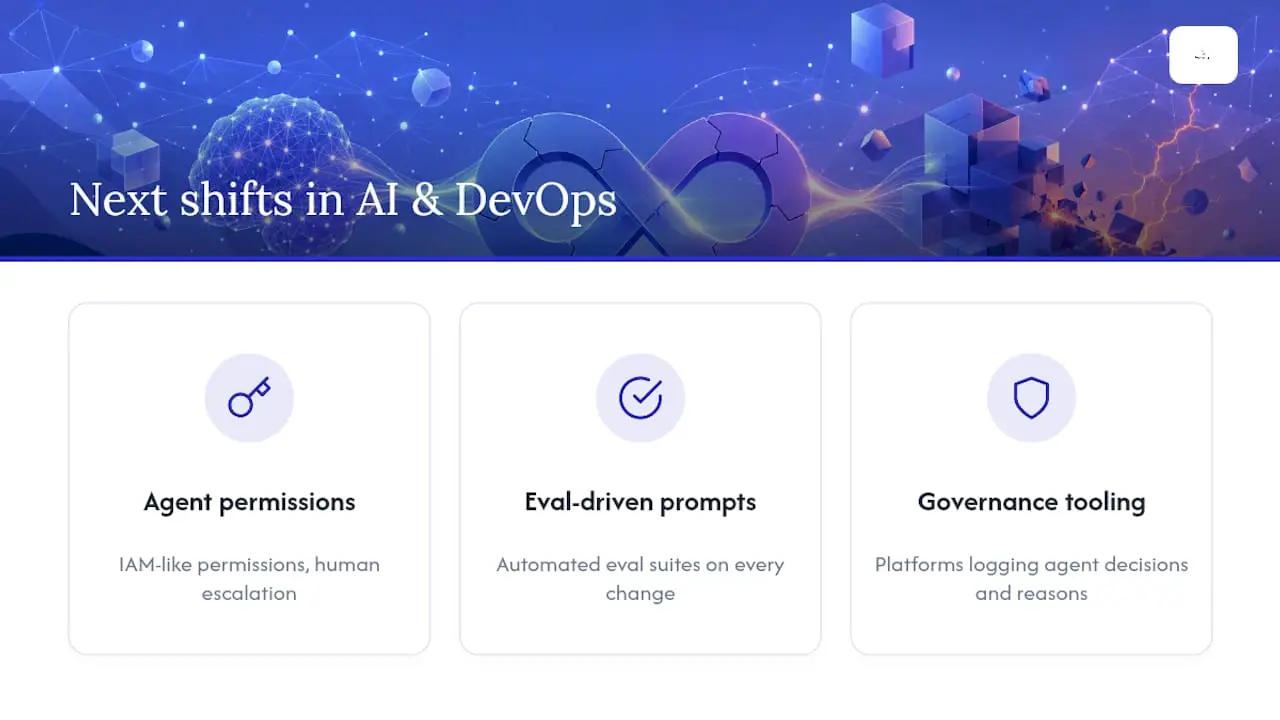
The near-term trajectory is less about smarter models and more about tighter integration and better verification. Expect three shifts to matter most over the next couple of years.
Agentic workflows will get more granular permission models, closer to how cloud IAM policies work today, letting teams grant an agent write access to staging but only read access to production, with automatic escalation to a human for anything outside that boundary. That is a natural extension of the sequential-execution pattern already proving out in research on AI-driven DevOps workflows, and it addresses the biggest current gap: permission models built for humans, retrofitted awkwardly onto agents.
Evaluation-driven prompt engineering will become standard practice rather than an advanced technique. Just as unit tests became non-negotiable for code, automated evaluation suites for prompts and agent behaviour, run on every change, will become the expected baseline rather than something only sophisticated teams bother with.
Expect governance tooling itself to mature into a distinct category. Right now, most teams stitch together logging, approval workflows and policy enforcement from general-purpose tools not built for AI-specific risks. Purpose-built AI governance platforms, tracking not just what changed but what an agent decided and why, will likely become as standard as observability platforms are today.
The organisations that benefit most will not be the ones chasing the newest model release. They will be the ones that already built the verification habits and audit infrastructure to absorb whatever comes next without re-architecting their governance from scratch.
Cleverbit perspective: governance as the design starting point
Most organisations treat AI governance as something to retrofit once an agent has already caused a problem. We think that gets the sequence backwards, and it is the single most consistent failure pattern we see across engineering teams adopting agentic AI.
Our approach starts with embedded teams that carry governance into the pipeline from day one, not as a compliance afterthought. We run pilots against a defined maturity scorecard, measuring the same things this article recommends: time saved, MTTR movement, and governance incidents, before recommending any scaling decision. That evidence base is what lets engineering leaders scale from a position of proof rather than optimism.
Preventing vibe code drift is not a one-off audit. It is a structural property of how a team works, built through review gates that apply identically whether a developer or an agent wrote the change. If you are weighing where to start, the right first move is designing a pilot with a clear hypothesis, a defined blast radius, and gates you can point to afterwards. That is a scoping conversation worth having before you commit to a tool.
Ready to pilot agentic AI with governance built in?
Plenty of vendors will sell you a faster agent. Fewer will sell you the review gates, audit trails, and pilot discipline that keep that speed from becoming next year’s incident. Cleverbit designs and manages embedded engineering teams that run agentic AI inside your existing standards from the outset, so the productivity gains show up without a parallel spike in undiscovered risk.
We suit engineering leaders who want measurable evidence before scaling, not a leap of faith: a defined pilot, a maturity scorecard, and audit trails that hold up under compliance scrutiny. If you have read this far, you already understand why “fast” and “controlled” need to be designed together rather than chosen between.
The practical next step is to design a governed pilot scoped to a single low-blast-radius workflow, with success metrics agreed before day one, and a clear path to scale once the evidence is in.
Sources
- Agentic DevOps | Microsoft Azure
- Why Every DevOps Engineer Should Learn AI — KodeKloud
- LADs: Leveraging LLMs for AI-Driven DevOps (arXiv)
- Integrate with LLM app devops — Azure Machine Learning docs