
A practical, copy-and-adapt AI policy template exists, and the strongest versions cover five things without exception: approved tools and how they get approved, data rules for what never touches a public model, human oversight mapped to risk, vendor checks, and an incident response path. This article gives you that structure, along with the operational guardrails needed to stop agentic AI from quietly rewriting your engineering standards from the inside.
What are the key components of an AI usage policy?
An AI usage policy that actually holds up under scrutiny is built from a small number of load-bearing sections. Miss one, and the policy either fails to protect the organisation or fails to get used at all, because nobody can tell what it actually requires of them day to day.
Start with purpose and scope. Name who owns the policy (usually a joint IT/compliance/HR sponsor), which teams and tools it covers, and who is exempt, if anyone. Vague ownership is the single biggest reason AI policies gather dust: no one enforces a document nobody is accountable for.
Next comes the approved-tools list and the process for adding to it. Employees should never have to guess whether a tool is sanctioned. A short register, refreshed on a fixed cadence, with a named route for requesting new additions, removes the ambiguity that pushes staff toward shadow AI use.
Permitted and prohibited uses need concrete examples, not abstractions. “Drafting a first pass of a client email” is permitted; “pasting a client contract into a public chatbot to summarise it” is not. Specificity is what makes a policy enforceable rather than aspirational.
The data-handling rules deserve their own weight. Treat anything typed into a public AI tool as potentially retained by the vendor, and restrict entry of personal, confidential, or proprietary data accordingly, a principle borne out by practitioner guidance on AI policy templates. Pair this with human oversight requirements tied to risk tier, so a low-stakes drafting task gets a light touch while a decision affecting a customer’s finances or employment gets a mandatory human sign-off.
Round out the core policy with:
- Vendor and security checks, including data-processing agreements, SOC 2 or ISO 27001 evidence, and clarity on how a vendor trains its models
- Training requirements before staff get tool access, not after
- Version control and a review cadence, so the policy ages with the technology rather than against it
Data-protection obligations sit underneath all of this. Where AI processing touches personal data at scale, a Data Protection Impact Assessment is not optional, per UK data-protection guidance.
How do you structure an editable AI policy template?
A workable template runs twelve numbered sections. Keep the core document to eight or twelve pages; anything longer belongs in an annex, not the main text, because a policy nobody reads is functionally the same as no policy at all.
- Purpose and scope — “This policy governs the use of artificial intelligence tools by [organisation name] employees, contractors, and embedded teams across [departments/functions].”
- Definitions — define AI tool, generative AI, agentic AI, and personal/confidential data as your organisation uses those terms.
- Policy ownership — name the accountable owner and the review committee.
- Approved tools register — reference the annex; list the approval request process in the body.
- Permitted uses — “Employees may use approved tools for drafting, summarising, and research where no confidential or personal data is entered.”
- Prohibited uses — “Employees must not enter client data, source code, or unreleased financial information into any non-approved tool.”
- Data-handling rules — “Any input to a public AI tool is treated as potentially retained by the vendor unless a signed enterprise agreement states otherwise.”
- Human oversight — “Outputs used in [customer-facing / financial / HR] decisions require review and sign-off by a named human before use.”
- Vendor and security requirements — “Third-party AI tools require a signed DPA and evidence of SOC 2 or ISO 27001 certification before approval.”
- Incident reporting — “Suspected data exposure or AI-generated error must be reported to [owner] within [timeframe].”
- Training and awareness — “Access is granted only after completion of the mandatory AI usage briefing.”
- Review cadence — “This policy is reviewed every [six/twelve] months or on material change to approved tools.”
Fill each bracket with your specifics, then route the draft to legal before publishing. Keep the approved-tools register, the data-classification matrix, and any risk-tier definitions as living annexes, updated independently of the core document, so a tool addition doesn’t force a full policy reissue and a fresh signature round.
How do you adapt the template for your organisation’s size and sector?
A ten-person startup and a regulated bank should never run the same policy at the same length, and treating them identically is how templates fail in practice.
Start by mapping scope to business units. Decide explicitly who is covered, whether embedded contractor teams fall inside or outside the policy, and who owns tool approvals for each function, engineering, marketing, HR, finance, so that ownership doesn’t default to whoever wrote the document.
Regulated sectors need more, not less. Financial services and healthcare organisations should expand the core policy with sector-specific annexes covering audit trails, explainability requirements, and heightened human oversight for any AI output touching a regulated decision. The UK government’s approach to AI regulation is explicitly risk-based rather than one-size-fits-all, and your policy should mirror that logic rather than apply a blanket rule to every use case.
Before publishing anything, confirm local data-protection and AI-specific law applies as you’ve assumed. Rules diverge sharply by jurisdiction, and a policy written for one market can misstate obligations in another.
Recommended annexes worth building alongside the core policy:
- An approved-tools register with owner, approval date, and renewal cycle
- A model inventory tracking which AI systems touch which business process
- A data-classification matrix defining what counts as confidential, personal, or public
- Risk-tier definitions that map directly to the human-oversight rules in section 8
Operationalising the policy: a checklist for agentic AI and SDLC guardrails
A policy that lives in a PDF and never touches your delivery pipeline is a policy in name only. The organisations getting real value from agentic AI are the ones that turn each clause into a gate an engineer actually encounters, not an abstract rulebook they’re told to remember.
Build a pre-deployment gate for anything AI touches before it ships: risk classification, a model card where relevant, bias and safety testing, and a compliance sign-off logged against the change. This is where NIST’s AI Risk Management Framework earns its place, giving you a lifecycle structure to map these checks against rather than inventing one from scratch.
Define human oversight per risk tier, explicitly, in the policy itself:
- Human-in-the-loop for high-risk changes, where nothing ships without a named reviewer’s sign-off
- Human-on-the-loop for medium-risk work, where a human monitors and can intervene but doesn’t gate every action
- Human-in-command for low-risk, reversible tasks, where the human retains override authority but doesn’t review each output
Engineering controls matter as much as the paper policy. Commit-level review gates that apply identically to AI-generated and human-written code, CI test coverage thresholds that don’t relax for AI contributions, and deterministic reproducibility checks all guard against the slow accumulation of unreviewed changes that we’d call vibe code drift, code that technically works today but has quietly diverged from your architectural standards because no one gate caught it. Our own guidance on AI code guardrails goes deeper on how these gates work in practice.
For agentic AI specifically, scope-limited agents, full activity logs, ongoing monitoring, and explainability artefacts for every consequential decision are non-negotiable, not nice-to-haves. Vendor procurement should require a signed DPA, transparency on training-data use, current SOC 2 or ISO 27001 evidence, and a right-to-audit clause, expectations consistent with how AWS frames responsible AI use for its own customers.
Pro Tip: Run the policy as a pilot before it becomes law across your engineering organisation. Pick one team, apply the gates for four to six weeks, and measure defect escape rate and review turnaround time before scaling the controls company-wide.
How does Cleverbit turn AI policy into governed delivery?
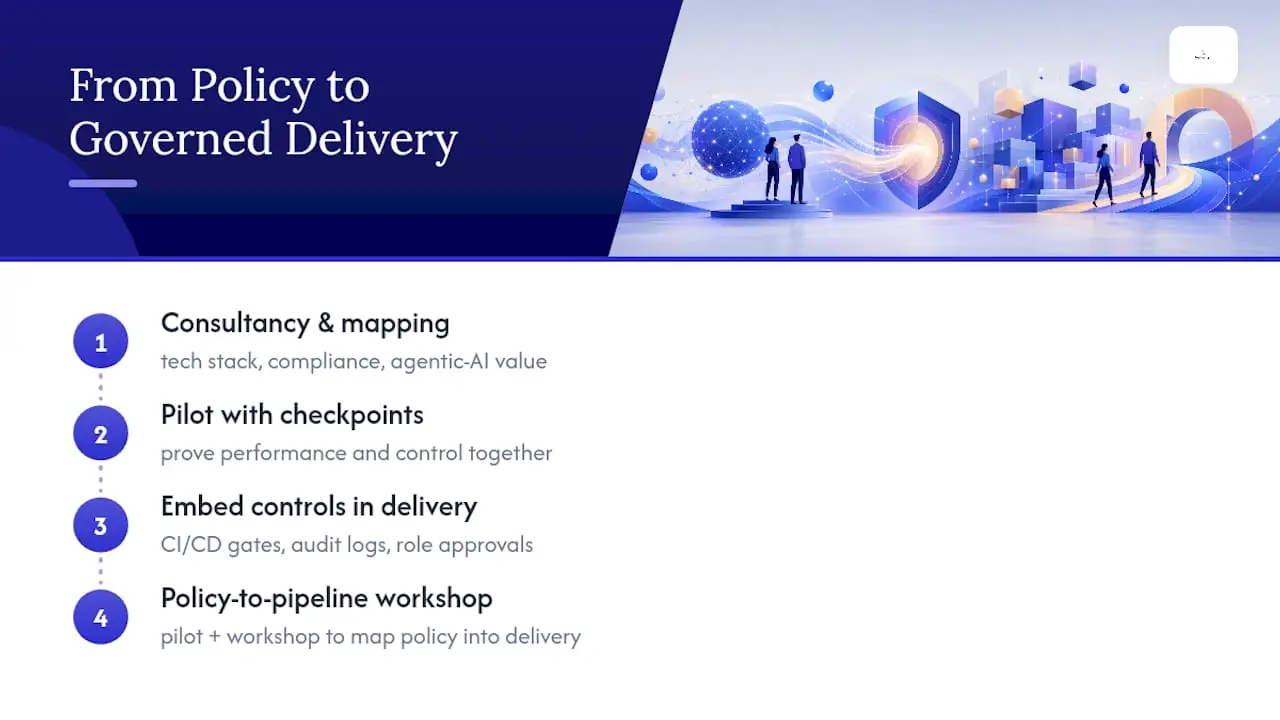
Our engagements start with consultancy, mapping your technical stack, your compliance obligations, and where agentic AI creates real value in your specific pipeline before any controls are written down. We run pilots with governance checkpoints built in from day one, so performance and control get proven together rather than one being bolted onto the other afterwards.
This includes review gates embedded directly in CI/CD, audit logs that capture what an agent did and why, and role-based approvals that apply the same way regardless of whether a developer or an agent wrote the change. If you want help mapping your policy into your actual delivery pipeline, we run a pilot and workshop model built exactly for that.
Turn your AI policy into a governed delivery pipeline
A template gets you a document. It doesn’t get you review gates that hold when an agent writes fifty pull requests overnight, or audit logs that survive a compliance inquiry. That gap, between the policy on paper and the controls actually running in your pipeline, is where some firms specialize in designing and managing engineering teams that build agentic AI governance into the delivery process itself, not as a checklist appended afterwards.
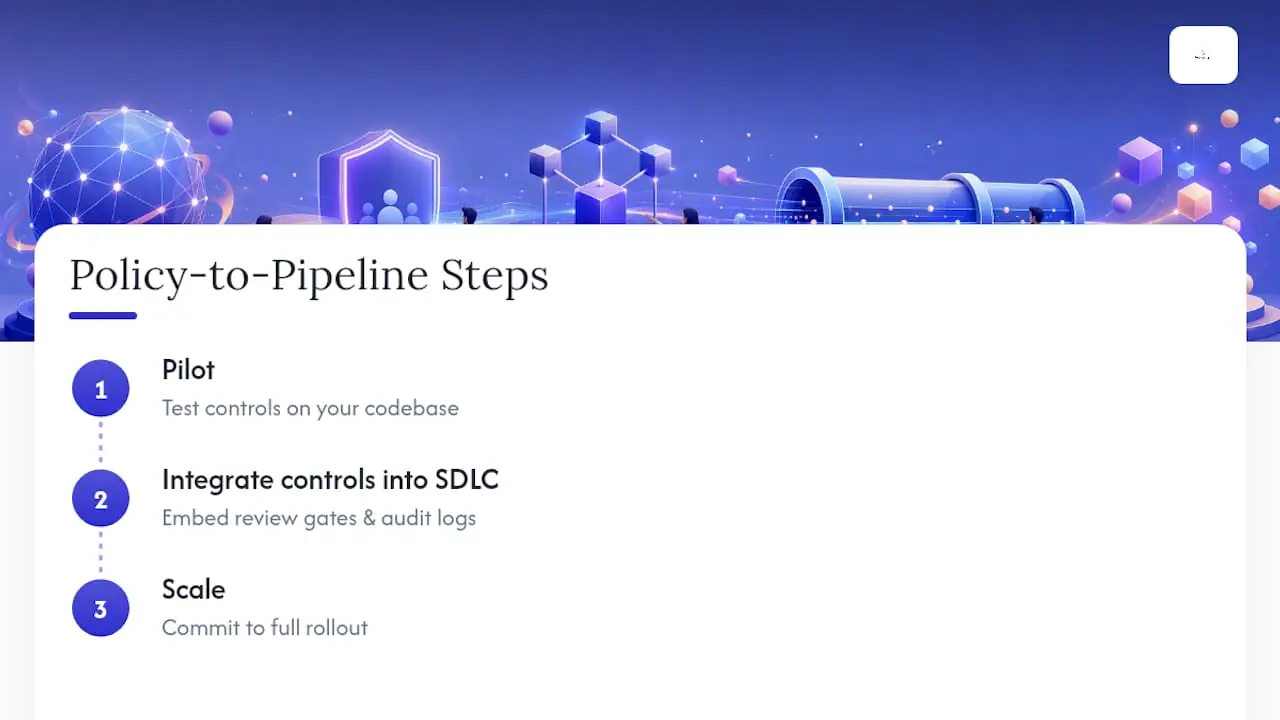
We start with a pilot, so you see the controls working against your own codebase before committing to scale. If your policy needs to become a working part of your SDLC, Cleverbit’s AI software delivery practice is the place to start that conversation.
Where to go for authoritative AI policy guidance
For risk taxonomy and lifecycle controls, consult the NIST AI Risk Management Framework. For UK legal context, see gov.uk’s AI regulation guidance and its data-protection guidance. For vendor expectations, review AWS’s responsible AI policy, and for HR-facing language, see SHRM’s ChatGPT policy guidance.
Sources
- NIST AI Risk Management Framework — NIST
- Gov
- AWS responsible AI policy
- How to create the best ChatGPT policies — SHRM