
Team as a Service (TaaS) is a managed, outcome-oriented delivery model in which a cross-functional software team is embedded into your organisation, operates inside your processes, and integrates agentic AI tools with governance built in from the start. If you are evaluating this model for multi-quarter product work that requires continuous AI integration and clear accountability, the right first move is a two-week discovery pilot with defined DARCI roles and security gates in place before a single line of code is written. Cleverbit structures every engagement this way, aligning to ISO/IEC 27001 practices and ICO-aligned data handling from day one.
Scaling software teams is rarely a simple hiring problem. Slow recruitment, fragmented ownership, compounding delivery risk, and the governance overhead that agentic AI now demands make the traditional headcount route increasingly costly. TaaS addresses all of that in a single operating model.
What does team as a service actually look like in practice?
A TaaS team is not a roster of contractors billed by the hour. It is a long-term, managed delivery team that combines execution capacity with clear ownership and delivery structure. In an Agentic Software Development Lifecycle (ASDLC) context, the team typically spans product, engineering, ML/AI, QA, SRE, security, and compliance capabilities, aligned to outcomes rather than individual timesheets.
Key structural features to expect:
- Single delivery owner. DARCI accountability is assigned from day one: one person decides, one person is accountable, others are consulted or informed. This prevents the diffuse ownership that makes agentic AI risky.
- Context retention across quarters. The team onboards to your domain, tooling, and pipelines and carries that knowledge forward. Tribal context does not evaporate at contract renewal.
- Embedded AI guardrails. Model usage policies, prompt libraries, lineage logging, and decision audit trails are part of how the team works, not a compliance layer bolted on afterwards.
- Outcome-aligned reporting. Velocity, cycle time, and governance metrics are reported against your goals, not against hours consumed.
Pro Tip: When negotiating the onboarding contract, require explicit clauses covering knowledge transfer, runbook ownership, and code ownership. Without these, even the best-performing TaaS team can leave you with a delivery dependency rather than a compounding asset.
How TaaS compares to in-house teams, outsourcing, and staff augmentation
TaaS sits between staff augmentation and project outsourcing: more control than handing a fixed scope to an outsourcer, more accountability than adding temporary resource to an existing team. The table below maps the dimensions that matter most to engineering leaders evaluating these models.

| Dimension | In-house | Project outsourcing | Staff augmentation | TaaS (ASDLC) |
|---|---|---|---|---|
| Control vs speed | High control, slow ramp | Low control, fixed scope | Medium control, variable | High control, fast ramp |
| Onboarding time | several months per hire | 2–4 weeks scoping | 1–2 weeks per person | a few weeks for full team |
| Cost model | FTE salary + overhead | Fixed project fee | Day rate per person | Fixed managed monthly fee |
| Governance & compliance | Internal policy | Provider-defined | Client-defined, ad hoc | Embedded, provider-managed |
| Accountability | Distributed internally | Provider for scope only | Client owns outcomes | Single delivery owner |
| Scalability | Slow, high friction | Scope-bound | Flexible but fragmented | Structured, rapid |
For a multi-quarter platform modernisation with ML components, TaaS delivers faster than building headcount and retains more accountability than staff augmentation. For a narrowly specified, fixed-scope short project, project outsourcing is often the cleaner choice. The distinction matters: TaaS is a living system, not a one-time delivery vehicle.
When is TaaS the right model, and how long does it take to get going?
Operational signals that point toward TaaS:
- Multi-quarter roadmaps where context continuity is a delivery dependency
- AI integration requirements that demand embedded governance, not ad hoc tooling
- Hiring constraints that make building in-house impractical within your delivery window
- Fragmented ownership across contractors, agencies, and internal teams
- Regulatory or security requirements (UK GDPR, ICO guidance, FCA-regulated environments) that demand audit trails and data residency controls
Typical onboarding timeline: discovery runs for a few weeks, team ramp takes several weeks, and stable velocity is usually reached after a few sprints. On cost, a fixed, managed monthly fee is generally more predictable than FTE overhead once you account for recruitment, benefits, tooling licences, and management time. When comparing proposals, weight governance capability and delivery accountability at least as heavily as the headline rate. The success of a TaaS engagement depends more on the operating model than on hourly rates.
How the Agentic Software Development Lifecycle embeds AI safely across delivery
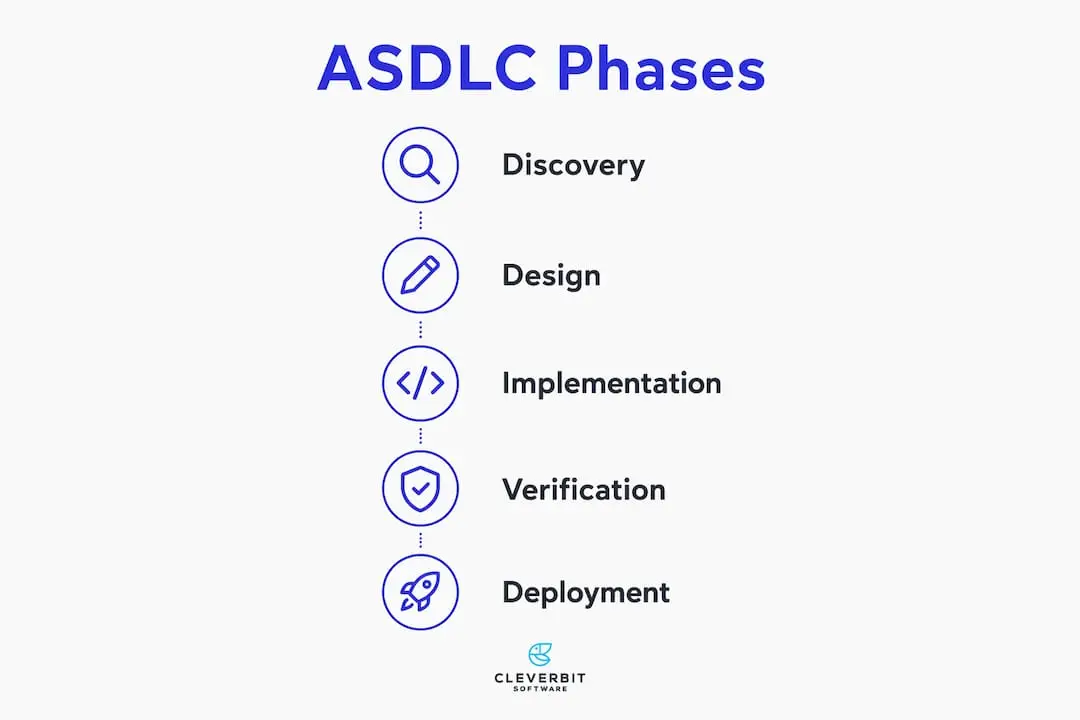
The ASDLC is the operational framework that makes TaaS work when agentic AI is in the pipeline. Each phase carries specific AI control points.
Discovery: requirements analysis with AI-assisted synthesis; DARCI roles assigned before any model is invoked; data handling and residency confirmed against ICO guidance.
Design: architecture decisions logged with rationale; model selection documented with version pinning; prompt libraries reviewed and approved by the accountable engineer.
Implementation: code generation within defined policy boundaries; CI tests validate AI outputs as first-class artefacts, not informal suggestions. Preventing vibe code drift requires reproducible prompts, model version pinning, and knowledge-anchored code reviews that treat AI-generated code with the same scrutiny as human-written code.
Verification: automated test generation audited for coverage gaps; agentic PR triage reviewed by a named engineer before merge.
Deployment: rollback guarantees documented; deployment gates include a compliance attestation.
Observability and iteration: model drift rate and prompt failure rate tracked continuously; incident response ownership is explicit in the DARCI assignment.
DARCI combined with time-bound discovery sessions creates rapid alignment and makes accountability explicit, which is crucial when teams exercise agentic capabilities.
Agentic AI outputs must be treated as first-class artefacts: require lineage, versioning, and test coverage just as you would for any production code. Without that discipline, AI-assisted development does not accelerate delivery — it defers risk into the codebase where it compounds silently.
Pro Tip: Structure review gates so they check governance compliance automatically in CI rather than relying on manual sign-off at sprint end. Automated gates catch agentic drift early without becoming a delivery bottleneck.
How to run a TaaS pilot: a 60–90 day implementation roadmap
Before you engage a provider
- Define objectives and measurable success criteria (cycle time, deploy frequency, defect rate, governance audit pass rate).
- Assign DARCI roles for the engagement on your side before the first discovery session.
- Scope a two-week discovery with defined inputs and outputs, not an open-ended requirements phase.
- Validate data and security posture: confirm data residency, access controls, and classification requirements.
- Agree MVP scope, acceptance criteria, and exit points for each pilot phase.
Questions to ask any provider
- How do you manage model governance and prompt-library ownership across the team?
- What does your incident response process look like for an agentic failure in production?
- How is knowledge transferred if the engagement ends?
- What audit logs do you produce, and who owns them?
Red flags
- No audit logs for agentic decisions
- DARCI roles undefined or assigned to the provider’s account manager
- No model versioning or prompt reproducibility controls
- Unclear escalation path for security incidents
- Offshore data handling for UK-regulated data without explicit residency guarantees
The enterprise team building checklist Cleverbit uses covers these points systematically and is a useful reference when briefing any provider.
What KPIs and SLA clauses should you require?
TaaS is outcome-driven, which means the commercial structure should reflect delivery performance, not hours logged. Require these metrics and SLA items in writing.
| Metric | Measurement method | Suggested target | Reporting cadence |
|---|---|---|---|
| Cycle time | Issue open to production deploy | Agreed baseline reduction | Weekly |
| Deploy frequency | Deployments per sprint | Increasing trend | Sprint review |
| MTTR | Incident open to resolution | < 4 hours P1 | Per incident |
| Model drift rate | Automated output comparison | < defined threshold | Weekly |
| Prompt failure rate | CI pipeline logs | < 2% of runs | Weekly |
| Audited agentic decisions | Percentage with lineage log | — | Monthly |
SLA clauses worth requiring: availability commitments, security compliance attestations (ISO/IEC 27001 alignment), UK data residency confirmation, P1 incident response times, remediation timelines, and rollback guarantees. Tie commercial holdbacks to governance failures, not just availability incidents. That single structural choice shifts the incentive from shipping fast to shipping safely.
What does a typical UK pilot actually deliver?
An anonymised example from a UK-based regulated SaaS platform illustrates realistic expectations. The team reached stable velocity within several weeks of engagement start. AI-assisted test generation reduced manual QA effort materially, and automated PR triage cut review cycle time. Defect escape rate to production fell across the pilot period, and every agentic decision carried a lineage log by week four.
Operationally, the shift that mattered most was ownership clarity. Before the engagement, delivery accountability was distributed across three internal teams and two contractors. After DARCI was applied, a single delivery owner held the outcome and reported against it weekly. That change in reporting cadence, more than any tooling decision, was what made the governance model credible to the client’s compliance team.
The cultural lesson: external AI-integrated teams need explicit integration into your engineering rituals, not just your Jira board. Sprint reviews, architecture decision records, and incident retrospectives should include the TaaS team from week one. Treating them as a separate delivery unit is where communication debt accumulates.
Why Cleverbit recommends TaaS for AI-integrated, regulated work
Cleverbit recommends the TaaS model specifically for engineering organisations running multi-quarter roadmaps where agentic AI is in the delivery pipeline and governance is non-negotiable. For short, fixed-scope projects, a different engagement structure is often the right answer. For regulated environments, platform modernisation with ML components, or any context where vibe code drift poses a real compliance risk, TaaS with embedded ASDLC governance is the model that holds.
The contracting advice: require ISO/IEC 27001-aligned practices and ICO-compliant data handling in the statement of work, not as a side letter. Require DARCI assignments in the onboarding documentation. And require that AI governance tooling is part of the team’s operating model from day one, not a retrospective audit.
On cultural integration: the teams that compound positively are the ones that attend your engineering rituals, carry your coding standards, and treat your architecture decision records as living documents. That is the difference between a managed team that builds institutional knowledge and one that creates a dependency.
Work with Cleverbit on AI-integrated delivery
Cleverbit’s AI-integrated software delivery model gives engineering leaders a dedicated team with agentic AI embedded across the SDLC and governance controls that hold under audit. The engagement starts with a structured discovery pilot, scoped to your stack and compliance requirements, so you build from evidence rather than assumption. If you are evaluating whether TaaS is the right model for your next programme of work, request the scorecard or book a discovery session to get a clear picture before you commit.