
Poor team structures don’t just slow you down. They cost you. Poor structures cost 23% more and slow delivery by 60%, yet many scaling tech companies still rely on loosely defined ownership models that create confusion, duplicate effort, and erode accountability. Adding headcount or layering more process rarely fixes the underlying problem. What actually moves the needle is clarity over who owns what, end to end. This article covers what enterprise team ownership means in practice, which frameworks best support it, how to implement it safely, and what real organisations have learned from getting it right and wrong.
Key Takeaways
| Point | Details |
|---|---|
| Clear ownership drives results | Small, autonomous teams with defined domains increase accountability and delivery speed. |
| Choose the right model | Team Topologies and Spotify frameworks can be tailored to your context for more effective team structure. |
| Boundaries protect focus | Clear domain and code ownership boundaries prevent cognitive overload and delivery bottlenecks. |
| Iterate and review regularly | Evolving team ownership through pilots and reviews sustains long-term performance and reduces sprawl. |
| Stewardship outperforms control | Empowered teams focused on stewardship outperform those with rigid or ambiguous ownership. |
Defining enterprise team ownership
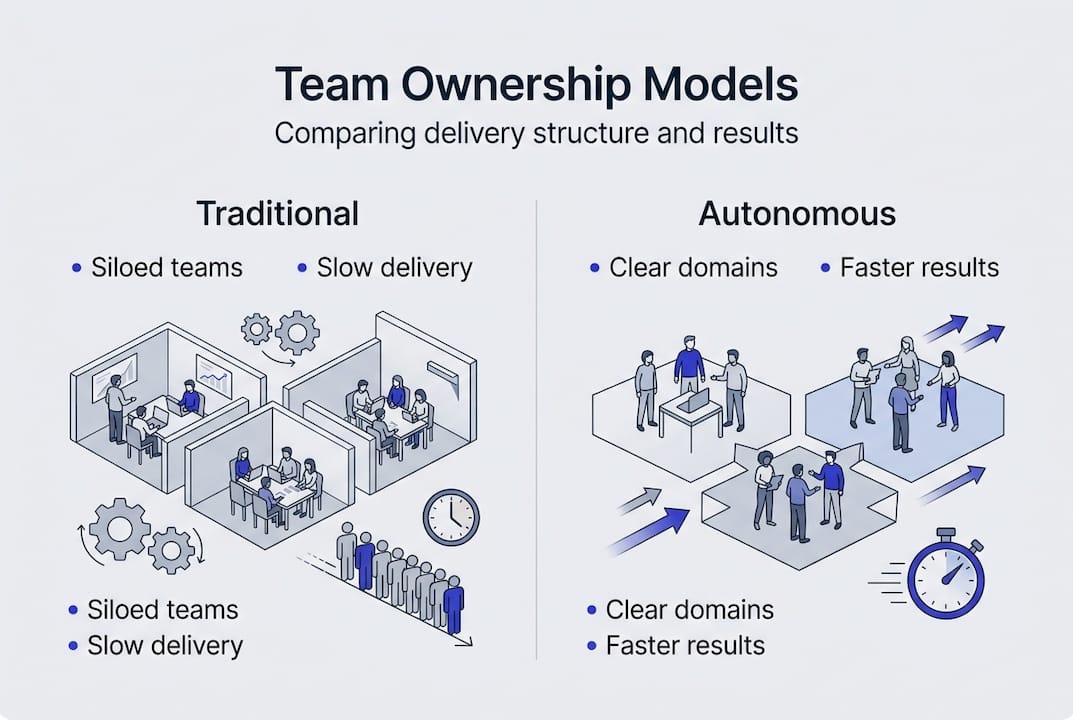
Enterprise team ownership is not simply assigning a codebase to a group of engineers. It is a structural commitment. Enterprise team ownership means small, autonomous, cross-functional teams hold end-to-end responsibility for specific domains, features, or value streams. That includes architecture decisions, delivery, quality, and operational outcomes.
This is a significant departure from traditional project-based models, where accountability fragments across functional silos. In those older structures, a developer writes code, a separate QA team tests it, and a different ops team deploys it. Nobody owns the outcome. Ownership becomes collective in name only, which is another way of saying nobody owns it at all.
The shift to genuine ownership brings measurable benefits:
- Faster flow: Teams make decisions without waiting for cross-functional approval chains
- Improved accountability: Clear ownership means clear responsibility when things go wrong
- Reduced silos: Teams that own outcomes are incentivised to collaborate across boundaries
- Higher quality: Ownership creates pride and long-term investment in the product
| Ownership model | Decision speed | Accountability | Delivery flow |
|---|---|---|---|
| Traditional siloed | Slow | Fragmented | Interrupted |
| Project-based | Moderate | Shared | Inconsistent |
| Enterprise team ownership | Fast | Clear | Continuous |
When building or reviewing your structure, an enterprise team building checklist helps ensure you are not skipping foundational steps. The goal is not just to reorganise boxes on an org chart. It is to create conditions where high-performance development teams can operate with genuine autonomy and produce consistent results.
Pro Tip: Ownership without boundaries is chaos. Before assigning ownership, define the domain scope explicitly, including what the team does NOT own.
Key models and frameworks: Team Topologies, Spotify, and more
With the core definition established, let’s explore how leading frameworks shape real-world team ownership.
Team Topologies’ four team types and interaction modes provide one of the most practical blueprints available, with teams sized between five and nine members. The four types are stream-aligned (focused on a specific value stream), platform (providing internal services to other teams), enabling (helping teams adopt new practices), and complicated-subsystem (handling technically complex components that require specialist knowledge).
The Spotify model, widely adopted in scaling tech companies, organises teams into squads, tribes, chapters, and guilds. Squads are autonomous units similar to stream-aligned teams. Tribes group related squads. Chapters connect people with similar skills across squads. Guilds are informal communities of interest. It is worth noting that Spotify itself has evolved significantly beyond this model, which is a useful reminder that no framework is permanent.
Code ownership also comes in three variants worth understanding:
- Strong ownership: One team owns a service entirely. Best for critical or regulated systems.
- Weak ownership: A primary team owns the service but others can contribute with review.
- Collective ownership: Any team can modify shared code. Works in high-trust, mature environments.
| Framework | Team structure | Autonomy level | Best suited for |
|---|---|---|---|
| Team Topologies | Four team types | High | Complex enterprise systems |
| Spotify model | Squads, tribes, chapters | Moderate to high | Fast-scaling product companies |
| Traditional | Functional silos | Low | Stable, low-change environments |
Choosing the right model requires honest self-assessment. Consider the role of software teams in scaling before committing to a framework. The team autonomy spectrum is not one-size-fits-all. For teams integrating AI software delivery, the right ownership model becomes even more critical to maintain governance without slowing velocity.
Practical implementation: Domains, boundaries, and ownership transfer
After understanding model options, practical steps become essential for effective ownership.
Methodologies emphasise domain-driven design, repository ownership, and staged transitions as the backbone of reliable microservices ownership. Domain-driven design (DDD) is a software approach that aligns code structure with business domains, making ownership boundaries intuitive rather than arbitrary. When a team’s codebase maps directly to a business capability, clarity follows naturally.
For each team, the following are non-negotiable:
- Dedicated repositories: Each team owns its own code repo, with clear access controls
- Independent CI/CD pipelines: Teams deploy without depending on shared pipeline queues
- Defined interfaces: APIs and contracts between services are versioned and documented
- Operational responsibility: Teams monitor and respond to incidents in their domain
Ownership transfer, when teams are restructured or domains are reassigned, is where many organisations stumble. The ownership transfer patterns that work best involve staged handovers covering four dimensions: semantic (shared understanding of the domain), interface (API contracts and documentation), data (schemas and migration plans), and operational (runbooks, alerting, and on-call responsibilities).
Teams larger than ten members show a measurable increase in cognitive overload, communication failures, and reduced delivery velocity. Keeping teams small is not a preference. It is a structural safeguard.
Pro Tip: Use a staged handover checklist covering all four dimensions before any ownership transfer is considered complete. Rushing this step creates hidden technical debt and operational risk.
When choosing the best software teams for a new domain, consider cognitive load from the start. The science behind building high-performance teams consistently shows that team size and boundary clarity are stronger predictors of success than individual talent alone.
Success stories and common pitfalls: Lessons from leaders
Theoretical models matter, but practical results and real risks bring the picture into focus.
Empirical data from Penta Technologies, REA Group, EBSCO, Adidas, and Protime shows that structured team ownership consistently improves empowerment, flow, and delivery predictability. REA Group, for instance, restructured around stream-aligned teams and saw measurable improvements in release frequency and team morale. These are not marginal gains. They are structural shifts that compound positively over time.

| Metric | Before ownership model | After ownership model |
|---|---|---|
| Release frequency | Monthly or quarterly | Weekly or daily |
| Incident response time | Hours to days | Minutes to hours |
| Team empowerment score | Low | High |
| Cross-team dependencies | Many | Minimal |
However, the failures are equally instructive. Common pitfalls include:
- Fuzzy boundaries: When two teams both think they own a service, neither truly does
- Collective ownership confusion: Without clear norms, collective ownership becomes collective neglect
- Oversized teams: Teams beyond nine members suffer from coordination overhead and diluted accountability
- Premature autonomy: Granting full autonomy before establishing shared standards creates fragmentation
The micromanagement case study from Agile Alliance illustrates how replacing micromanagement with genuine ownership transformed delivery outcomes at an enterprise level. The lesson is consistent: ownership must be earned and structured, not simply declared.
The costs of getting this wrong are not just operational. As explored in the illusion of cheap engineering, poorly structured teams create deferred costs that surface later as technical debt, rework, and attrition.
Expert insights: Balancing autonomy, stewardship, and organisational evolution
Having seen what works and what fails, expert advice rounds out the picture.
Effective models balance autonomy and boundaries, and participatory change significantly boosts buy-in across engineering organisations. Autonomy without boundaries produces chaos. Boundaries without autonomy produce bureaucracy. The goal is calibrated freedom, where teams have genuine decision-making power within a well-understood scope.
Evolutionary rollouts outperform big-bang reorganisations. Starting with a pilot software team approach allows you to test ownership structures with lower risk, gather real data, and refine before scaling. Self-selection, where engineers choose their teams based on interest and expertise, often produces stronger ownership culture than top-down assignment.
Four expert tips for sustainable team ownership:
- Review boundaries regularly: Ownership models should evolve with your product and organisation, not ossify
- Invest in enabling teams: Platform and enabling teams reduce friction for stream-aligned teams and prevent duplication
- Measure cognitive load: If teams are consistently overwhelmed, the domain scope is too broad
- Reward stewardship: Recognise teams that maintain and improve existing systems, not just those building new features
The DevOps team topologies framework reinforces that sustainable ownership requires ongoing investment in team health, not just initial structure design.
Pro Tip: Stewardship, caring for what you own over the long term, is more valuable than the initial act of claiming ownership. Build a culture where maintaining quality is as celebrated as shipping new features.
Why ownership is the real lever for scaling tech teams
Most scaling conversations fixate on process: better sprints, more ceremonies, tighter governance. We understand the appeal. Process feels controllable. But in our experience, process tweaks rarely solve what is fundamentally an ownership problem.
When teams lack clear ownership, they default to waiting, escalating, and hedging. No sprint cadence fixes that. What does fix it is recalibrating ownership and stewardship based on where a product sits in its lifecycle and what cognitive load the team can genuinely carry.
A team in early-stage product development needs different ownership boundaries than one maintaining a regulated, high-availability platform. Treating them identically is a governance failure, not a process gap.
The uncomfortable truth is that collective ambiguity, where everyone is responsible and therefore nobody is, is one of the most expensive conditions in software delivery. It masquerades as collaboration. It is actually diffusion of accountability.
Building high-performance teams means being willing to make ownership explicit, even when that conversation is uncomfortable. Scale comes from clarity, not from adding more people to an unclear structure.
Empower your teams with the right ownership model
Putting these principles into practice requires more than a framework. It requires the right team structure, the right governance, and a partner who understands both. At Cleverbit Software, we specialise in building scalable software development structures that give enterprise teams genuine ownership without the operational risk of getting there alone. Our high-performance development teams are designed to integrate as extensions of your organisation, with clear boundaries, accountability, and delivery focus built in from day one. Explore how our fully managed software teams can help you move from structural ambiguity to scalable, accountable delivery.
Frequently asked questions
What’s the difference between enterprise team ownership and code ownership?
Enterprise team ownership covers end-to-end responsibility for value streams or domains, including delivery, quality, and operations. Team ownership means teams own outcomes, not just code, making it a broader and more strategically significant commitment.
How often should organisations review team ownership boundaries?
Reviewing boundaries every 6 to 12 months, or after major product shifts, keeps ownership aligned with business needs. Regular reassessment prevents sprawl and ensures teams are not carrying domains that no longer match their capacity or expertise.
What teams are best suited to strong vs. collective ownership?
Strong ownership fits critical code or regulated domains where accountability must be unambiguous. Strong for critical, collective for trusted teams is a reliable rule of thumb when assessing which model to apply.
Can enterprise team ownership models work in non-software organisations?
Yes. Team Topologies principles apply to various organisation types, boosting accountability and flow in any cross-functional setting by aligning teams to outcomes rather than functions.