
Outsourcing is defined as contracting a vendor to deliver a defined scope of work, where the vendor owns the team, manages the process, and is accountable for the output. A managed team is a dedicated, cross-functional unit provided by a vendor, where the vendor governs execution and delivery, but the client retains full ownership of the product direction. The difference between outsourcing and managed teams is, at its core, a question of who holds accountability for outcomes. That distinction shapes your management overhead, cost structure, knowledge continuity, and your ability to govern AI-assisted development responsibly.
How do outsourcing and managed teams differ in delivery ownership?
Outsourcing places delivery governance entirely with the vendor. The vendor selects the team, manages its members, and reports against the agreed scope. Your internal engineering lead has limited visibility into day-to-day decisions. That works well when the scope is fixed and the risk of change is low.
Managed teams operate differently. The provider governs execution, HR, and delivery processes, but your organisation sets the product direction and priorities. The team works inside your processes, carries your engineering culture, and reports against your goals. This is not staff augmentation, where individuals join your team under your management. Managed teams replace the need for an internal engineering lead to run delivery operations.

The practical consequence is significant. Managed teams replace 8–15 hours of internal management time weekly for engineering leads. That is time your technical leadership can redirect to architecture, product thinking, and governance.
Key structural differences between the two models:
- Delivery ownership: Outsourcing sits with the vendor. Managed teams sit with the vendor for execution, with the client for product.
- Team composition: Outsourcing uses the vendor’s pooled resources. Managed teams provide a dedicated, stable unit.
- Reporting lines: Outsourcing reports against a contract. Managed teams report against your goals and KPIs.
- Management burden: Outsourcing reduces your oversight but limits your control. Managed teams transfer governance without removing your product authority.
Pro Tip: When evaluating either model, ask the provider to describe who owns the sprint retrospective. If the answer is unclear, your governance is already at risk.
What are the cost implications of outsourcing vs managed teams?
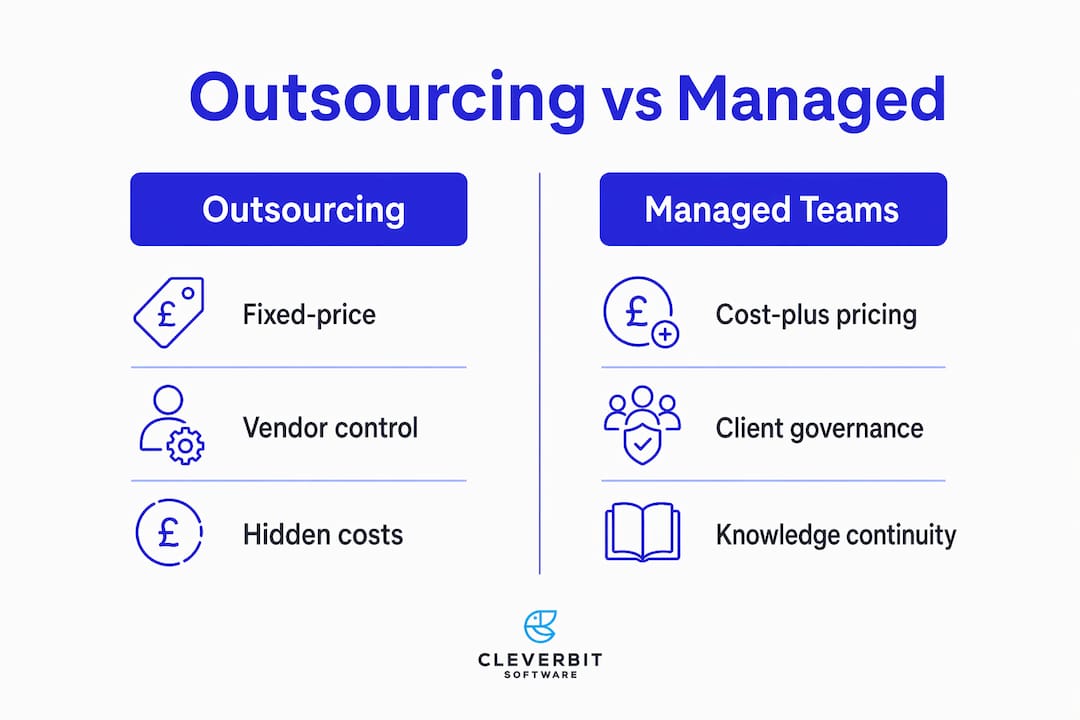
Cost structure is where the outsourcing advantages and disadvantages become most visible. Outsourcing contracts typically use fixed-price or time-and-material arrangements. Fixed-price contracts carry vendor margin built into the quote. Time-and-material contracts expose you to change order costs when scope shifts, which it almost always does in software development.
Managed teams use transparent cost-plus pricing with predictable monthly fees. You see what you pay for the team and what you pay for the management layer. There are no hidden change order risks because the team adapts to your evolving priorities by design.
The management layer in a managed team does carry a cost. Managed teams typically add 15–25% contract value for the management overhead. That figure sounds significant until you account for what it replaces: internal engineering lead time, HR overhead, attrition management, and onboarding costs when team members leave.
| Cost factor | Outsourcing | Managed teams |
|---|---|---|
| Pricing model | Fixed-price or time-and-material | Cost-plus, predictable monthly |
| Change order risk | High | Low |
| Management layer cost | Embedded in vendor margin | Transparent, 15–25% addition |
| Internal management time | Reduced but visibility limited | 8–15 hours per week recovered |
| Onboarding speed | Varies by agency | 2–4 weeks typical |
Choosing the wrong model carries a measurable penalty. The wrong engagement model can increase overhead by 30–50% and delay projects by 3–6 months. That is not a theoretical risk. It is the cost of misaligned governance showing up in your delivery timeline.
Hidden management costs in staff augmentation and outsourcing frequently outweigh the lower invoice rates. For engagements longer than six months, managed teams are more cost-effective when total internal overhead is counted honestly.
How do these models affect knowledge continuity and compliance?
Knowledge continuity is the risk that most outsourcing evaluations ignore until it is too late. When a vendor rotates team members, or when a contract ends, the product knowledge those individuals carried leaves with them. This is the knowledge cliff: a sudden loss of context that forces your next team to rediscover decisions already made.
Managed teams embed documentation, retention planning, and structured handoffs into their operating model. Knowledge transfer is not an event at the end of a contract. It is a continuous process built into how the team works. Personnel changes do not create knowledge cliffs because the documentation exists independently of any individual.
For regulated industries, this distinction becomes a compliance matter. Managed teams incorporate compliance decision logs and regulatory documentation as a core output of each sprint. Healthcare, financial services, and other regulated sectors cannot treat compliance documentation as an afterthought. It must be produced continuously and auditably.
Practical protections that managed teams provide:
- Sprint-level documentation: Every decision is recorded as part of the delivery process, not retrospectively.
- Retention planning: The provider manages attrition risk and succession, not your HR team.
- IP ownership: Product knowledge and codebase ownership remain with the client throughout the engagement.
- Structured handoffs: If the engagement ends or the client takes ownership of the team, the transition is planned and documented.
Pro Tip: Ask any managed team provider to show you a sample knowledge transfer artefact from a previous engagement. If they cannot produce one, their retention planning exists only on paper.
Understanding staff augmentation versus managed teams is useful context here, because augmentation carries the same knowledge cliff risks as outsourcing, despite feeling more like an internal arrangement.
What role do these models play in AI-driven software development?
Agentic software development changes the governance calculus for both models. When AI agents generate code, write tests, and contribute to architecture decisions, the question of who owns quality and accountability becomes more urgent, not less. Fragmented teams with no shared standards are where AI-assisted development creates the most risk.
Outsourcing’s traditional model was designed for human-only delivery. The vendor owns the process, and the client reviews the output. That model does not translate well to agentic development, where the output can be generated faster than any review cadence designed for human-paced work.
Managed teams provide systemic guardrails and governance that help prevent vibe code drift during AI-centric development cycles. Vibe code drift occurs when AI-generated code accumulates without adequate review, testing, or alignment to architectural standards. The result is a codebase that works superficially but carries latent errors and technical debt that compounds over time.
The governance requirements for responsible AI development include:
- Defined AI usage policies aligned to your engineering standards, not generic vendor defaults.
- Review gates that apply to AI-generated code with the same rigour as human-written code.
- Clear visibility into what AI is doing at each stage of the delivery pipeline.
- Accountability structures that do not dissolve when an AI agent makes a poor architectural decision.
Managed teams are structurally better suited to agentic development because they operate as coherent systems with clear ownership. Agentic tools perform best inside that kind of environment. An outsourced vendor managing their own team with their own standards cannot embed your AI governance policies in any meaningful way. They can report against them, but they cannot carry them.
When should you choose outsourcing versus managed teams?
The decision between outsourcing and managed teams depends on four criteria: project scope, duration, your internal technical leadership capacity, and your governance requirements.
Choose outsourcing when the scope is well-defined, the duration is short, and you have internal capacity to review and accept the output. Outsourcing suits discrete projects: a specific integration, a legacy migration with a clear endpoint, or a proof-of-concept that does not need to become a living system.
Choose managed teams when the engagement is long-term, the product will evolve, and you need delivery accountability without building an internal engineering function. Managed teams suit product companies, regulated businesses, and any organisation where the software is a core part of the value proposition.
Consider your internal bandwidth honestly. If your engineering leads are already stretched, outsourcing does not solve the problem. It moves the problem to a vendor who has less context than you do. Managed teams transfer the operational burden with the governance intact.
Account for AI governance requirements. If your development pipeline includes or will include agentic AI, the model you choose must support the guardrails your business requires. That is not a feature you can add later.
Use a portfolio approach for complex organisations. Effective organisations combine delivery models rather than treating outsourcing and managed teams as mutually exclusive. A well-defined internal tool might go to an outsourcing vendor. Your core product team might be a managed unit. The key is matching the model to the context, not applying one model to everything.
The practical test is straightforward. Ask whether you want to buy labour under your control, or outcomes managed by the provider with clear SLAs. The answer to that question determines which model fits your situation. You can also use criteria for selecting software teams to pressure-test your decision against your specific product and project needs.
Why the governance question matters more than the cost question
The conversations we have with engineering leaders most often start with cost. That is understandable. But cost is the wrong primary lens for this decision, and experience makes that clear quickly.
The real cost of outsourcing is not the invoice. It is the management time your team spends compensating for the vendor’s lack of context. It is the knowledge that walks out the door when the contract ends. It is the compliance documentation that was never produced because no one owned it. These costs are deferred, not avoided.
Managed teams are not cheaper in the short term. They are more accountable, and accountability has a price. What they give back is internal bandwidth, knowledge continuity, and a delivery structure that does not require your engineering lead to become a full-time vendor manager.
The AI governance dimension makes this more urgent. Vibe code drift is not a hypothetical. It is what happens when AI-generated code accumulates without the review structures to catch what the agent got wrong. A managed team with embedded AI governance policies prevents that. An outsourcing arrangement with a vendor managing their own process does not, regardless of what the contract says.
The organisations that get the most from agentic development are not the ones moving fastest. They are the ones moving deliberately, with clear ownership at every stage. That is the environment a well-structured managed team creates. Ensuring software team accountability is not a governance luxury. It is the foundation that makes sustained delivery possible.
— Cleverbit
How Cleverbit approaches managed teams and AI software delivery
Cleverbit builds and manages dedicated software development teams that operate as extensions of your organisation, with AI governance embedded from day one. The engagement starts with consultancy: understanding your stack, your compliance requirements, and where agentic AI creates the most value in your pipeline. From there, Cleverbit designs the right team structure and guardrails for your context, runs a pilot to demonstrate performance, and scales from a position of evidence.
For business leaders evaluating AI software delivery with the governance structures to make it sustainable, Cleverbit’s model provides the accountability, transparency, and knowledge continuity that outsourcing cannot. Clients who want to take direct ownership of their teams can do so with minimal disruption. The structure is already in place.
FAQ
What is the core difference between outsourcing and managed teams?
Outsourcing delegates delivery control to the vendor, who manages their own team against a defined scope. A managed team embeds a dedicated unit under vendor governance, but the client retains product ownership and direction.
Are managed teams more expensive than outsourcing?
Managed teams typically add 15–25% to contract value for the management layer, but this is offset by recovering 8–15 hours of internal management time weekly and avoiding the knowledge loss costs that outsourcing carries.
Which model suits long-term software product development?
Managed teams suit long-term engagements because they embed knowledge continuity, retention planning, and compliance documentation into the delivery process. Outsourcing is better suited to short-term, well-defined projects.
How do managed teams support AI governance and prevent vibe code drift?
Managed teams provide systemic guardrails and defined review gates that apply to AI-generated code with the same rigour as human-written code. This prevents vibe code drift, where AI-generated output accumulates without adequate review or architectural alignment.
Can a business use both outsourcing and managed teams at the same time?
Yes. Effective organisations use a portfolio approach, combining outsourcing for discrete, well-scoped projects and managed teams for core product development where governance and continuity matter most.