Splitting a software project across multiple vendors feels like control. In reality, it often creates the opposite. Fragmented ownership, misaligned priorities, and costly handoff delays erode velocity before a single line of code ships.
30% faster SaaS delivery is achievable when unified, cross-functional teams replace the traditional multi-vendor relay race. For tech executives and product leaders at scaling companies, this is not a marginal efficiency gain. It is a structural advantage. This article explains what end-to-end team management actually means, how these teams operate day-to-day, what drives their success, and how to apply these principles to your own delivery model.
Key takeaways
| Point |
Details |
| Single-team accountability |
End-to-end management means one team is responsible for project delivery, eliminating confusion and delays. |
| Cross-functional effectiveness |
Teams blend development, QA, design, and DevOps, reducing the risks of handoffs and speeding results. |
| Proven speed and quality gains |
Empirical evidence shows up to 30% faster delivery and significant quality improvement when using end-to-end management. |
| Cultural shift required |
Success depends on psychological safety, async workflows, and shared goals, not just new processes. |
Defining end-to-end team management
Now that we have outlined the pitfalls of traditional multi-team delivery, let us clarify what end-to-end management actually involves.
End-to-end team management means a single, cross-functional team owns the entire software development lifecycle (SDLC), from initial concept and design through to deployment, operation, and ongoing support. There is no baton pass between a discovery team, a build team, and a support team. One group carries the full responsibility, and that changes everything about how decisions are made, how problems are solved, and how fast value reaches users.
The E2E development principles that underpin this model rest on three core mechanics: a single point of accountability, reduced handoffs between phases, and the integration of Agile, Scrum, and DevOps practices to keep delivery continuous and adaptive. Fragmented ownership is replaced by shared purpose.
For
enterprise team building at scale, this distinction matters enormously. When accountability is distributed across vendors or phases, no single party owns the outcome. Problems get escalated, blamed, or quietly deferred. With end-to-end management, the team that designs the architecture also lives with its consequences in production.
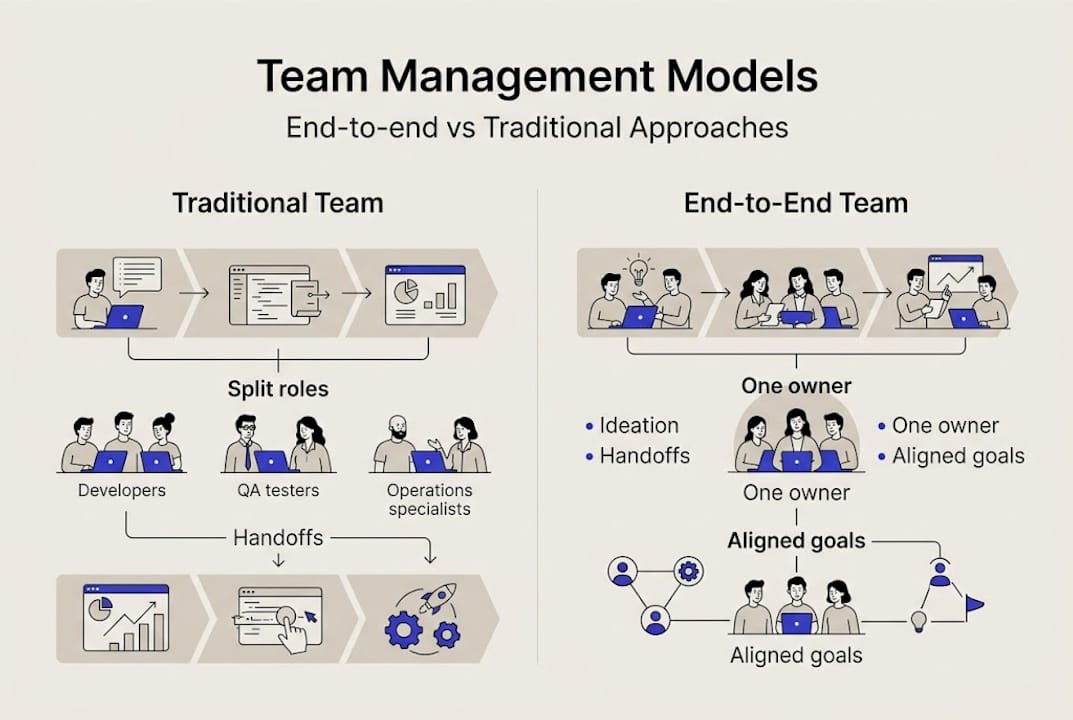
Here is a summary of the key characteristics that define a well-structured end-to-end team:
| Characteristic |
Traditional fragmented model |
End-to-end managed team |
| Ownership |
Divided by phase or vendor |
Single team, full lifecycle |
| Communication |
Cross-vendor, often delayed |
Internal, direct, continuous |
| Skills mix |
Siloed by specialism |
Cross-functional, overlapping |
| Decision speed |
Slow, requires escalation |
Fast, distributed authority |
| Accountability |
Shared and diluted |
Clear and singular |
The practical impact on
best software team selection decisions is significant. When you evaluate a team, you are no longer asking whether they can build. You are asking whether they can own. That is a fundamentally different question.
End-to-end management also changes the nature of
software teams scaling. Rather than adding headcount to each phase, you scale the team as an integrated unit, preserving the institutional knowledge and codebase familiarity that makes delivery reliable.
“End-to-end development reduces time-to-market and closes integration gaps by replacing handoff-heavy models with unified team ownership across the full SDLC.”
How end-to-end teams operate in practice
With a clear understanding of what end-to-end team management is, let us see how these teams deliver projects day-to-day.
A well-formed end-to-end team typically includes software developers, UX designers, QA engineers, and DevOps specialists. These roles are not isolated. They overlap deliberately. A developer who understands deployment constraints writes better code. A QA engineer involved in sprint planning catches edge cases before they become defects. This is not accidental.
Cross-functional collaboration across all SDLC phases, using iterative sprints to overlap activities, is what separates high-performing end-to-end teams from conventional project structures.

Compare the two models directly:
| Dimension |
Traditional multi-vendor |
End-to-end team |
| Accountability |
Fragmented by contract |
Unified by ownership |
| Communication |
Multi-party, often async by default |
Single thread, structured async |
| Delivery speed |
Slowed by handoffs |
Accelerated by shared context |
| Integration issues |
Frequent, expensive |
Rare, caught early |
| Escalation path |
Complex, vendor-dependent |
Internal, fast |
The operational flow of a mature end-to-end team follows a clear pattern:
- Single communication line. One team lead or product owner acts as the primary interface between the client and the team, eliminating the noise of multi-vendor coordination.
- Iterative sprints with shared backlogs. Every team member contributes to and draws from the same prioritised backlog, ensuring alignment across disciplines.
- Continuous integration and delivery. DevOps practices are embedded from day one, not bolted on at the end.
- Retrospectives and adaptation. The team reviews its own performance regularly, adjusting process before problems compound.
- Shared ownership of production. The team that builds the feature also monitors it in production, closing the feedback loop entirely.
Working with a trusted
software development partner who already operates this way dramatically reduces the ramp-up time for scaling companies.
Pro Tip: Prioritise psychological safety and structured async workflows from the outset. Teams that feel safe raising concerns early catch problems before they become costly, and async clarity prevents the communication overhead that undermines even the best-intentioned cross-functional structures.
Key ingredients for successful end-to-end teams
Understanding the mechanics is one thing, but what are the essential drivers that enable these teams to succeed?
The answer sits across three layers: cultural, technical, and organisational. Miss any one of them, and the model underperforms regardless of how well you have structured the team on paper.
Culturally,
GitLab TeamOps research is clear: success hinges on psychological safety, async communication norms, and measurement clarity. Teams need to know that raising a concern will not be penalised. They need shared KPIs that reflect collective outcomes, not individual output. Without these foundations, cross-functional teams default to siloed behaviour, which is exactly what end-to-end management is designed to prevent.
Technically, this model demands more than full-stack coding ability. It requires deep codebase ownership, fast decision-making authority, and a culture of shared responsibility for system health. Engineers must understand the architecture they are maintaining, not just the feature they are building. Continuous delivery pipelines, automated testing, and infrastructure-as-code are not optional extras. They are the scaffolding that makes end-to-end ownership viable at pace.
Organisationally, single-thread leadership is essential. One person owns the outcome. Distributed autonomy within the team is equally important. Team members must be empowered to make decisions within their domain without waiting for approval chains that slow delivery.
When these ingredients are missing, the consequences are predictable:
- Accountability gaps appear as blame cycles between disciplines
- Velocity drops as decisions require escalation outside the team
- Technical debt accumulates when no single owner maintains architectural oversight
- Morale erodes when team members feel disconnected from the product’s success
- Integration failures surface late, when they are most expensive to resolve
Building
high-performance teams requires investing in these cultural and organisational prerequisites as seriously as you invest in technical capability. For companies exploring
AI-enabled delivery, these foundations become even more critical, as AI tools amplify both the strengths and the weaknesses of the team structures they are embedded within.
Pro Tip: Establish a regular cadence of retrospectives, not just sprint reviews. Retrospectives surface process friction before it becomes structural. A team that improves its own ways of working compounds positively over time.
Benchmarks and real-world outcomes for scaling teams
Now that you know what makes end-to-end team management successful, let us look at the tangible results from industry leaders.
The data is compelling. SaaS delivery is 30% faster with unified end-to-end teams, and quality improves by 61% compared to fragmented delivery models. Integration gaps, which are among the most expensive and disruptive failure modes in complex software projects, reduce significantly when a single team owns the full lifecycle.
“SaaS delivery is up to 30% faster and quality improves by 61% with end-to-end teams, driven by unified ownership and the elimination of costly handoff delays.”
Here is how the metrics compare before and after end-to-end adoption:
| Metric |
Before E2E adoption |
After E2E adoption |
| Delivery speed |
Slowed by handoffs |
Up to 30% faster |
| Quality outcomes |
Variable, vendor-dependent |
61% improvement |
| Integration issues |
Frequent post-launch |
Rare, caught in-sprint |
| Time-to-market |
Extended by coordination |
Significantly reduced |
| Team alignment |
Fragmented by contract |
Unified by shared ownership |
In practice, not every organisation transitions to a pure end-to-end model overnight.
Hybrid approaches that balance full team ownership with shared tooling and central platforms are common in scaling engineering environments. A product team might own its full SDLC while drawing on a shared data platform or security function. This is not a compromise. It is a pragmatic architecture that preserves the accountability benefits of end-to-end ownership while leveraging economies of scale in infrastructure.
SaaS companies and enterprise platforms that have adopted these models report faster feature cycles, fewer post-launch incidents, and stronger team retention. The last point is underappreciated. Teams that own their work tend to stay. Ownership is a powerful motivator.
For companies building
AI-integrated approaches into their delivery pipelines, end-to-end team structures provide the governance and contextual depth that AI-assisted development requires. For those pursuing
scalable software delivery at enterprise level, these benchmarks represent a credible target, not an aspiration.
The real value and common misconceptions about end-to-end teams
With the data and models on the table, it is worth addressing what most experts and tech executives often overlook.
Simply relabelling your existing teams as end-to-end does not deliver faster outcomes. We see this repeatedly. An organisation restructures on paper, assigns cross-functional labels, and then wonders why velocity has not improved. The reason is almost always cultural. Accountability without authority is just pressure. Teams need genuine ownership, not the appearance of it.
Ignoring the cultural shift required is where most implementations stall. End-to-end is not a process change. It is a leadership and trust challenge. Leaders must relinquish control at the micro level to gain it at the outcome level. That is uncomfortable for many organisations, particularly those with strong centralised governance cultures.
Hybrid and transition models often work better for complex organisations than a full, immediate shift. Piloting end-to-end ownership on a single product line before scaling the model across the portfolio reduces risk and builds the internal capability needed to sustain it.
“End-to-end team management is not a plug-and-play process upgrade. It is a structural commitment to accountability, trust, and shared ownership that must be built deliberately.”
Invest most heavily in communication norms and measurement frameworks, not just tooling. Tools support the model. They do not create it. Understanding the role of software teams in your scaling strategy is the starting point for getting this right.
Pro Tip: Before restructuring your teams, audit your accountability model. If you cannot clearly name who owns each outcome today, no structural change will fix that until ownership is genuinely assigned and supported.
If you are ready to experience the delivery gains described above, here is how Cleverbit Software can help.
At Cleverbit Software, we design and manage fully integrated, end-to-end software teams for scaling technology companies. Our high-performance teams operate as genuine extensions of your organisation, with clear ownership, embedded Agile and DevOps practices, and the cultural foundations that make sustained delivery possible. We also offer AI software delivery capabilities for teams ready to accelerate further. Whether you are building from scratch or transitioning from a fragmented model, our approach as a software development partner is built around your strategic goals, not a generic outsourcing template.
Frequently asked questions
What does end-to-end team management actually involve?
It means a dedicated cross-functional team takes charge of your entire software project from concept to launch and support, minimising handoffs and bottlenecks. The single point of accountability is what distinguishes it from traditional phased delivery models.
What is the main advantage of end-to-end over traditional team approaches?
End-to-end management streamlines delivery, reduces integration issues, and speeds up time-to-market through aligned ownership and fewer delays. Empirically, this translates to 30% faster delivery and a 61% improvement in quality outcomes.
Do end-to-end teams need to be fully cross-functional?
Yes, success relies on blending developers, QA, design, and DevOps to handle all SDLC phases collaboratively. Iterative sprints that overlap activities across disciplines are central to how these teams maintain speed and quality simultaneously.
How do you measure success with end-to-end team management?
Key metrics are delivery speed, quality improvement, and the reduction of post-launch integration issues. These empirical benchmarks provide a clear baseline against which any end-to-end transition can be evaluated objectively.
Yes, hybrid approaches are common, balancing full team ownership with efficient, shared technical platforms. Scaling engineering benchmarks confirm that this balance is both practical and effective for complex organisations.
Recommended
