
Scalability is not a feature you add later. Yet most enterprise teams behave as though it is, treating it as a post-launch concern rather than a foundational strategic decision. This approach creates a dangerous illusion of progress: teams ship quickly in the short term, only to find that enterprise-readiness requirements cause deals to slip and timelines to collapse when it matters most. If you are responsible for engineering direction, product strategy, or growth at an enterprise organisation, what follows will give you a clear framework for thinking about scalability before it becomes a crisis.
True scalability, in the enterprise context, refers to a system’s ability to grow across multiple dimensions without requiring fundamental architectural rewrites. This includes technical capability, yes, but also organisational agility, process maturity, and compliance readiness. A platform may handle ten million requests per day with admirable efficiency, yet still fail to support enterprise features such as multi-tenancy, role-based access controls, or cross-workspace search. Performance and scalability are related but distinct.
The table below illustrates this distinction clearly:
For scalable software development in enterprise environments, the core elements to consider include:

The following comparison illustrates the cost difference between early planning and late remediation:
Three outcomes consistently emerge for organisations that neglect scalability:
Understanding web hosting scalability considerations is also pertinent. Infrastructure decisions made early, around auto-scaling groups, load balancing strategies, and database clustering, create either headroom or hard ceilings for later growth. The time to think about those ceilings is before you hit them.
Organisations scaling tech teams globally face an additional layer of complexity. Distributed teams must maintain architectural coherence across time zones and codebases, which makes well-documented scalability standards even more essential.
Pro Tip: Embed scalability requirements into your product roadmap from the very first sprint. Define the target enterprise use cases, the expected tenant volume, and the regulatory environments you intend to operate in before your engineers write the first line of production code. Retrofitting these requirements later will almost always cost more in time and capital than doing it correctly from the outset.
Using scalable hosting infrastructure as the technical foundation is necessary but not sufficient. Infrastructure elasticity must be paired with application-level design that can actually exploit that elasticity. An auto-scaling group cannot compensate for a database schema that cannot be partitioned effectively.
The enterprise team building checklist is a useful starting point for evaluating whether your team structure supports the scalability demands of your roadmap. Similarly, end-to-end team management disciplines significantly reduce the coordination overhead that typically slows scalability initiatives in large organisations.
Regulatory and compliance planning deserves particular emphasis. If your enterprise roadmap includes customers in regulated industries such as financial services, healthcare, or government, then your scalability architecture must accommodate data residency requirements, encryption standards, and audit log retention from the beginning. These are not features you can layer on. They are structural.
Consider what becomes possible when scalability is embedded in the architecture and organisational culture from the outset:
The organisations that lead their markets do not treat scalability as a phase. They treat it as a discipline. It becomes part of how they evaluate architecture decisions, how they hire engineers, how they define done, and how they structure their roadmaps. Scalability is a cultural commitment as much as a technical one.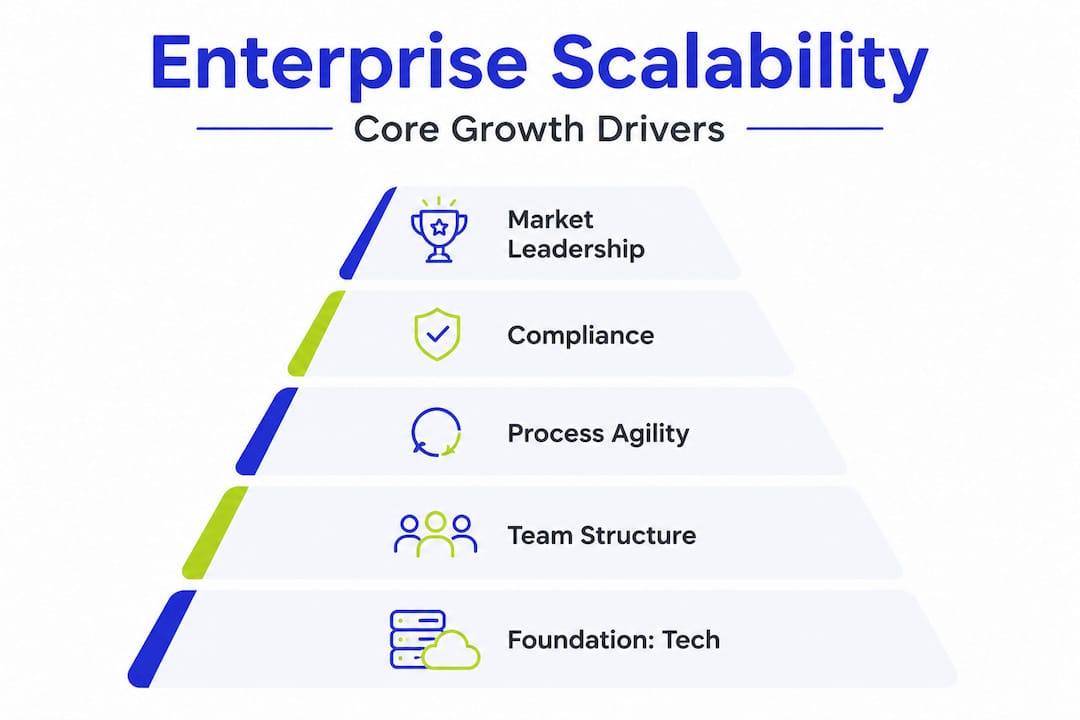 Best cloud solution examples for enterprise IT demonstrate how mature organisations operationalise this commitment through their infrastructure choices, release cadences, and team structures simultaneously. Scalability at the infrastructure level, without corresponding maturity at the team and process level, delivers far less than its theoretical potential.
We have observed this repeatedly. A technically capable team produces a well-performing product for its initial segment, secures promising early enterprise interest, and then discovers that the gap between where they are and where enterprise buyers need them to be is far wider than the architecture review suggested. As research consistently shows, building enterprise capabilities takes four or more quarters and a dedicated team. That is not a technical timeline. It is a strategic one.
The myth that scalability is primarily a technical concern is perhaps the most damaging assumption in enterprise product development. In reality, scalability failures are almost always cross-functional failures. The engineering team built for the customer they had. Product management did not model the customer they were pursuing. Legal did not communicate the data residency requirements in time. The commercial team signed a contract with compliance obligations that did not exist in the product. Sound familiar?
See how this played out in practice through our scaling SaaS platform case study, which illustrates the organisational and technical decisions required to take a platform from mid-market to genuine enterprise readiness.
Pro Tip: Schedule a quarterly scalability review at the executive level. Treat it the same way you would a financial review. Track your technical debt ratio, your architectural constraints against your roadmap, and your outsourcing risk exposure. This single governance change will do more to protect enterprise growth than any individual technical improvement.
Key Takeaways
| Point | Details |
|---|---|
| Scalability is multidimensional | Enterprise scalability covers technology, organisation, compliance, and processes for reliable growth. |
| Early planning prevents risk | Addressing scalability at the start avoids costly rewrites and missed business opportunities. |
| Testing is critical | Using real-world benchmarks ensures your system survives peak loads and unexpected events. |
| Supports innovation in-house | Scalable architecture empowers teams to innovate rapidly without overreliance on outsourcing. |
What scalability means for enterprise teams
Scalability is frequently misunderstood. Many leaders conflate it with raw performance, assuming that if the system handles current load efficiently, scalability is not a concern. That assumption is costly.True scalability, in the enterprise context, refers to a system’s ability to grow across multiple dimensions without requiring fundamental architectural rewrites. This includes technical capability, yes, but also organisational agility, process maturity, and compliance readiness. A platform may handle ten million requests per day with admirable efficiency, yet still fail to support enterprise features such as multi-tenancy, role-based access controls, or cross-workspace search. Performance and scalability are related but distinct.
The table below illustrates this distinction clearly:
| Dimension | Raw performance | True enterprise scalability |
|---|---|---|
| Primary measure | Throughput, latency | Growth capacity, feature extensibility |
| Bottleneck type | CPU, memory, network | Architecture, governance, compliance |
| Typical concern | Speed under current load | Readiness for future requirements |
| Team impact | Engineering only | Engineering, product, legal, security |
| Risk horizon | Immediate | Medium to long term |
- Horizontal scaling: The ability to add capacity by distributing workload across additional nodes, rather than relying solely on more powerful individual servers
- Multi-tenancy: Isolating customer data and configuration in a shared infrastructure, a baseline requirement for most enterprise contracts
- Compliance and security support: Built-in capabilities for audit logging, data residency controls, and regulatory frameworks such as GDPR, SOC 2, and ISO 27001
- Admin and governance functions: Enterprise buyers require centralised user management, provisioning controls, and reporting that smaller organisations rarely need
- Extensibility: APIs, webhooks, and integration points that allow the platform to connect with a complex enterprise technology ecosystem
“Structural choices such as a sharding model can limit enterprise features even when raw performance looks perfectly fine.” Slack’s distributed architecture is a well-documented example of this principle in action. Slack’s workspace-level sharding worked brilliantly at scale for individual teams, yet that same architectural decision became a significant constraint when the product needed to evolve to support cross-workspace enterprise features.Understanding cloud solutions for enterprise scalability has become increasingly important as organisations adopt hybrid and multi-cloud strategies. The cloud does not automatically solve architectural limitations. It amplifies both good and poor design decisions.
The risks of neglecting scalability
When scalability is treated as a deferred concern, the consequences are rarely theoretical. They materialise in lost revenue, failed enterprise deals, and engineering teams caught in expensive rewrites at precisely the moment the business is trying to grow fastest.
The following comparison illustrates the cost difference between early planning and late remediation:
| Scenario | Early scalability planning | Late scalability remediation |
|---|---|---|
| Engineering effort | Incremental, predictable | Disruptive, often full rewrites |
| Deal closure risk | Low | High, feature gaps cause lost contracts |
| Time-to-market impact | Minimal | 4+ quarters of delayed capabilities |
| Outsourcing dependency | Controlled | Often reactive, increases vendor risk |
| Technical debt accumulation | Manageable | Compounding, blocks velocity |
| Governance and compliance | Baked in by design | Bolted on, often incomplete |
- Deal loss at the enterprise threshold: Prospective enterprise clients conduct rigorous due diligence. When a platform cannot demonstrate audit logging, multi-tenancy, or adequate access controls, the deal does not close. Slack hit limits precisely because its workspace-sharded data prevented cross-workspace queries, a fundamental enterprise requirement that exposed an architectural gap rather than a performance shortcoming.
- Accumulation of technical debt that blocks future velocity: Teams that ship features without scalability in mind often find that, six to twelve months later, adding a seemingly straightforward capability requires rewriting core components. This is not an engineering failure. It is a planning failure.
- Governance and compliance gaps that create regulatory exposure: Enterprise buyers operate under stringent regulatory frameworks. If your system cannot produce audit trails, enforce data residency, or support role-based access at the tenant level, you are not just losing deals. You are accumulating legal and reputational risk.
Understanding web hosting scalability considerations is also pertinent. Infrastructure decisions made early, around auto-scaling groups, load balancing strategies, and database clustering, create either headroom or hard ceilings for later growth. The time to think about those ceilings is before you hit them.
Organisations scaling tech teams globally face an additional layer of complexity. Distributed teams must maintain architectural coherence across time zones and codebases, which makes well-documented scalability standards even more essential.
Pro Tip: Embed scalability requirements into your product roadmap from the very first sprint. Define the target enterprise use cases, the expected tenant volume, and the regulatory environments you intend to operate in before your engineers write the first line of production code. Retrofitting these requirements later will almost always cost more in time and capital than doing it correctly from the outset.
How to plan for enterprise-level scalability
Proactive scalability planning is not about predicting every possible future state. It is about designing sufficient flexibility so that growth does not require destruction. Here are the concrete steps that enterprise product leaders and engineering executives should follow:- Forecast realistic growth scenarios: Define your three-year user growth, data volume, and tenancy expectations. Work with your commercial team to understand the scale of the enterprise accounts you intend to win. These numbers become your architectural target state.
- Assess current architectural constraints: Conduct an honest architectural review against your growth forecasts. Identify the specific points where your current design would break, become prohibitively expensive, or block required features. Slack’s experience is instructive. Architecture patterns that work for initial customer segments can block enterprise capabilities later, making early-stage reviews non-negotiable.
- Engage cross-functional stakeholders: Scalability planning cannot be confined to the engineering team. Product managers, security leads, legal counsel, and commercial teams all carry requirements that must be incorporated. Multi-tenancy has legal implications. Compliance has architectural ones. Treat these conversations as part of the design process, not as constraints imposed after the fact.
- Create and maintain a scalability test plan: Scalability testing using realistic scenarios and performance benchmarks uncovers production bottlenecks before they impact business operations. Your test plan should simulate peak demand, not average demand.
- Establish and track forward-looking metrics: Beyond standard uptime and latency metrics, track tenant isolation performance, API response times under concurrent enterprise workloads, and provisioning speed for new accounts. These metrics reveal scalability health before customers tell you about it.
Using scalable hosting infrastructure as the technical foundation is necessary but not sufficient. Infrastructure elasticity must be paired with application-level design that can actually exploit that elasticity. An auto-scaling group cannot compensate for a database schema that cannot be partitioned effectively.
The enterprise team building checklist is a useful starting point for evaluating whether your team structure supports the scalability demands of your roadmap. Similarly, end-to-end team management disciplines significantly reduce the coordination overhead that typically slows scalability initiatives in large organisations.
Regulatory and compliance planning deserves particular emphasis. If your enterprise roadmap includes customers in regulated industries such as financial services, healthcare, or government, then your scalability architecture must accommodate data residency requirements, encryption standards, and audit log retention from the beginning. These are not features you can layer on. They are structural.
Scalability’s impact on enterprise innovation and outsourcing risk
The strategic case for scalability extends well beyond engineering hygiene. When built thoughtfully, scalability converts demand growth into reliable capacity and faster delivery cycles while controlling risk, so that growth does not require risky rewrites or excessive outsourcing.Consider what becomes possible when scalability is embedded in the architecture and organisational culture from the outset:
- Faster time-to-market for new enterprise features: When your architecture is extensible, adding a new integration or compliance capability is an incremental change, not a major project. This directly accelerates your commercial velocity.
- Lower cost per user at scale: Horizontal scaling and efficient multi-tenancy reduce the marginal cost of onboarding each new enterprise customer, improving unit economics significantly.
- Reduced outsourcing dependency: Teams that build scalability into their processes can handle growth in-house, avoiding the vendor lock-in, quality variability, and governance gaps that come with reactive outsourcing.
- Continuous delivery without systemic disruption: A scalable architecture supports deployment pipelines that release frequently without risking tenant stability or compliance posture.
- Regulatory readiness as a competitive advantage: Enterprise buyers increasingly use security and compliance posture as a procurement criterion. Organisations with scalable, compliant architectures close deals faster.
Statistic to note: Research indicates that building enterprise-grade capabilities, when not planned for from the outset, typically requires four or more quarters of dedicated engineering effort. That represents an entire year of commercial velocity lost to remediation rather than innovation.Enterprise team ownership and agile delivery practices are central to sustaining this kind of scalable innovation. When teams own their domains end-to-end and operate with genuine accountability, scalability improvements compound positively over time rather than accumulating as unresolved technical debt.
The organisations that lead their markets do not treat scalability as a phase. They treat it as a discipline. It becomes part of how they evaluate architecture decisions, how they hire engineers, how they define done, and how they structure their roadmaps. Scalability is a cultural commitment as much as a technical one.
Best cloud solution examples for enterprise IT demonstrate how mature organisations operationalise this commitment through their infrastructure choices, release cadences, and team structures simultaneously. Scalability at the infrastructure level, without corresponding maturity at the team and process level, delivers far less than its theoretical potential.
The uncomfortable truth about enterprise scalability strategies
Here is what the mainstream advice rarely acknowledges: most teams do not fail at scalability because they lack technical knowledge. They fail because they underestimate the organisational complexity and the leadership commitment required.We have observed this repeatedly. A technically capable team produces a well-performing product for its initial segment, secures promising early enterprise interest, and then discovers that the gap between where they are and where enterprise buyers need them to be is far wider than the architecture review suggested. As research consistently shows, building enterprise capabilities takes four or more quarters and a dedicated team. That is not a technical timeline. It is a strategic one.
The myth that scalability is primarily a technical concern is perhaps the most damaging assumption in enterprise product development. In reality, scalability failures are almost always cross-functional failures. The engineering team built for the customer they had. Product management did not model the customer they were pursuing. Legal did not communicate the data residency requirements in time. The commercial team signed a contract with compliance obligations that did not exist in the product. Sound familiar?
“Enterprise scalability is not a sprint. It is a sustained leadership commitment that requires every function in the organisation to align around a shared growth model.”Our perspective, informed by working with enterprises navigating exactly this challenge, is that scalability must become a board-level consideration. Not in the sense that your board reviews architecture diagrams, but in the sense that growth assumptions, technical debt exposure, and outsourcing risk are discussed at the leadership level with the same rigour applied to financial forecasting.
See how this played out in practice through our scaling SaaS platform case study, which illustrates the organisational and technical decisions required to take a platform from mid-market to genuine enterprise readiness.
Pro Tip: Schedule a quarterly scalability review at the executive level. Treat it the same way you would a financial review. Track your technical debt ratio, your architectural constraints against your roadmap, and your outsourcing risk exposure. This single governance change will do more to protect enterprise growth than any individual technical improvement.