
Most CTOs and product managers believe innovation is a matter of strategy, hiring the right talent, or investing in the latest tooling. In reality, cross-boundary collaboration is what separates initiatives that stall from those that scale. The disconnect between intent and delivery is rarely a technical problem. It is an organisational one. This article unpacks why team-driven models outperform centralised directives, what conditions must exist for innovation to take root, and how structured experimentation and smart governance can compound your engineering team’s output in ways that no mandate alone ever will.
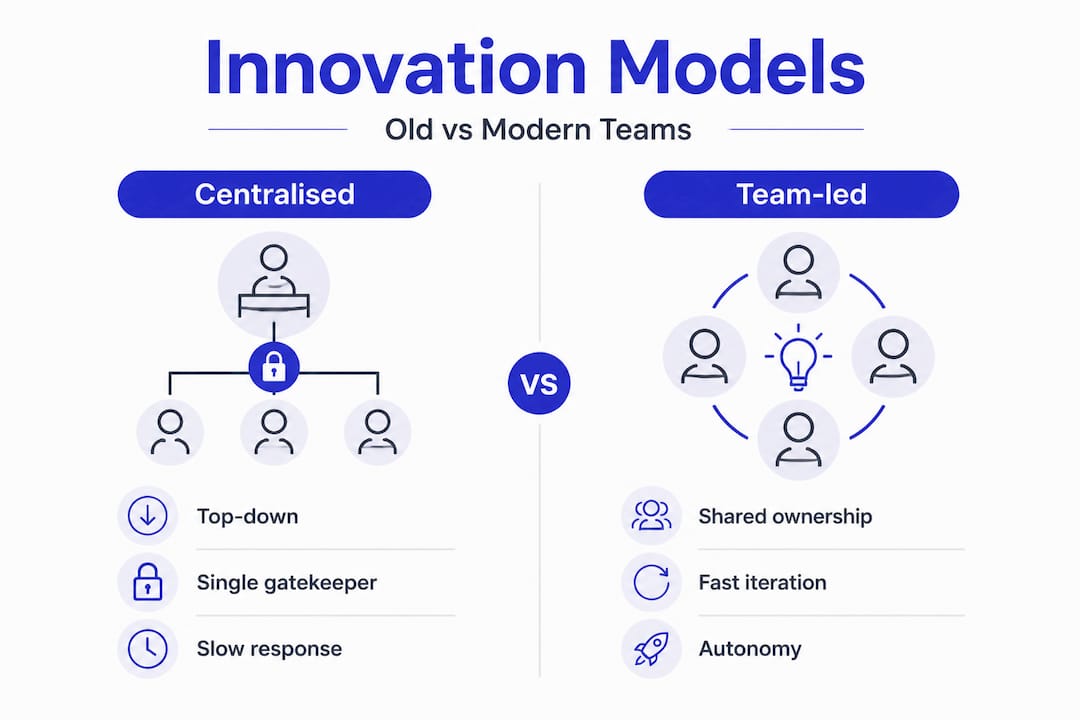
Centralised models tend to create bottlenecks. A single product council reviewing every new idea, or a CTO signing off on architectural decisions in isolation, produces exactly the kind of friction that kills momentum. Decisions slow. Context is lost in translation. Engineers spend more time seeking approval than building. The result is a culture where innovation is theoretically valued but practically discouraged.
Modern team-led models operate on a fundamentally different logic. Autonomy is distributed. Context is owned by the people closest to the problem. Decisions are made at the right level, by people with enough information to make them well.
The shift from old to modern is not just structural. It requires deliberate investment in team management for innovation practices that keep teams aligned without constraining them. What makes this particularly challenging is the rise of cross-boundary dependency. As organisations scale, no single team can own an entire product or feature end to end. This is where the risk intensifies.
Innovation requires bridgers, people and roles specifically designed to facilitate collaboration between specialised teams. Without them, specialisation becomes fragmentation. Knowledge accumulates in pockets. Integration failures multiply. The bridger role is not glamorous, but it is often the single most important structural investment a scaling engineering organisation can make.
Key risks of neglecting integration roles include:

Leadership behaviour is the single most influential variable. Not digital tools, not process frameworks, not quarterly innovation sprints. Empirical innovation performance is directly linked to leaders’ innovative work behaviour and the quality of the work environment they create. This is a sobering finding for organisations that have invested heavily in tooling while underinvesting in leadership development.
The work environment matters in ways that are often invisible until things go wrong. Teams that feel safe to propose unconventional ideas, challenge assumptions, and report problems without fear of blame produce measurably better innovation outcomes. This is not a soft observation. It is an empirical one.
How do you build this environment deliberately? Here is a practical sequence:
Evidence-based management (EBM) is the practice of guiding team decisions through intentional experimentation, measurable outcomes, and continuous feedback. In a software engineering context, this means teams do not just build features. They form hypotheses, run experiments, measure results, and adapt. Sprint Reviews become opportunities to test assumptions against real user behaviour. Retrospectives surface process experiments as much as interpersonal issues.
For enterprise releases, software testing strategies that integrate experimentation at every stage of the delivery cycle significantly reduce the cost of failure at scale. This applies whether you are running a SaaS platform, a regulated financial product, or an internal enterprise system.
The critical step is to make experimentation a team-level responsibility, not a specialist function. When choosing the best software teams, look for teams that have already built a culture of regular experimentation, not teams that treat it as something done by a separate data science or UX research group.
Pro Tip: Every team should own at least one active experiment at any given time. Not just product A/B tests but also process hacks, tooling trials, and workflow changes. This keeps the muscle active and signals that learning is a team-level expectation, not an exceptional activity.
This is where many scaling companies hit a ceiling that feels inexplicable. Individually, teams are performing well. Collectively, the organisation is slower than expected. The root cause is almost always at the boundaries, not within the teams themselves.
We have worked with and observed scaling organisations where every structural element was theoretically in place. Dedicated teams, clear ownership, experimentation cadences, bridger roles. And yet innovation still stalled. The reason, almost without exception, was misaligned incentives and unresolved power dynamics between product and engineering leadership.
Product leaders optimise for market responsiveness. Engineering leaders optimise for system integrity and technical sustainability. Both are right. But when these two voices compete rather than govern jointly, the trade-offs that emerge are wrong for the organisation. Product wins the argument and ships a feature that accumulates significant technical debt. Engineering wins and over-engineers a solution that misses the market window. Neither outcome serves the company.
The fix is not better communication workshops. It is structural governance. Build enterprise team ownership models where both the product voice and the engineering voice have genuine, formalised authority over major deliverables. Not advisory input. Actual veto power over decisions that would compromise either market viability or technical integrity.
This changes the dynamic from negotiation under pressure to joint accountability. When both leaders know that a poor decision will reflect on both of them equally, the quality of the decision-making improves dramatically. The conversation shifts from winning an argument to finding the right answer.
The organisations that sustain innovation at scale have figured out that governance is a delivery mechanism, not an oversight function. It is not about reviewing what teams have done. It is about aligning the conditions under which teams make decisions, so that innovation can compound positively over time rather than being throttled by political friction at the leadership layer.
Whether you are pursuing scalable software development across SaaS, AI, or regulated industries, or looking for a trusted software development partner to accelerate your product delivery without the typical pitfalls of vendor lock-in, we have the methodology and the track record to help you move faster with confidence. Let us help you build the team infrastructure that makes sustained innovation possible.
Key Takeaways
| Point | Details |
|---|---|
| Teams boost innovation | Dedicated teams unlock scalable innovation that top-down mandates cannot achieve. |
| Leadership sets culture | Innovative leadership and supportive environments are crucial for sustained team creativity. |
| Data-driven experimentation | Evidence-based management with measurable experiments drives continuous improvement. |
| Integration roles matter | Bridgers and partnership mechanisms are essential for scaling innovation across boundaries. |
| Overcome political barriers | True innovation scale depends as much on governance and political integration as on technical solutions. |
Why teams are the engine of innovation in scaling organisations
There is a persistent myth in many scaling organisations: that innovation comes from a visionary leader, a dedicated R&D function, or a well-funded transformation programme. The evidence tells a different story. Sustainable, scalable innovation is almost always a team-level phenomenon, not a top-down directive.Centralised models tend to create bottlenecks. A single product council reviewing every new idea, or a CTO signing off on architectural decisions in isolation, produces exactly the kind of friction that kills momentum. Decisions slow. Context is lost in translation. Engineers spend more time seeking approval than building. The result is a culture where innovation is theoretically valued but practically discouraged.
Modern team-led models operate on a fundamentally different logic. Autonomy is distributed. Context is owned by the people closest to the problem. Decisions are made at the right level, by people with enough information to make them well.
| Old model | Modern team-led model |
|---|---|
| Centralised decision-making | Distributed ownership and accountability |
| Innovation driven by directives | Innovation driven by team-level experimentation |
| Specialisation in silos | Specialisation with integration roles |
| Slow approval cycles | Rapid feedback loops and iteration |
| Knowledge held by individuals | Shared context across the team |
The shift from old to modern is not just structural. It requires deliberate investment in team management for innovation practices that keep teams aligned without constraining them. What makes this particularly challenging is the rise of cross-boundary dependency. As organisations scale, no single team can own an entire product or feature end to end. This is where the risk intensifies.
Innovation requires bridgers, people and roles specifically designed to facilitate collaboration between specialised teams. Without them, specialisation becomes fragmentation. Knowledge accumulates in pockets. Integration failures multiply. The bridger role is not glamorous, but it is often the single most important structural investment a scaling engineering organisation can make.
Key risks of neglecting integration roles include:
- Context loss at team handoffs, leading to rework and misaligned deliverables
- Duplication of effort when parallel teams solve the same problem independently
- Velocity collapse when integration dependencies are discovered late in delivery cycles
- Accountability gaps where no single team owns the outcome of cross-functional work
Creating environments where team innovation thrives
Recognising teams as the primary engine of innovation is only half the work. The harder question is what conditions allow those teams to actually innovate, rather than simply execute on a backlog.
Leadership behaviour is the single most influential variable. Not digital tools, not process frameworks, not quarterly innovation sprints. Empirical innovation performance is directly linked to leaders’ innovative work behaviour and the quality of the work environment they create. This is a sobering finding for organisations that have invested heavily in tooling while underinvesting in leadership development.
| Leader trait | Correlated innovation outcome |
|---|---|
| Models experimental thinking | Teams generate more testable hypotheses |
| Creates psychological safety | Engineers surface failure signals earlier |
| Provides clear strategic intent | Teams self-direct without constant escalation |
| Recognises and celebrates learning | Risk-taking behaviour increases across the team |
| Removes blockers proactively | Delivery velocity improves across release cycles |
How do you build this environment deliberately? Here is a practical sequence:
- Audit your current team dynamics. Before changing anything, understand where psychological safety is low, where decision-making is confused, and where context is being lost between teams.
- Train engineering leaders on innovation-enabling behaviours. Provide coaching on how to ask better questions, how to unblock without directing, and how to frame failure as data rather than deficit.
- Invest in team building for innovation as a deliberate practice. Cross-functional pairing, shared retrospectives, and joint problem-solving sessions build the relational capital that makes innovation possible.
- Remove structural friction. Bureaucratic approval processes, unclear ownership, and misaligned incentives are innovation killers. Identify three specific blockers in your current setup and eliminate them in the next quarter.
- Measure the environment, not just the output. Regular team health checks, sentiment surveys, and retrospective data give you early warning signals before innovative capability degrades.
Embedding evidence-based management and experimentation
Once environments and leadership frameworks are in place, the real gains come from systematic experimentation and evidence-based decision-making. Structure without learning cycles is just bureaucracy with better vocabulary.Evidence-based management (EBM) is the practice of guiding team decisions through intentional experimentation, measurable outcomes, and continuous feedback. In a software engineering context, this means teams do not just build features. They form hypotheses, run experiments, measure results, and adapt. Sprint Reviews become opportunities to test assumptions against real user behaviour. Retrospectives surface process experiments as much as interpersonal issues.
“The goal is not to eliminate uncertainty but to reduce the cost of being wrong. Teams that experiment frequently make cheaper mistakes and learn faster than those that invest heavily in avoiding failure altogether.”The types of experiments that drive genuine learning across engineering teams include:
- Product experiments: A/B tests, feature flags, and staged rollouts that validate user behaviour assumptions before full deployment
- Process experiments: Adjustments to team rituals, sprint length, or review cadence that are tested over a fixed period and measured for impact on velocity and quality
- Architectural experiments: Time-boxed spikes that test technical approaches before committing to a full implementation
- Operational experiments: Changes to on-call rotations, incident response workflows, or deployment pipelines, measured against reliability and team wellbeing metrics
For enterprise releases, software testing strategies that integrate experimentation at every stage of the delivery cycle significantly reduce the cost of failure at scale. This applies whether you are running a SaaS platform, a regulated financial product, or an internal enterprise system.
The critical step is to make experimentation a team-level responsibility, not a specialist function. When choosing the best software teams, look for teams that have already built a culture of regular experimentation, not teams that treat it as something done by a separate data science or UX research group.
Pro Tip: Every team should own at least one active experiment at any given time. Not just product A/B tests but also process hacks, tooling trials, and workflow changes. This keeps the muscle active and signals that learning is a team-level expectation, not an exceptional activity.
Solving for cross-boundary collaboration and integration
Systematic experimentation delivers compounding returns only when its outputs are effectively shared and integrated across team boundaries. Localised learning that stays within a single squad is useful. Learning that propagates across a product organisation is transformational.This is where many scaling companies hit a ceiling that feels inexplicable. Individually, teams are performing well. Collectively, the organisation is slower than expected. The root cause is almost always at the boundaries, not within the teams themselves.
“Initiatives fail not because of a lack of talent or ambition within individual teams, but because the connective tissue between them is missing. Innovation fails to scale without proper partnership mechanisms and integration roles that span organisational boundaries.”The most common collaboration failure points, and the practical fixes for each, include:
- Unclear ownership at handoffs: Define explicit interfaces between teams, including who owns what decision and who needs to be informed versus consulted. RACI matrices are blunt instruments. Interface agreements are sharper ones.
- Asynchronous misalignment: When teams in different time zones or departments work without shared documentation standards, context degrades rapidly. Invest in lightweight but rigorous documentation practices that do not slow delivery.
- Incentive misalignment: When two teams are rewarded on different metrics, collaboration becomes a cost rather than a benefit for both. Align at least some incentives around shared outcomes, particularly at product and engineering leadership level.
- Missing escalation paths: When cross-boundary conflicts arise, teams need a clear, trusted escalation route that does not default to a six-week governance review. Designate a senior leader with the authority and context to resolve inter-team disputes quickly.
- Bridger role absent or informal: If nobody is explicitly responsible for maintaining shared context between teams, this function will be performed sporadically and poorly by whoever happens to notice the gap.
A fresh perspective on team-enabled innovation: Why the real barriers are political, not technical
Here is the uncomfortable reality that most frameworks, tools, and process consultants will not tell you. The hardest barriers to team-enabled innovation are not architectural, not structural, and not even cultural in the broad sense. They are political.We have worked with and observed scaling organisations where every structural element was theoretically in place. Dedicated teams, clear ownership, experimentation cadences, bridger roles. And yet innovation still stalled. The reason, almost without exception, was misaligned incentives and unresolved power dynamics between product and engineering leadership.
Product leaders optimise for market responsiveness. Engineering leaders optimise for system integrity and technical sustainability. Both are right. But when these two voices compete rather than govern jointly, the trade-offs that emerge are wrong for the organisation. Product wins the argument and ships a feature that accumulates significant technical debt. Engineering wins and over-engineers a solution that misses the market window. Neither outcome serves the company.
The fix is not better communication workshops. It is structural governance. Build enterprise team ownership models where both the product voice and the engineering voice have genuine, formalised authority over major deliverables. Not advisory input. Actual veto power over decisions that would compromise either market viability or technical integrity.
This changes the dynamic from negotiation under pressure to joint accountability. When both leaders know that a poor decision will reflect on both of them equally, the quality of the decision-making improves dramatically. The conversation shifts from winning an argument to finding the right answer.
The organisations that sustain innovation at scale have figured out that governance is a delivery mechanism, not an oversight function. It is not about reviewing what teams have done. It is about aligning the conditions under which teams make decisions, so that innovation can compound positively over time rather than being throttled by political friction at the leadership layer.
Take the next step: Build high-impact, innovative software teams
At Cleverbit Software, we design and manage high-performance development teams built specifically for the challenges described in this article. Our teams are not outsourced resources handed over with a statement of work. They are integrated, fully managed engineering teams that operate as extensions of your organisation, complete with the governance structures, bridger roles, and experimentation culture needed to drive real innovation at scale.Whether you are pursuing scalable software development across SaaS, AI, or regulated industries, or looking for a trusted software development partner to accelerate your product delivery without the typical pitfalls of vendor lock-in, we have the methodology and the track record to help you move faster with confidence. Let us help you build the team infrastructure that makes sustained innovation possible.