
The pilot team approach is defined as a deliberate, small cross-functional unit, fully empowered and shielded from legacy processes, used to prove a new operating model before scaling it across an organisation. Unlike a prototype or a proof of concept, a pilot team is an evidence generator focused on measurable business outcomes rather than shipping volume. For product managers and team leaders in tech companies, understanding this distinction is the difference between a transformation that scales and one that stalls. Practitioners like Gabrielle Bufrem and frameworks from the Silicon Valley Product Group treat pilot teams not as experiments but as proof points. They are the make-or-break mechanism in every serious agile transformation.
What is the pilot team approach and why does it matter?
The pilot team approach is a team-based pilot strategy in which a small, cross-functional group operates under protected conditions to demonstrate that a different way of working produces better outcomes. The term “pilot team” is the recognised industry term; you may also encounter it described as a team pilot phase or a collaborative team approach in agile transformation literature. The core idea is that organisations cannot change at scale without first proving change is possible in a controlled, observable setting.
A pilot team is deliberately shielded from legacy habits to prove a different operating model. This matters because most transformation efforts fail not from lack of intent but from lack of evidence. When a pilot team produces clear, credible results, it gives leadership the confidence and the data to commit to broader change. Without that proof point, transformation remains a slide deck.

The pilot team approach also differs fundamentally from a prototype. A prototype tests a product idea. A pilot team tests an organisational model. The question it answers is not “does this feature work?” but “can we work differently and produce better outcomes for customers?” That distinction shapes everything: how the team is formed, what it measures, and how success is defined.
What constitutes an effective pilot team in tech organisations?
Effective pilot teams share a consistent set of attributes that separate them from ordinary project squads. Getting the composition and conditions right from the start determines whether the team generates credible evidence or simply adds noise.
A well-formed pilot team typically includes:
- A product manager with authority to make scope and prioritisation decisions without escalation
- Engineers, UX designers, and QA specialists who can deliver end-to-end without external dependencies
- Direct access to customers and data to validate whether outcomes are improving in the real world
- A meaningful but non-critical problem to solve, important enough to matter but not so critical that failure threatens the business
- Coaching support from leadership, not directive management
The access to customers and data requirement is non-negotiable. Teams that measure only output velocity miss the pilot’s purpose entirely. The goal is to prove viability through real-world customer impact, not sprint throughput.
Selecting the right problem is equally consequential. Pilot teams require a clear problem focus that is important but not critical to business survival. This gives the team room to experiment, learn from failure, and iterate without existential pressure distorting their behaviour.
Pro Tip: When forming a pilot team, resist the temptation to assign your most available people. Assign your most coachable people. Coachability, not seniority, predicts pilot team success.
The agile team management context matters here too. Pilot teams embedded in agile environments benefit from sprint cadences and retrospective culture, but they must be protected from the backlog pressures and stakeholder demands that govern the rest of the organisation.
How does leadership influence pilot team success and scalability?
Leadership is the single most consequential variable in pilot team outcomes. Teams can be perfectly composed and still fail if the leadership context around them is wrong.
Executive sponsorship must go beyond passive support to active boundary-setting and constraint removal. This means leaders actively deflecting interruptions, resolving infrastructure blockers, and communicating to the wider organisation why this team operates differently. Passive sponsorship, the kind that appears on a project charter but not in weekly behaviour, produces isolated experiments that never scale.
“If leadership does not adapt, pilot teams fail to scale despite isolated success.” This is the uncomfortable truth most transformation programmes avoid confronting directly.
Leadership must shift from control to coaching and strategic clarity to support pilot teams effectively. Old habits, prescribing solutions, reviewing every decision, measuring activity over outcomes, actively constrain the team’s ability to operate in the new model. Leaders need to define the problem clearly and then step back, reinforcing new behaviours rather than reverting to familiar control patterns.
The behaviours that pilot teams surface in leadership are as valuable as the product outcomes themselves. When a pilot team succeeds, it reveals which leadership behaviours enabled that success. When it fails, it reveals which leadership habits blocked it. Either way, the organisation learns something it could not have learned from a workshop or a consultant’s report.
Scalable team-centric transformation requires leadership to sponsor cross-functional teams, lift their own capabilities, and remove obstacles for faster outcome delivery. McKinsey’s research on team-centric transformation confirms that organisations where leaders actively remove constraints see materially faster delivery and higher team engagement than those where sponsorship is nominal.
What phases and operational framework guide pilot teams?
Pilot project methodology follows a consistent cadence regardless of the technology domain or organisation size. Understanding this cadence prevents the most common operational failure: treating a pilot as an open-ended experiment with no defined endpoint.
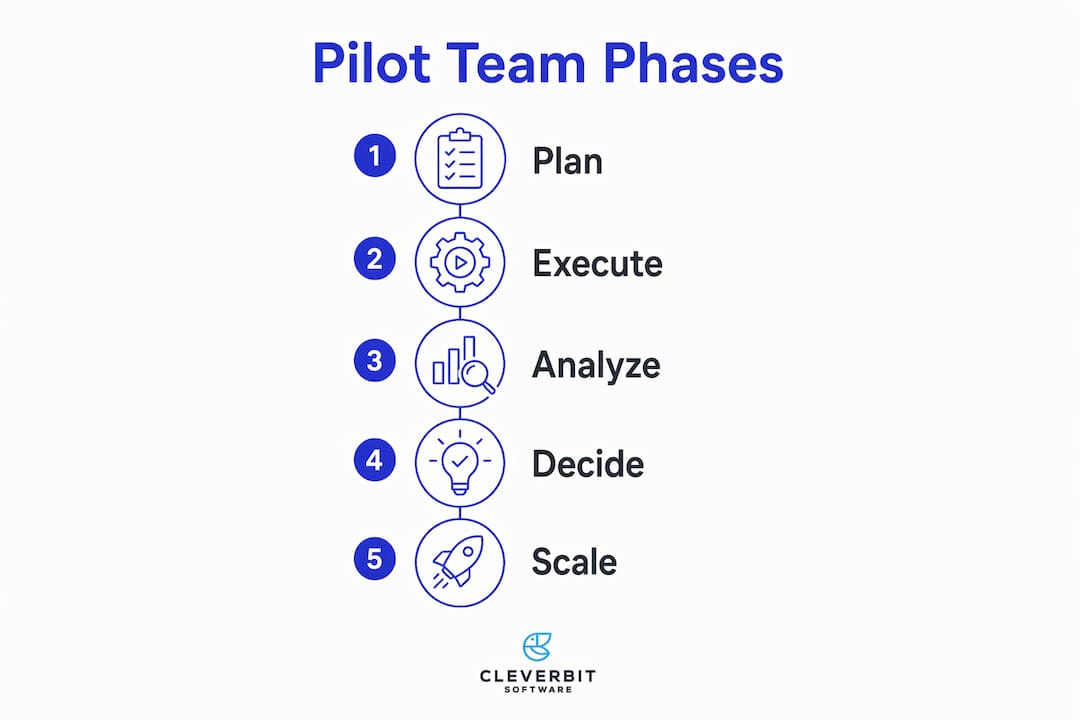
The standard pilot team framework moves through four phases:
- Plan. Define the problem, success criteria, scope, team composition, and resource allocation. Set an explicit timebox. Without a defined end date, pilots drift indefinitely.
- Execute. The team works under protected conditions, applying the new operating model to the defined problem with access to real customers and data.
- Analyse. Measure outcomes against the pre-defined success criteria. This is where data-driven feedback reduces risk and cost before full deployment.
- Decide. Scale, revise, or discontinue. This decision must be made explicitly and on schedule. Avoiding it is how organisations enter pilot purgatory.
The table below summarises what each phase requires and what failure looks like when it is skipped:
| Phase | Key deliverable | Common failure mode |
|---|---|---|
| Plan | Defined success criteria and timebox | Vague objectives, no endpoint |
| Execute | Protected team operating in new model | Legacy interruptions, scope creep |
| Analyse | Outcome data vs. success criteria | Measuring output, not outcomes |
| Decide | Explicit scale, revise, or stop decision | Indefinite extension, pilot purgatory |
The plan-execute-analyse-decide cadence is not bureaucracy. It is the mechanism that converts a pilot from an experiment into an evidence base. Organisations that skip the decide phase consistently find themselves running the same pilot two years later with a different team name.
Common challenges with pilot teams and how to overcome them
The most dangerous failure mode in pilot team methodology is not a bad team. It is a good team trapped in a bad system. Recognising the signs of systemic failure early is what separates organisations that learn from pilots from those that simply repeat them.
Pilot purgatory occurs when pilots stall in transition due to unclear ownership, infrastructure disputes, or use case sprawl, sometimes lasting a year or more. The team continues working, stakeholders continue watching, and nothing scales. Resolving it requires execution discipline, modular scaling decisions, and explicit infrastructure commitments from engineering leadership.
Common warning signs include:
- The pilot has been running for more than six months without a formal scale decision
- Team members are being pulled into other workstreams “temporarily”
- Success criteria have been revised more than once without a corresponding reset of the timebox
- Infrastructure and operational ownership remain unresolved after the execute phase
Clear endpoints, success criteria, and a planned scaling path are the primary defence against burnout and pilot drift. Teams that know when their pilot ends and what happens next maintain focus and energy. Teams that do not know when it ends gradually lose both.
Organisational resistance is a separate challenge. Stakeholders outside the pilot often perceive it as a threat to existing processes or resource allocation. The response is transparency, not politics. Share outcome data early and often. When the pilot produces credible results, resistance tends to dissolve faster than any internal communication campaign could achieve.
Pro Tip: Set the scale decision date on day one, not after the execute phase. Pre-committing to a decision date forces the organisation to treat the pilot seriously rather than as a low-stakes side project.
How do pilot teams connect to AI governance and agentic development?
The pilot team approach has become a critical governance mechanism as organisations begin deploying agentic software workflows and AI-assisted development at scale. The risks of moving fast without controlled testing in this context are materially higher than in conventional software delivery.
Pilot teams are effective in AI governance contexts to test agentic workflows under controlled conditions with leadership oversight. This matters because agentic systems, those that take autonomous actions within a software environment, can produce compounding errors that are difficult to detect and expensive to reverse once they reach production.
The table below maps pilot team functions to specific AI governance concerns:
| Pilot team function | AI governance concern addressed |
|---|---|
| Protected operating environment | Prevents vibe code drift from spreading to production |
| Defined success criteria | Establishes measurable guardrails for autonomous behaviour |
| Outcome-focused measurement | Detects unintended AI actions before scale |
| Explicit scale or stop decision | Prevents ungoverned AI deployment |
Preventing vibe code drift, the gradual divergence of AI-generated code from intended architecture and standards, requires exactly the kind of controlled, observable environment that pilot teams provide. When engineers work within a pilot framework, deviations are caught at the team level before they compound across a codebase. The agentic software development webinar from Cleverbit covers this in practical detail for engineering teams navigating these decisions now.
AI guardrails are not a compliance checkbox. They are architectural decisions that must be tested under real conditions before deployment. Pilot teams provide the governance structure to do that testing responsibly, with defined ownership, measurable outcomes, and a clear decision point.
What we have learned running pilot teams in practice
At Cleverbit, the pattern we observe most consistently is not technical failure. It is leadership hesitation at the decide phase. Teams do the work. They generate the evidence. Then the organisation pauses, waiting for more data, more certainty, more consensus. That pause is where transformation dies.
The coaching mindset is not a soft skill. It is a structural requirement. Leaders who cannot resist prescribing solutions during the execute phase undermine the very conditions that make pilot teams work. We have seen technically excellent teams produce credible outcomes that were then ignored because leadership had already mentally moved on to the next initiative.
The other pattern worth naming directly: pilot teams are not a low-commitment option. They require real protection, real access to customers, and real decision authority. Organisations that treat them as a way to appear agile without changing leadership behaviour will get exactly the results they deserve: isolated success that never scales.
What the pilot team approach actually produces, when it works, is not just a better product or a faster delivery cycle. It produces an organisation that has evidence it can change. That evidence is worth more than any roadmap.
— Cleverbit
How Cleverbit helps you implement and scale pilot teams
Cleverbit works with enterprise and scaling tech companies to design, staff, and manage pilot team implementations that are built to scale rather than stall. Our approach covers the full cycle: defining the right problem, forming a cross-functional team with the right composition, establishing governance and AI guardrails for agentic workflows, and making the scale decision with confidence. For organisations building on SaaS platforms, our enterprise SaaS development practice brings pilot methodology directly into product delivery. If you are ready to move beyond isolated experiments and build the evidence base for real transformation, we can help you do that without the typical delays.
FAQ
What is the pilot team approach in agile?
The pilot team approach is a method of running a small, cross-functional, fully empowered team under protected conditions to prove a new operating model before scaling it. It is used in agile transformations to generate credible evidence of better outcomes rather than simply trialling a new process.
How is a pilot team different from a prototype team?
A prototype team tests a product idea; a pilot team tests an organisational operating model. The pilot team’s purpose is to prove that a different way of working produces measurable business outcomes, not to validate a feature or technical concept.
What causes pilot purgatory and how do you avoid it?
Pilot purgatory occurs when a pilot stalls due to unclear ownership, unresolved infrastructure decisions, or the absence of a formal scale decision. Avoiding it requires setting an explicit timebox and a pre-committed decision date from the start of the pilot phase.
How do pilot teams support AI governance?
Pilot teams provide a controlled environment to test agentic workflows, establish measurable guardrails, and detect unintended AI behaviour before it reaches production. They are the governance mechanism that prevents vibe code drift and ungoverned AI deployment at scale.
How many people should be on a pilot team?
A pilot team is typically small enough to maintain focus and communication without formal coordination overhead, often between five and nine people. The composition matters more than the headcount: the team must cover product, engineering, design, and QA with direct access to customers and data.