
Client-centric software development is the practice of designing and building software by placing the customer’s real problems and goals at the centre of every decision, starting before any code is written. The standard industry term for this discipline is customer-centred development, though client-centric development is the phrase most project managers reach for when scoping a new engagement. Both describe the same fundamental shift: away from internal assumptions and towards validated, observed user need. For business leaders and project managers, understanding this distinction is not academic. It is the difference between shipping software that gets used and shipping software that gets shelved.
What is client-centric software development and how does it differ from traditional approaches?
Client-centric software development prioritises validating urgent customer problems before a single line of code is written. Traditional development inverts this sequence. Teams gather internal requirements, build for months behind closed doors, and then present a finished product to users who were never consulted. The result is predictable: features that solve the wrong problems, or solve the right problems in ways nobody actually wants to use.
Generic, template-based design compounds this further. Every project is treated as a unique problem informed by deep user and business research in a client-centric model. A template approach applies the same information architecture and navigation patterns regardless of the client’s specific workflows, constraints, or audience. The difference in outcomes is significant.

The table below shows where the two approaches diverge most sharply.
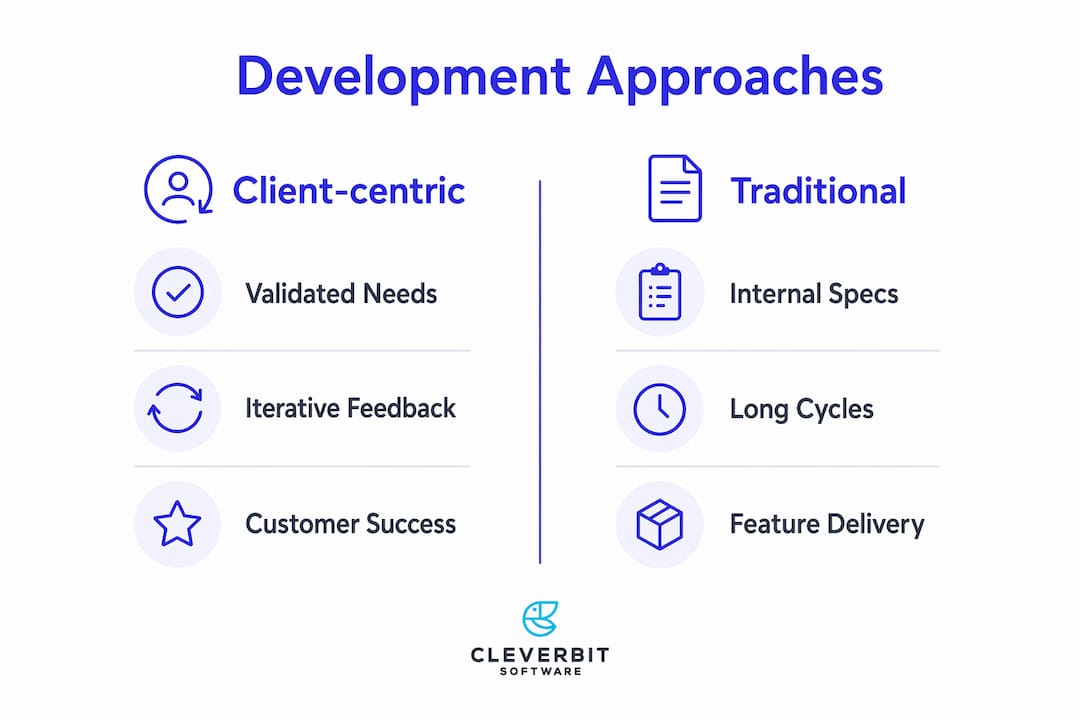
| Dimension | Client-centric development | Traditional development |
|---|---|---|
| Starting point | Validated customer problem | Internal requirements document |
| Design approach | Unique to each client’s context | Template or pattern library |
| Feedback cycle | Continuous, iterative | End of project or post-launch |
| Success metric | Business outcome achieved | Features shipped on time |
| Risk management | Short iterations and MVPs | Long cycles with late testing |
| Scope management | Collaborative prioritisation | Change control process |
The most telling column is success metrics. When a team measures success by features shipped, it has no mechanism for knowing whether those features solved anything. Client-centric teams measure whether the customer achieved the outcome they needed. That single shift changes how every decision in the project gets made.
Balancing user advocacy with business realities is also part of this model. Client-centric development does not mean delivering whatever the client requests. It means understanding the underlying business problem well enough to recommend the right solution, even when that differs from the requested feature.
What are the core practices of client-centric software development?
The practices that define client-centric development are specific and sequenced. They are not a mindset poster on a wall. They are operational disciplines that change how teams spend their time.
- Validate the problem before scoping the solution. Confirm that the customer problem is urgent, real, and worth solving before committing engineering resource to it.
- Separate discovery from usability testing. User discovery research understands needs and workflows; usability testing validates design decisions. Conflating the two produces misleading data.
- Use short iterations and Minimum Viable Products. Shorter iterations and MVPs validate ideas and reduce the risk that comes with long development cycles.
- Ground decisions in observed behaviour, not stated preferences. Feature bloat results from asking customers what they want rather than watching what they actually do. Behavioural research reveals the real friction points.
- Measure outcomes, not outputs. Track whether users achieved their goals, not whether the team shipped on schedule.
- Maintain a shared, visible prioritisation list. Every scope change and new request should appear on a list with rough effort estimates, reviewed collaboratively with the client.
The sixth practice deserves particular attention for project managers working with non-technical clients. Scope creep is not a client failing. It is a communication failure. When clients cannot see the full list of requests and their relative cost, they have no basis for making informed trade-off decisions.
Pro Tip: Maintain a shared, visible list of all scope changes with rough effort estimates. Review it with the client at every sprint review. This turns scope management into a cooperative exercise rather than an adversarial negotiation.
How can business leaders implement client-centric software effectively?
The most consequential change is not a process change. It is a mental one. Successful teams shift from shipping software to solving business problems, measuring success by client impact rather than technical specifications. For engineering leaders, this means redefining what “done” looks like. For project managers, it means reframing every status update around outcomes rather than task completion.
Operationally, embedding client-centricity requires several deliberate choices:
- Involve clients in sprint reviews, not just sign-offs. Clients who see working software every two weeks give better feedback than clients who review a requirements document once.
- Build feedback loops into the roadmap. Allocate time for user research at the start of each planning cycle, not as an afterthought when something goes wrong.
- Use research-driven team processes to align on user goals and business context before architecture decisions are made.
- Integrate client feedback directly into prioritisation. The backlog should reflect what users are struggling with today, not what the team assumed they would struggle with six months ago.
- Maintain transparency in software projects as a structural discipline, not a communication style. Clients who understand trade-offs make better decisions.
The shift from technical specs to business results also changes how you evaluate your development team. A team that ships features on time but cannot articulate the business problem each feature solves is not a client-centric team. It is a delivery machine pointed in the wrong direction.
Pro Tip: When onboarding a new development team, ask them to describe the last project they worked on in terms of the business problem it solved, not the technology it used. The answer tells you everything about their default orientation.
What role does AI play in client-centric development and how do you govern it?
AI tools accelerate client-centric development at every stage of the software delivery lifecycle: requirements analysis, architecture planning, code generation, and test coverage. The productivity gains are real. The risks are equally real, and less discussed.
The specific risk is what practitioners call vibe code drift. This is the gradual loss of focus and code quality that occurs when AI-generated code accumulates without sufficient human review. AI tools require guardrails to prevent vibe code drift where code quality or client focus degrades over time. In a client-centric model, this risk is compounded: if the team loses sight of the customer problem it is solving, AI-assisted velocity simply produces the wrong thing faster.
Effective AI governance in a client-centric context requires:
- Defined AI usage policies aligned to your engineering standards, not bolted on after the fact.
- Review gates that apply to all code, regardless of whether a developer or an AI agent wrote it.
- Clear visibility into what AI is doing inside the delivery pipeline at every point.
- Human decision-making at outcome-critical junctures, particularly when prioritising features or interpreting user research.
Effective AI governance requires clear guardrails to prevent the team’s focus from drifting away from genuine client needs during AI-assisted development. The guardrails are not bureaucratic friction. They are the mechanism that keeps AI productivity aligned with client outcomes.
Agentic AI performs best inside coherent systems with clear ownership. Fragmented teams with no shared standards are where AI-assisted development creates the most risk.
Pro Tip: Treat AI governance as an engineering discipline, not a compliance exercise. Define what AI can and cannot do autonomously in your pipeline before you start, not after the first incident.
What are the key benefits of client-centric software development?
The business case for client-centric development is grounded in what it prevents as much as what it produces. The most expensive mistake in development is building features users never adopt. Training users on features they did not need is the second most expensive. Client-centric methods eliminate both by grounding every decision in observed behaviour and validated need.
The measurable benefits include:
- Higher user adoption. Software built around real workflows gets used. Software built around assumed workflows gets worked around.
- Reduced engineering waste. Short iterations and MVPs surface misalignment early, when it is cheap to correct.
- Faster time to value. Validated MVPs reach users sooner than fully specified releases, generating feedback and revenue earlier.
- Better stakeholder alignment. When clients participate in prioritisation, they understand trade-offs and accept constraints more readily.
- Lower long-term maintenance cost. Features built to solve real problems require fewer patches and workarounds than features built on assumptions.
- Reduced delivery risk. De-risking software development through continuous validation prevents the capital waste that comes from late-stage discovery of fundamental misalignment.
The compounding effect matters here. Each iteration that produces validated learning reduces the uncertainty in the next one. Over a twelve-month engagement, a client-centric team accumulates a significant advantage in understanding over a team that relies on upfront specification alone.
Cleverbit’s perspective on client-centric practices
The hardest part of client-centric development is not the methodology. It is the discipline required to hold the line when pressure mounts to ship something, anything, to demonstrate progress. We have seen this pattern repeatedly: a client grows anxious, the team accelerates, and the next sprint delivers features that nobody validated. The velocity looks good. The outcomes do not.
What we have learned is that the mental shift from shipping code to solving problems has to be embedded in how a team is structured, not just how it is briefed. When developers understand the business problem they are solving, they make better micro-decisions throughout the day. They push back on vague requirements. They flag when a requested feature conflicts with observed user behaviour. They ask the right questions before writing the first line.
The integration of AI into this model adds a layer of responsibility that most teams underestimate. AI-assisted development is genuinely faster. It is also genuinely capable of producing coherent, well-structured code that solves the wrong problem with impressive efficiency. Governance is not optional in this context. It is the thing that keeps speed aligned with purpose.
For business leaders, the most useful thing you can do is define success in outcome terms before the project starts. Not “we will deliver a reporting module” but “finance teams will close the month-end process two days faster.” That framing changes every conversation that follows.
— Cleverbit
How Cleverbit supports client-centric AI software delivery
Cleverbit builds and manages dedicated software development teams that operate as extensions of your organisation, with client-centric principles and AI governance embedded from day one. For business leaders and project managers who want the productivity gains that agentic AI software delivery makes possible, without the governance gaps that create risk, Cleverbit’s model is designed around that specific challenge. Teams work inside your processes, carry your engineering culture, and report against your business outcomes. If you are evaluating where AI creates the most value in your pipeline, the AI Engineering Maturity Scorecard is a practical starting point.
FAQ
What is client-centric software development?
Client-centric software development is the practice of designing and building software by validating real customer problems before coding begins, measuring success by business outcomes rather than features shipped.
How does client-centric development differ from traditional development?
Traditional development starts with internal requirements and long build cycles. Client-centric development uses continuous user research, short iterations, and MVPs to validate decisions throughout the project.
What is vibe code drift and why does it matter?
Vibe code drift is the gradual loss of code quality and client focus that occurs when AI-generated code accumulates without sufficient human review. It is a specific risk in AI-assisted development that governance guardrails are designed to prevent.
How do you manage scope creep with non-technical clients?
Maintain a shared, visible list of all scope changes and new requests with rough effort estimates. Reviewing this list collaboratively with the client at each sprint turns scope management into a prioritisation exercise rather than a conflict.
What role does AI governance play in client-centric projects?
AI governance defines the policies, review gates, and visibility mechanisms that keep AI-assisted development aligned with client outcomes. Without it, AI velocity can produce the wrong solution faster, which is more costly than moving slowly.