
Only 34% of software projects succeed, and poor transparency around progress, risks, and decisions is among the primary reasons why. The role of transparency in software projects is widely acknowledged, yet most teams treat it as a reporting obligation rather than a structural discipline. They share status updates and call it done. The trouble is that transparency without design creates noise, not clarity. And noise, at scale, is just as damaging as silence. This article examines what transparency actually means in engineering environments, the measurable advantages it delivers, and where even well-intentioned teams go wrong.
At its core, transparency means giving stakeholders, both technical and commercial, a clear and accurate picture of what is happening, why decisions are being made, and where risks exist. That is a different proposition from publishing dashboards or sending weekly updates. It requires intent.
It helps to distinguish between three related but distinct concepts:
Progressive transparency is the concept worth adopting here. Rather than revealing everything to everyone simultaneously, progressive transparency stages the disclosure of information based on role, context, and decision relevance. A senior engineer and a CFO need different views of the same project. Giving them the same dashboard is a failure of design, not a triumph of openness.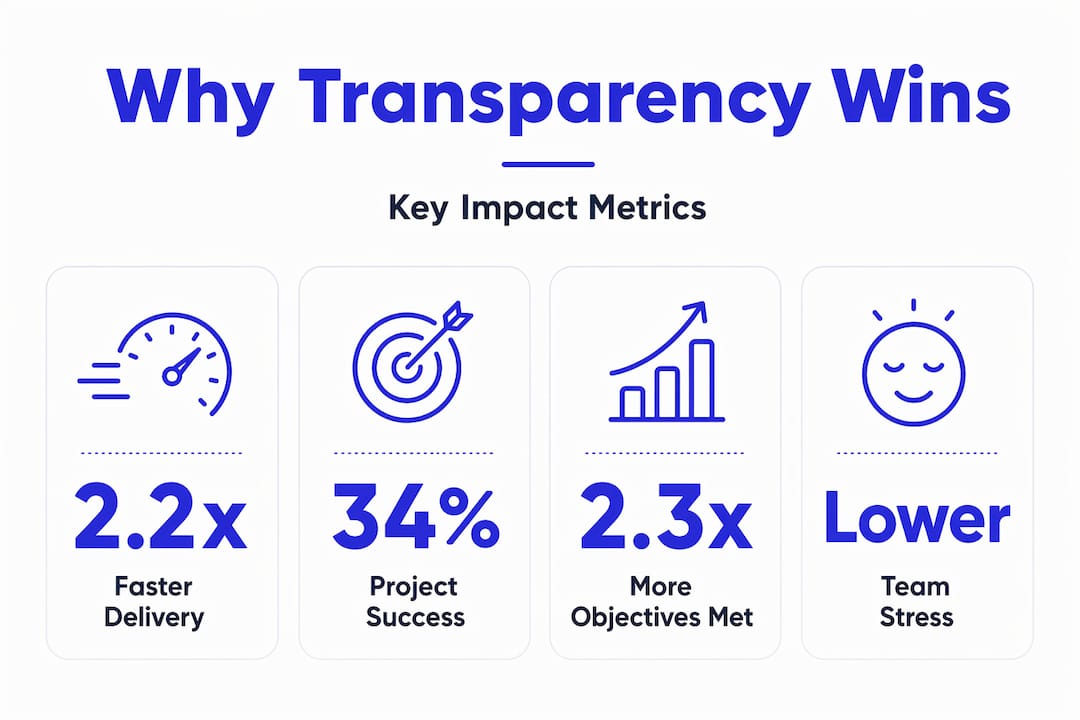 The risk management benefits are equally significant. Organisations with high project transparency are 2.3x more likely to meet their objectives and budgets. The mechanism is straightforward: when risks are visible early, interventions cost less and happen sooner. When risks are hidden until they become crises, the cost of correction multiplies.
Two further metrics deserve attention:
Pro Tip: Track how long it takes your team to make decisions on blocked items. If the average exceeds 48 hours, you likely have a visibility problem rather than a process problem. Address the information architecture before adding more meetings.
The trust dimension adds another layer of complexity. Trust in software projects is not a fixed attribute that you either have or do not. Research frames it as liquid trust, a dynamic, continuously updated state that shifts based on what people see, hear, and experience over time. Transparency influences trust, but it does so in both directions. Consider the comparison below:
Performative transparency deserves particular attention. This is the practice of appearing transparent without actually surfacing meaningful information. Status reports that say everything is green when risks are amber. Dashboards that track activity rather than outcomes. This approach is worse than no transparency at all, because it trains stakeholders to distrust the very mechanisms designed to inform them.
The design of transparency must be intentional. Who sees what? At what level of detail? In what format? These are architectural decisions, not administrative ones.
Pro Tip: Before rolling out a new reporting layer, ask whether it resolves complexity for the recipient or transfers it. If your stakeholders need to interpret the data themselves to understand what action to take, the transparency design is incomplete.
Practical signals to monitor across your team include:
Teams that use DORA as a transparency instrument rather than a performance scorecard report substantially different outcomes. When the metrics are shared openly with leadership in context, they drive architectural decisions. When they are used to rank teams, they drive gaming.
The most effective organisations combine DORA metrics with project-specific leading indicators and communicate both in layered formats. Operational teams receive granular weekly data. Programme boards receive directional summaries monthly. Executives receive exception-based reporting: tell me what changed, what it means, and what we are doing about it.
Coordinated communication across teams and leadership is not a soft skill. It is a structural requirement for transparency to produce its advertised benefits. The science behind high-performance teams consistently points to information architecture as a predictor of team effectiveness. Teams that know what each other knows make better decisions, faster.

Teams add metrics because something went wrong. They add dashboards to reassure stakeholders. They add status meetings because the dashboard was not enough. What they rarely do is step back and ask whether the entire information architecture is serving the people it is supposed to serve. In my experience, that question is almost always worth asking before any new reporting layer is introduced.
The trust dimension is particularly underestimated. I have seen teams achieve impressive transparency tooling and still lose stakeholder confidence, because the information shared did not match what people were experiencing on the ground. Liquid trust is a useful frame here: trust is earned incrementally and lost quickly. Transparency maintains it only when it is honest, consistent, and contextualised.
The teams I have seen get this right share one common trait. They treat transparency as a product, not a process. They design the stakeholder experience of receiving information with the same care they bring to designing the product itself. That means asking who the user is, what they need to do with the information, and what would make their decision clearer.
As AI increasingly mediates how delivery data is collected and presented, the risk of performative transparency grows. Automated summaries can sound authoritative while concealing the complexity that actually matters. The discipline of AI software delivery must include the same transparency principles as human-led delivery, perhaps more so.
The role of transparency in software projects
Transparency in software projects is not simply about sharing information. Most organisations already share information. The question is whether that information creates understanding or adds to the pile of things people have to process.At its core, transparency means giving stakeholders, both technical and commercial, a clear and accurate picture of what is happening, why decisions are being made, and where risks exist. That is a different proposition from publishing dashboards or sending weekly updates. It requires intent.
It helps to distinguish between three related but distinct concepts:
- Visibility refers to what can be seen. A build pipeline is visible. A burndown chart is visible. Visibility is a precondition for transparency but not the same thing.
- Communication refers to the act of transmitting information. You can communicate constantly and still leave your stakeholders entirely unclear on what matters.
- Transparency is the deliberate structuring of information so that the right people understand the right things at the right time.
Progressive transparency is the concept worth adopting here. Rather than revealing everything to everyone simultaneously, progressive transparency stages the disclosure of information based on role, context, and decision relevance. A senior engineer and a CFO need different views of the same project. Giving them the same dashboard is a failure of design, not a triumph of openness.
Business and team benefits
The case for transparency is not philosophical. It is quantifiable, and the numbers are substantial. Organisations with mature measurement and transparency practices achieve 2.2x faster delivery and demonstrate improvements of 60 points or more in customer satisfaction. That is not a marginal gain. It is a structural competitive advantage that compounds over time.
The risk management benefits are equally significant. Organisations with high project transparency are 2.3x more likely to meet their objectives and budgets. The mechanism is straightforward: when risks are visible early, interventions cost less and happen sooner. When risks are hidden until they become crises, the cost of correction multiplies.
Two further metrics deserve attention:
- Transparency can reduce rework by up to 30% even in teams with slower release cadences. Fewer surprises mean fewer reversals.
- Strong project visibility reduces decision latency by up to 40% by removing ambiguity before it hardens into delay.
Pro Tip: Track how long it takes your team to make decisions on blocked items. If the average exceeds 48 hours, you likely have a visibility problem rather than a process problem. Address the information architecture before adding more meetings.
Challenges and pitfalls to avoid
Transparency is not unconditionally beneficial. This is the uncomfortable truth that most advocacy for openness glosses over.“Transparency that relocates complexity rather than resolving it simply shifts the burden to the recipient. The cognitive load increases. The decisions slow down. The anxiety rises.” — Steven BroughWhen teams expose every metric, every risk log entry, and every architectural debate to all stakeholders simultaneously, they create cognitive overload rather than clarity. The recipient receives more data but has less capacity to act on any of it. This is the paradox of unmanaged transparency: more information produces worse decisions.
The trust dimension adds another layer of complexity. Trust in software projects is not a fixed attribute that you either have or do not. Research frames it as liquid trust, a dynamic, continuously updated state that shifts based on what people see, hear, and experience over time. Transparency influences trust, but it does so in both directions. Consider the comparison below:
| Transparency approach | Likely effect on trust | Decision quality |
|---|---|---|
| Raw data without context | Confusion, anxiety | Reduced |
| Staged disclosure by role | Confidence, clarity | Improved |
| No transparency at all | Suspicion, disengagement | Poor |
| Performative transparency | Short-term reassurance, eventual distrust | Inconsistent |
The design of transparency must be intentional. Who sees what? At what level of detail? In what format? These are architectural decisions, not administrative ones.
Pro Tip: Before rolling out a new reporting layer, ask whether it resolves complexity for the recipient or transfers it. If your stakeholders need to interpret the data themselves to understand what action to take, the transparency design is incomplete.
Best practices for embedding transparency
Getting the mechanics right requires discipline across people, process, and tooling. Here is a framework that works in practice.- Embed transparency into existing workflows from day one. Do not create separate reporting systems that engineers must populate manually. Transparency should be a byproduct of the work itself: code review activity, deployment frequency, and incident logs all carry signal without additional overhead.
- Prioritise leading indicators over lagging metrics. Deployment frequency and change failure rate matter, but review time and rework rates reveal emerging problems before they appear in DORA metrics. Leading indicators give you time to intervene. Lagging indicators tell you what already went wrong.
- Report in business-relevant terms. Technical metrics are necessary internally, but progress and trade-offs reported in business terms enable leadership to make real decisions under uncertainty. “We are three sprints behind and this is what we can defer to recover” is more useful to a commercial leader than a velocity chart.
- Apply progressive disclosure across stakeholder groups. Engineers need granular visibility into technical debt and architectural risk. Executives need directional indicators, budget adherence, and risk classification. Forcing both groups to consume the same view fails both groups.
- Build governance structures that maintain visibility without creating micromanagement. Weekly written updates, async risk registers, and monthly steering reviews can carry most of the transparency load without consuming engineering time in meetings.
Practical signals to monitor across your team include:
- Time from decision made to team aware (should be less than 24 hours for blockers)
- Percentage of retrospective items linked to missing information
- Stakeholder satisfaction with status visibility in quarterly reviews
- Number of escalations that could have been prevented with earlier disclosure
Metrics and frameworks that demonstrate impact
The DORA metrics framework, which covers deployment frequency, lead time for changes, change failure rate, and mean time to recovery, is the most widely adopted transparency framework in software delivery. Its value lies not in the metrics themselves but in the discipline of measuring and sharing them consistently across teams and leadership.Teams that use DORA as a transparency instrument rather than a performance scorecard report substantially different outcomes. When the metrics are shared openly with leadership in context, they drive architectural decisions. When they are used to rank teams, they drive gaming.
| Metric | What it signals | Transparency application |
|---|---|---|
| Lead time for changes | Cycle efficiency | Identify bottlenecks before delivery slips |
| Change failure rate | Quality risk | Surface technical debt conversations earlier |
| Mean time to recovery | Resilience | Indicate readiness for scale |
| Rework rate | Clarity of requirements | Diagnose communication failures upstream |
Coordinated communication across teams and leadership is not a soft skill. It is a structural requirement for transparency to produce its advertised benefits. The science behind high-performance teams consistently points to information architecture as a predictor of team effectiveness. Teams that know what each other knows make better decisions, faster.
My perspective on transparency in practice
I have worked alongside enough software teams to say this plainly: the biggest transparency failures are rarely about hiding information. They are about designing information badly.
Teams add metrics because something went wrong. They add dashboards to reassure stakeholders. They add status meetings because the dashboard was not enough. What they rarely do is step back and ask whether the entire information architecture is serving the people it is supposed to serve. In my experience, that question is almost always worth asking before any new reporting layer is introduced.
The trust dimension is particularly underestimated. I have seen teams achieve impressive transparency tooling and still lose stakeholder confidence, because the information shared did not match what people were experiencing on the ground. Liquid trust is a useful frame here: trust is earned incrementally and lost quickly. Transparency maintains it only when it is honest, consistent, and contextualised.
The teams I have seen get this right share one common trait. They treat transparency as a product, not a process. They design the stakeholder experience of receiving information with the same care they bring to designing the product itself. That means asking who the user is, what they need to do with the information, and what would make their decision clearer.
As AI increasingly mediates how delivery data is collected and presented, the risk of performative transparency grows. Automated summaries can sound authoritative while concealing the complexity that actually matters. The discipline of AI software delivery must include the same transparency principles as human-led delivery, perhaps more so.