
Strategic team scaling is the deliberate process of expanding a workforce to meet growing business demands without sacrificing culture, productivity, or clarity. It is distinct from simply hiring more people. Where reactive headcount growth creates coordination chaos and dilutes institutional knowledge, strategic scaling treats team expansion as a living system requiring architectural oversight at every stage. For business leaders and project managers in tech-focused organisations, understanding what is strategic team scaling means understanding that growth is a governance problem as much as a talent problem.
What are the key principles behind strategic team scaling?
Scaling failures trace back to a single root cause more often than any other: loss of explicit clarity in roles, decision rights, and expectations. Not talent shortages. Not budget constraints. Clarity. When a team of five doubles to ten without formalising who owns what decision, coordination costs compound faster than output does.
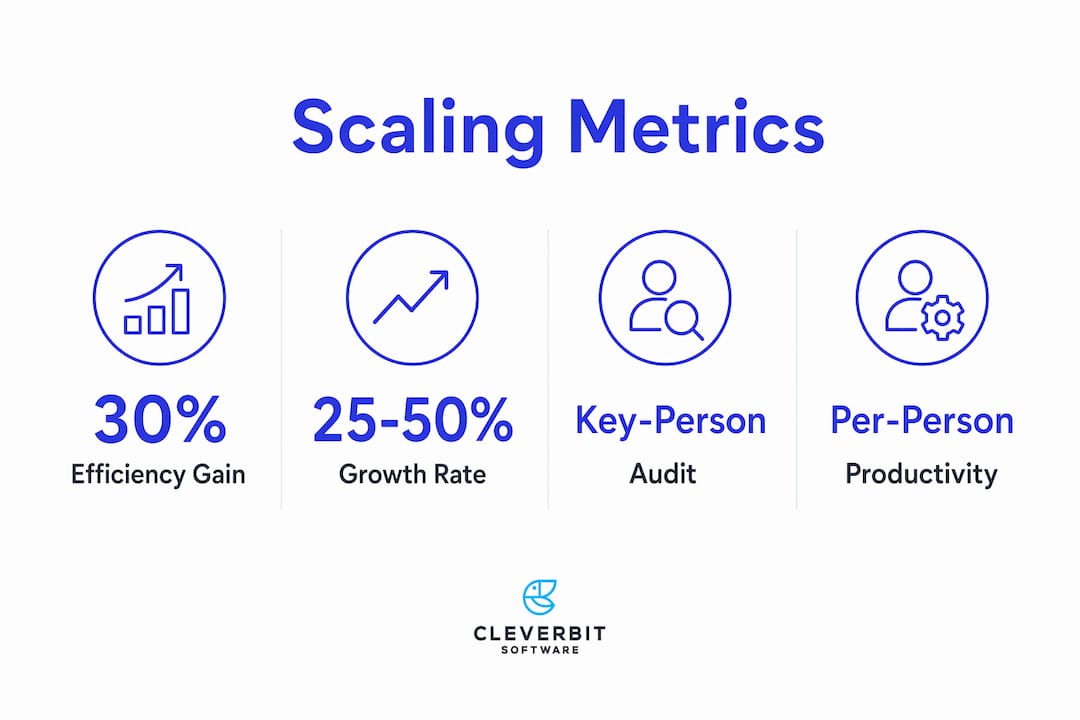
The first principle is pacing. Sustainable engineering growth sits at 25 to 50 per cent annually. Doubling a team in under six months almost always produces cultural and operational degradation that takes years to repair. This is not a soft warning. It is a structural reality: new hires need context, mentorship, and time to become net contributors rather than net consumers of senior attention.
The second principle is role architecture. Before adding headcount, every existing role needs explicit accountability boundaries. Frameworks like RACI matrices and the Scaling Up methodology’s One-Page Strategic Plan give teams a shared language for ownership. Without this foundation, each new hire inherits ambiguity and amplifies it.
Key principles to embed before scaling:
- Hiring pace matched to onboarding capacity, not to vacancy lists
- Decision-making thresholds documented so junior staff can act without escalation
- Delegation frameworks that distribute authority rather than concentrate it
- Role clarity reviews conducted before each hiring cohort, not after
- Cultural onboarding treated as a structured programme, not informal absorption
Pro Tip: Before approving a new headcount request, audit whether the existing team’s meetings, tooling, and priorities are genuinely optimised. A well-run six-person team frequently outperforms a poorly organised ten-person team.
Which organisational structures best support scaling?
Coordination costs rise exponentially as teams grow, which means the flat, centralised structures that work at ten people actively obstruct performance at thirty. The shift to autonomous, mission-oriented sub-teams is not a cultural preference. It is an operational necessity that should happen before the pain of coordination overload becomes visible.
The structural evolution follows a predictable sequence:
- Below 8 members: A single team with a player-manager at the centre. Direct communication is feasible. Documentation is light.
- 8 to 15 members: Sub-teams begin forming around product areas or technical domains. Ownership boundaries must be explicit. The manager transitions from contributor to coordinator.
- 15 to 25 members: At 25 engineers, managers participate in only 5 per cent of conversations. The remaining 95 per cent happen asynchronously through documentation, wikis, and sub-team interfaces. This is not a failure of communication. It is the correct design.
- Beyond 25 members: Distinct management layers, regular leadership cadences, and formal inter-team protocols become non-negotiable. Managers are now architects of information flow, not technical contributors.
The practical implication is that agile team scaling methodologies need to be adopted before the team feels the need for them. Waiting until coordination breaks is waiting too long.
Pro Tip: When splitting a team, assign a named owner for every cross-team dependency before the split takes effect. Unowned dependencies become the primary source of delivery delays in scaled organisations.
How to implement effective onboarding during team growth
Onboarding bandwidth, not budget, is the binding constraint on sustainable hiring. Successful engineering teams cap new hires at two to three per quarter specifically to protect senior engineers’ mentoring capacity. Exceeding this threshold does not accelerate growth. It degrades the quality of every hire made during that period.
Structured onboarding programmes share several characteristics that distinguish them from informal sink-or-swim approaches:
- Staggered start dates prevent cohort overload on senior mentors and allow each new hire to receive genuine attention during their first 90 days
- Milestone-based progress tracking replaces vague probationary periods with measurable expectations: first commit by day 10, first independent feature by day 45, first code review ownership by day 60
- Dedicated mentorship pairings assign a named senior engineer to each new hire, with protected time in that engineer’s calendar
- Onboarding satisfaction scores collected at 30, 60, and 90 days provide early warning signals before a new hire disengages
- Leadership development tracks for high-potential engineers, because 90 per cent of employees cite professional development as critical to their decision to stay
The last point deserves emphasis. Scaling a team without investing in the leadership pipeline creates a ceiling. You add individual contributors but never develop the senior engineers and technical leads who can absorb the next wave of growth. The ‘A-player’ system, where high performers receive accelerated development opportunities and explicit career progression, is not a perk. It is a retention mechanism with direct impact on scaling velocity.
What operational metrics support sustainable team scaling?
Measuring scaling health requires moving beyond headcount and velocity. The metrics that matter are those that reveal whether growth is compounding positively or accumulating hidden debt.
| Metric | What it measures | Healthy signal |
|---|---|---|
| Per-person productivity | Output per engineer per sprint | Stable or improving as team grows |
| Onboarding satisfaction score | New hire experience at 30/60/90 days | Above 7/10 consistently |
| Decision escalation rate | How often decisions require senior approval | Declining over time |
| Key-person dependency index | Tasks only one person can complete | Reducing quarter on quarter |
| Meeting load per engineer | Hours per week in synchronous meetings | Below 20% of working time |
Removing key-person dependencies through formal delegation frameworks can improve operational efficiency by 30 per cent. This is the most underutilised lever in scaling organisations. When a single engineer holds critical architectural knowledge without a documented succession path, that knowledge becomes a liability rather than an asset.
The Scaling Up framework addresses this through its One-Page Strategic Plan, which aligns people, strategy, execution, and cash decisions on a single reference document. The discipline of weekly, monthly, and quarterly meeting rhythms that the framework prescribes prevents the drift that occurs when growing teams lose shared context. Operational consistency is not bureaucracy. It is the infrastructure that allows enterprise teams to scale sustainably without losing execution discipline.
Pro Tip: Run a quarterly ‘key-person audit’ to identify any process, system, or decision that only one team member can handle. Document and distribute that knowledge before it becomes a single point of failure.
How does AI governance impact team scaling in 2026?
Agentic software development, where AI agents autonomously write, test, and deploy code, is reshaping what team scaling means in practice. A team of twelve engineers augmented by well-governed AI tooling can deliver the output previously associated with a team of twenty. But this productivity multiplier comes with a governance obligation that many scaling organisations underestimate.
The risk is what practitioners now call vibe code drift: the gradual erosion of code quality, architectural coherence, and security standards when AI-generated code is merged without sufficient human review. In regulated environments such as fintech and enterprise SaaS, vibe code drift is not a technical inconvenience. It is a compliance and reputational exposure.
Embedding AI governance into scaling workflows requires deliberate design:
- Mandatory human review gates for all AI-generated code before it enters the main branch, with senior engineers accountable for architectural decisions
- Guardrail documentation that defines what AI agents are permitted to modify autonomously and what requires explicit approval
- Audit trails for AI-assisted commits, enabling post-incident analysis when production issues arise
- Regular governance reviews as AI tooling evolves, because guardrails written for one generation of tooling may be inadequate for the next
- Cultural norms that treat AI as a junior contributor requiring oversight, not an autonomous peer with equivalent judgement
The collaboration infrastructure supporting AI-augmented teams also needs to evolve. Asynchronous documentation, shareable methodology documentation, and structured review processes become more critical, not less, when AI is generating a significant proportion of the codebase. Governance is not a constraint on AI-augmented scaling. It is the condition that makes it safe.
What we have learned from scaling teams at the sharp end
We have seen the same pattern repeat across scaling engagements: organisations that treat team growth as a hiring problem consistently underperform those that treat it as a systems problem. The leaders who scale well are not those who hire fastest. They are those who build the conditions for each new hire to become effective quickly.
The most common mistake we observe is the false economy of skipping structured onboarding to accelerate delivery. The deferred cost always exceeds the short-term gain. A new engineer who takes six months to reach full productivity because mentorship was unavailable costs more in lost velocity than the two weeks of senior time that structured onboarding would have required.
We are also cautious about the instinct to hire senior engineers exclusively during scaling phases. Senior engineers make better architectural decisions, but a team without sufficient junior and mid-level engineers creates a bottleneck at the execution layer. The balance matters. A ratio of roughly one senior engineer to two mid-level engineers tends to sustain both architectural quality and delivery throughput.
On AI governance specifically: we believe the organisations that will scale most effectively in the next three years are those that treat AI guardrails as a first-class engineering concern today, not a compliance exercise to be addressed later. Vibe code drift is already a measurable problem in teams that adopted agentic development without governance frameworks. The cost of retrofitting governance into a scaled codebase is substantially higher than building it in from the start.
— Cleverbit
How Cleverbit supports strategic team scaling
Cleverbit builds fully managed, high-performance development teams that operate as genuine extensions of your organisation, not as external vendors. For enterprise clients and scaling tech companies in SaaS and fintech, Cleverbit’s approach covers the full arc of team growth: from initial consultancy and pilot teams through to structured scaling and, where appropriate, client ownership via SPV structures. If you are working through the operational and governance challenges that come with scaling a software team, the Cleverbit scaling case study demonstrates how these principles apply in a live enterprise SaaS context. For AI-augmented delivery with the governance guardrails already built in, explore Cleverbit’s AI software delivery service.
FAQ
What is strategic team scaling in simple terms?
Strategic team scaling is the deliberate, structured process of growing a team to meet business demands while preserving culture, role clarity, and productivity. It contrasts with reactive hiring by treating growth as a systems and governance challenge rather than a headcount exercise.
What is a sustainable growth rate for an engineering team?
A sustainable growth rate for engineering teams is 25 to 50 per cent annually. Doubling a team in under six months almost always causes significant cultural and operational degradation that takes considerable time to reverse.
Why does onboarding matter more than budget when scaling?
Onboarding bandwidth is the binding constraint on sustainable hiring because senior engineers have finite mentoring capacity. Successful teams limit new hires to two to three per quarter to protect that capacity and maintain the quality of each new hire’s integration.
How does AI governance affect team scaling strategies?
AI governance prevents vibe code drift, the erosion of code quality and architectural coherence when AI-generated code is merged without sufficient human review. In regulated environments, embedding mandatory review gates and guardrail documentation into scaling workflows is a compliance requirement, not an optional practice.
What framework best supports effective team scaling?
The Scaling Up methodology, with its One-Page Strategic Plan aligning people, strategy, execution, and cash, is widely used to reduce complexity during growth. Combined with delegation frameworks and structured meeting rhythms, it provides the execution discipline that prevents growing teams from losing shared context.